Premium

Why Europe is warming faster: Causes many, including its cleaner air

Europe has warmed about twice as much as the world as a whole, the 2024 European State of the Climate Report said. Here are the causes and impact of this.

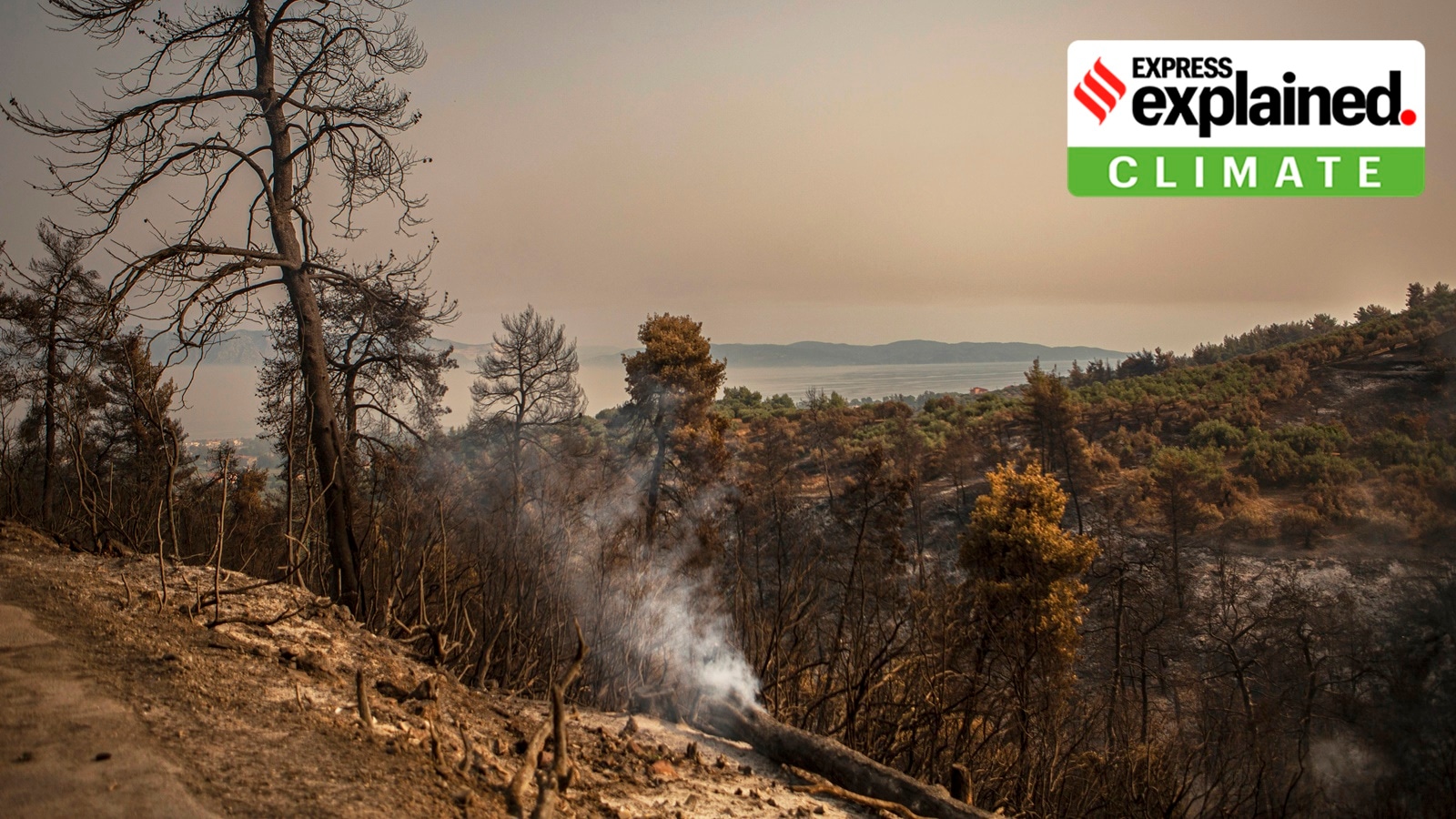
EuropeScorched trees after a wildfire in Greece. (File Photo: The New York Times)

While global temperatures have been rising rapidly, primarily due to human activities that release greenhouse gases into the atmosphere, not every region has been warming at the same rate. Europe, for example, has warmed about twice as much as the world as a whole, as highlighted by the 2024 European State of the Climate Report that came out last week.

The European State of Climate Report — an annual publication of Copernicus Climate Change Service, which is part of the European Commission — captures climate trends in Europe, and is published in collaboration with the World Meteorological Organisation.

The new edition of the report has said that the year 2024, which was the warmest ever for the planet, was the warmest for Europe as well, though there was a distinct East-West contrast within the continent. Eastern Europe was sunny and warm, while the western part was cloudier and wetter.

The report said much of eastern Europe saw warmer than average, or record-high, temperatures through the entire year in 2024. Southeastern Europe, comprising countries like Bulgaria, Romania, Croatia, Kosovo, Serbia and others, also experienced its longest heatwave on record.

Higher warming in Europe

The planet as a whole has seen its annual average temperature rise by about 1.3 degree Celsius from the pre-industrial baseline (the average of 1850-1900), though the year 2024 breached the 1.5 degree Celsius warming for the first time.

Europe, however, has seen its average annual temperature rise by about 2.4 degree Celsius compared with pre-industrial times. This has resulted in an unprecedented spate of extreme weather events, including heatwaves, heavy rainfall and flooding. In 2024 for example, the area of Europe that experienced less than 90 days of below-freezing temperatures was the maximum ever. At the same time, the number of ‘cold stress days’ — days with extremely cold temperatures — was the lowest on record.

The Arctic Effect

Several factors contribute to the greater rate of warming over Europe, the most prominent being the fact that a substantial part of the continent lies in the Arctic region. In fact, Europe has the largest inhabited landmass in the polar region. And the warming around the poles, particularly the North Pole, is much more pronounced than anywhere else in the world. The contribution of warming around the North Pole pushes the average for Europe.

Story continues below this ad

The prime reason for greater warming in the Arctic is what is known as the albedo effect. The ice cover in the Arctic is melting, because of which more land or water is getting exposed to the Sun. Ice traps the least amount of heat, reflecting most solar radiation back. Land or water, which are darker surfaces, tend to absorb solar radiation better, leading to higher degrees of warming. The melting of ice sheets is a little less in Antarctica, because of which warming in Antarctica is less pronounced than that in the Arctic.

The Arctic is known to be warming three to four times faster than the global average, and accounts for the substantial part of the average global warming.

Warming is not uniform over the entire planet. Land areas have warmed more than the oceans, and higher-latitude areas, in general, have warmed more than tropical areas, which are nearer the equator. India, for example, has warmed only 0.7 degree Celsius from pre-industrial times, compared with the average of 1.59 degree Celsius for the entire land area on the planet. These numbers are from studies conducted a few years ago, and would have changed in the last few years.

Reduction in aerosols

Another factor contributing to higher warming rate in Europe is the reduction in aerosols emissions, the State of Climate report said. This is ironic since reduction in aerosols points to reduced air pollution and cleaner air to breathe. Aerosols refer to all kinds of tiny solid and liquid particles suspended in the atmosphere, and largely consist of air pollutants.

Story continues below this ad

These particles are able to scatter sunlight back so that there is less absorption of solar radiation by the Earth’s surface. Aerosols also help in cloud formation and clouds, in turn, have an impact on how much sunlight is reflected or absorbed.

Europe having relatively cleaner air and less emission of aerosols contributes to a faster warming.

Many other factors contribute to Europe’s faster rate of warming, the climate report said. These include changes in atmospheric circulation that favour more frequent summer heatwaves in the European region, the higher than average increase in the sea-surface temperatures around Europe, urban heat island effect, and the melting of glaciers, which has similar consequences as the albedo effect.

Dipanita Nath is a Senior Assistant Editor at The Indian Express, based in Pune. She is a versatile journalist with a deep interest in the intersection of culture, sustainability, and urban life. Professional Background Experience: Before joining The Indian Express, she worked with other major news organizations including Hindustan Times, The Times of India, and Mint. Core Specializations: She is widely recognized for her coverage of the climate crisis, theatre and performing arts, heritage conservation, and the startup ecosystem (often through her "Pune Inc" series). Storytelling Focus: Her work often unearths "hidden stories" of Pune—focusing on historical institutes, local traditions, and the personal journeys of social innovators. Recent Notable Articles (December 2025) Her recent reporting highlights Pune’s cultural pulse and the environmental challenges facing the city during the winter season: 1. Climate & Environment "Pune shivers on coldest morning of the season; minimum temperature plunges to 6.9°C" (Dec 20, 2025): Reporting on the record-breaking cold wave in Pune and the IMD's forecast for the week. "How a heritage tree-mapping event at Ganeshkhind Garden highlights rising interest in Pune’s green legacy" (Dec 20, 2025): Covering a citizen-led initiative where Gen Z and millennials gathered to document and protect ancient trees at a Biodiversity Heritage Site. "Right to breathe: Landmark NGT order directs PMC to frame norms for pollution from construction sites" (Dec 8, 2025): Reporting on a significant legal victory for residents fighting dust and air pollution in urban neighborhoods like Baner. 2. "Hidden Stories" & Heritage "Inside Pune library that’s nourished minds of entrepreneurs for 17 years" (Dec 21, 2025): A feature on the Venture Center Library, detailing how a collection of 3,500 specialized books helps tech startups navigate the product life cycle. "Before he died, Ram Sutar gave Pune a lasting gift" (Dec 18, 2025): A tribute to the legendary sculptor Ram Sutar (creator of the Statue of Unity), focusing on his local works like the Chhatrapati Shivaji statue at Pune airport. "The Pune institute where MA Jinnah was once chief guest" (Dec 6, 2025): An archival exploration of the College of Agriculture, established in 1907, and its historical role in India's freedom struggle. 3. Arts, Theatre & "Pune Inc" "Satyajit Ray, Ritwik Ghatak were not rivals but close friends, says veteran filmmaker" (Dec 17, 2025): A deep-dive interview ahead of the Pune International Film Festival (PIFF) exploring the camaraderie between legends of Indian cinema. "Meet the Pune entrepreneur helping women build and scale businesses" (Dec 16, 2025): Part of her "Pune Inc" series, profiling Nikita Vora’s efforts to empower female-led startups. "How women drone pilots in rural Maharashtra are cultivating a green habit" (Dec 12, 2025): Exploring how technology is being used by women in agriculture to reduce chemical use and labor. Signature Style Dipanita Nath is known for intellectual curiosity and a narrative-driven approach. Whether she is writing about a 110-year-old eatery or the intricacies of the climate crisis, she focuses on the human element and the historical context. Her columns are often a blend of reportage and cultural commentary, making them a staple for readers interested in the "soul" of Pune. X (Twitter): @dipanitanath ... Read More


 

Latest Comment
Post Comment
Read Comments
Advertisement
Advertisement
Advertisement
Advertisement