Premium
This is an archive article published on December 10, 2023

Global Renewables And Energy Efficiency Pledge at COP28: what is the tripling renewable energy target?

The target is an essential part of the world governments’ plan of tackling the rising global average temperature. Here is everything you need to know about it.

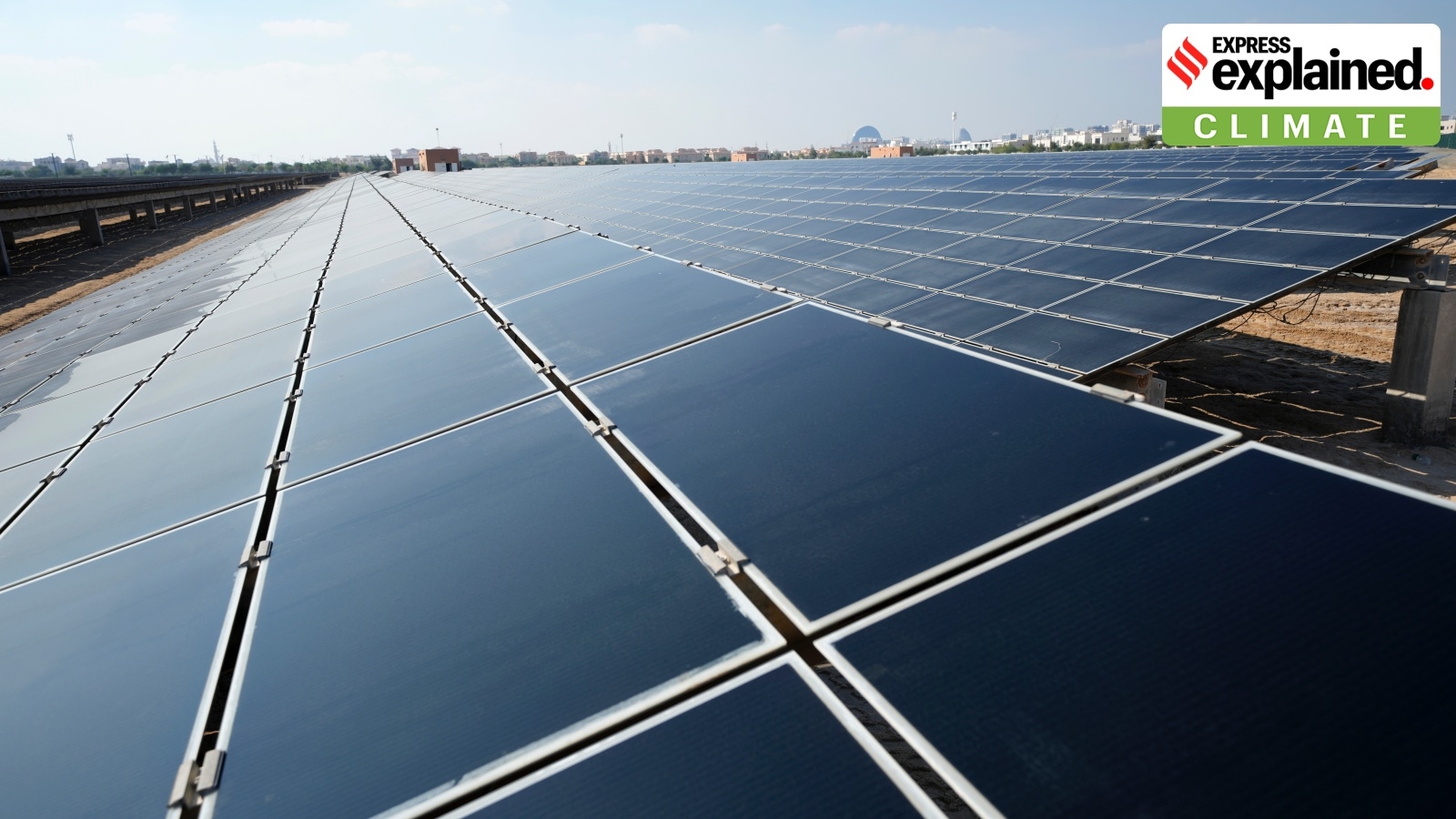
triple renewable energy target, cop28Solar panels sit at Masdar City near Abu Dhabi, United Arab Emirates, as Dubai hosts the COP28 UN Climate Summit, Friday, Dec. 8, 2023. (AP Photo/Kamran Jebreili)

On December 2, 118 countries signed a renewable energy pledge at the ongoing COP28 climate summit to triple the world’s green energy capacity to 11,000 GW by 2030, thereby, reducing the reliance on fossil fuels in generating energy.

According to the “Global Renewables and Energy Efficiency Pledge”, countries have to “double the global average annual rate of energy efficiency improvements from around 2% to over 4% every year until 2030”. By checking the rise in emissions, governments hope to curtail global average temperature below the 2 degree Celsius temperature limit since pre-industrial times, if not the ambitious 1.5 degree Celsius of the 2015 Paris Agreement.

The pledge is neither legally binding nor a part of the official COP28 calendar. COP28 also has the issue of tripling renewable energy on its agenda, the outcome of which is being keenly awaited. What the pledge does is indicate that world leaders want to be more active in checking global emissions.

Incidentally, the International Energy Agency (IEA) has found that, between 2022 and 2027, renewables will account for over 90% of global electricity capacity expansion. “The upward revision is mainly driven by China, the EU, the US and India, which are all implementing existing policies and regulatory and market reforms, while also introducing new ones more quickly than expected in reaction to the energy crisis,” says IEA.

Coming clean by 2050

Solar, wind, hydropower and biofuels are seen as the fuels of the future, even in developing countries. According to the pledge, the tripling of renewable energy is expected to practically eliminate fossil fuels as energy sources by 2050.

Renewable energy is already picking up pace across the world, thanks to policies in recent years enabling an increase in the generation capacity of renewables, especially solar photovoltaics and wind power.

According to the IEA, “over 2022-2027, renewables are seen growing by almost 2,400 GW in our main forecast, equal to the entire installed power capacity of China today. That’s an 85% acceleration from the previous five years… making it our largest ever upward revision”.

Story continues below this ad

Last year, India’s Ministry of New and Renewable Energy said that the country was the world’s third-largest producer of renewable energy, with 40% of its installed energy capacity coming from non-fossil fuel sources. India has announced its aim to meet 50% of its electricity demands from renewable energy sources by 2030 and reach net zero emissions by 2070.

The IEA has found that the electricity sector is the brightest spot globally for renewables, with the strong growth of solar photovoltaics and wind energy in recent years, building on the already significant contribution of hydropower. “But electricity accounts for only a fifth of global energy consumption and finding a greater role for renewable energy sources in transportation and heating remains critical to the energy transition,” it says.

Across the globe, the deployment of renewables is also running into trouble due to rising costs, labour constraints, and supply chain issues. These have forced project delays and cancellations in recent months, costing leading developers billions of dollars in write-offs, according to Reuters.

India’s stand

Story continues below this ad

The pledge was spearheaded by the EU, the US and the UAE and supported by Brazil, Nigeria, Australia, Japan, Canada, Chile and Barbados. India and China have stayed away as the initiative calls for phasing down of coal and “ending the continued investment in unabated new coal-fired power plants”. In September 2023, however, India had already supported, as part of the G20, a commitment to work towards tripling global renewable energy capacity by 2030. The announcement was one of the strongest declarations to come out of the G20. All eyes are now on the result of discussions at COP28.

Dipanita Nath is a Senior Assistant Editor at The Indian Express, based in Pune. She is a versatile journalist with a deep interest in the intersection of culture, sustainability, and urban life. Professional Background Experience: Before joining The Indian Express, she worked with other major news organizations including Hindustan Times, The Times of India, and Mint. Core Specializations: She is widely recognized for her coverage of the climate crisis, theatre and performing arts, heritage conservation, and the startup ecosystem (often through her "Pune Inc" series). Storytelling Focus: Her work often unearths "hidden stories" of Pune—focusing on historical institutes, local traditions, and the personal journeys of social innovators. Recent Notable Articles (December 2025) Her recent reporting highlights Pune’s cultural pulse and the environmental challenges facing the city during the winter season: 1. Climate & Environment "Pune shivers on coldest morning of the season; minimum temperature plunges to 6.9°C" (Dec 20, 2025): Reporting on the record-breaking cold wave in Pune and the IMD's forecast for the week. "How a heritage tree-mapping event at Ganeshkhind Garden highlights rising interest in Pune’s green legacy" (Dec 20, 2025): Covering a citizen-led initiative where Gen Z and millennials gathered to document and protect ancient trees at a Biodiversity Heritage Site. "Right to breathe: Landmark NGT order directs PMC to frame norms for pollution from construction sites" (Dec 8, 2025): Reporting on a significant legal victory for residents fighting dust and air pollution in urban neighborhoods like Baner. 2. "Hidden Stories" & Heritage "Inside Pune library that’s nourished minds of entrepreneurs for 17 years" (Dec 21, 2025): A feature on the Venture Center Library, detailing how a collection of 3,500 specialized books helps tech startups navigate the product life cycle. "Before he died, Ram Sutar gave Pune a lasting gift" (Dec 18, 2025): A tribute to the legendary sculptor Ram Sutar (creator of the Statue of Unity), focusing on his local works like the Chhatrapati Shivaji statue at Pune airport. "The Pune institute where MA Jinnah was once chief guest" (Dec 6, 2025): An archival exploration of the College of Agriculture, established in 1907, and its historical role in India's freedom struggle. 3. Arts, Theatre & "Pune Inc" "Satyajit Ray, Ritwik Ghatak were not rivals but close friends, says veteran filmmaker" (Dec 17, 2025): A deep-dive interview ahead of the Pune International Film Festival (PIFF) exploring the camaraderie between legends of Indian cinema. "Meet the Pune entrepreneur helping women build and scale businesses" (Dec 16, 2025): Part of her "Pune Inc" series, profiling Nikita Vora’s efforts to empower female-led startups. "How women drone pilots in rural Maharashtra are cultivating a green habit" (Dec 12, 2025): Exploring how technology is being used by women in agriculture to reduce chemical use and labor. Signature Style Dipanita Nath is known for intellectual curiosity and a narrative-driven approach. Whether she is writing about a 110-year-old eatery or the intricacies of the climate crisis, she focuses on the human element and the historical context. Her columns are often a blend of reportage and cultural commentary, making them a staple for readers interested in the "soul" of Pune. X (Twitter): @dipanitanath ... Read More


Latest Comment
Post Comment
Read Comments
Advertisement
Advertisement
Advertisement
Advertisement