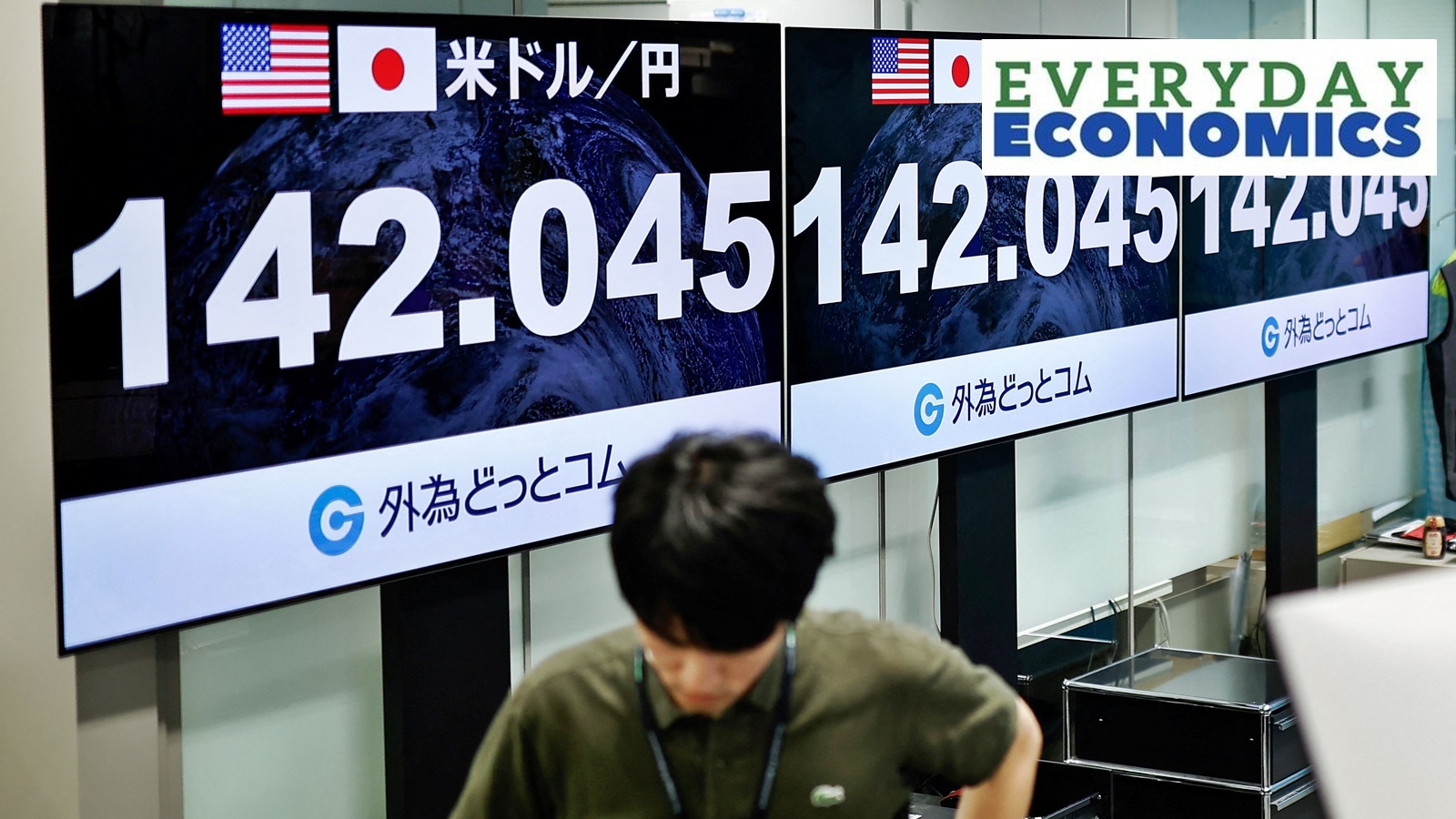
This is an archive article published on August 6, 2024
What is Yen carry trade and why did it help trigger a global stock market fall?
The unwinding of the yen carry trade was one reason behind the fall in global markets on Monday. It had to do with recent policy decisions from Japan's central bank, which led global investors to sell their assets. Here is why.
In Japan, the central bank kept interest rates at zero percent between 2011 and 2016, with the view that it would stimulate the economy. (REUTERS/Willy Kurniawan)
On Monday (August 5), major stock markets across the world experienced their sharpest decline in decades. While there was no paucity of reasons for jittery investor sentiment — for instance, the US economy is facing increasing odds of an economic recession or rising geopolitical tensions due to growing turmoil in West Asia — there was a new global trigger: The unwinding of the yen carry trade.
What is Yen carry trade?
Global investors are always looking for opportunities to make money. One way to do this is to borrow money in a country where the interest rates are low and invest that money (after converting the currency) in a country where the interest rates are much higher. Simply put, this is called a carry trade.
Such opportunities can exist because central banks of different countries try to keep interest rates at a level that suits their specific economic conditions. A case in point is that of Japan where the central bank (the Bank of Japan) had kept interest rates at zero percent between 2011 and 2016 and, in fact, pushed them even below zero (-0.10%) since 2016. The idea behind low interest rates is to stimulate economic activity.
But such a “cheap money” monetary policy has global ramifications, especially since Japan is the third-largest economy and its currency, the yen, is trusted. For instance, such low interest rates incentivise investors to borrow cheaply in yen and invest in other countries (such as Brazil, Mexico, India and even the US) in a bid to earn better returns. Such carry trades are called yen carry trades.
Since the BoJ continued to keep interest rates so low for as long as it did — it did not budge even when central banks across the world rapidly raised interest rates in the wake of the Russia-Ukraine war — it incentivised billions of dollars of “yen” carry trades, and these borrowings fuelled investments in several countries across the world.
So what changed?
Between mid-March and July-end this year, the BoJ raised interest rates by 35 basis points — that is, the interest rate now is 0.25% instead of -0.1% earlier. On the face of it, and especially from an Indian perspective where lending rates are upwards of 6.5%, this may not look like a massive increase but in Japan’s context it was nothing short of a monetary earthquake. What’s worse, it is expected that the BoJ may raise interest rates further.
This sharp reversal — a 25 basis point increase announced on July 31st — led to what is termed as the “unwinding” of the yen carry trade. In other words, it led to investors who had borrowed in yen and invested in Brazilian real or Mexican peso or Indian rupee, selling their assets in international markets.
Story continues below this ad
Why is Yen trade unwinding?
Higher interest rates in Japan led to the yen gaining strength against the dollar and most other emerging economy currencies. Over the past week, yen’s exchange rate — that is, how many dollars or rupees does one get for one yen — strengthened against currencies like dollar, real, rupee, peso etc.
In other words, assets held in these currencies were worth relatively less if converted back in yen. Not to mention the higher opportunity cost of yen carry trade because investing in yen now pays higher returns. This narrowing of returns (or yields) differential — and the possible likelihood of further move in this direction — triggered the slide and led to investors selling off those assets which were bought using cheap yen.
Udit Misra is Senior Associate Editor at The Indian Express. Misra has reported on the Indian economy and policy landscape for the past two decades. He holds a Master’s degree in Economics from the Delhi School of Economics and is a Chevening South Asia Journalism Fellow from the University of Westminster.
Misra is known for explanatory journalism and is a trusted voice among readers not just for simplifying complex economic concepts but also making sense of economic news both in India and abroad.
Professional Focus
He writes three regular columns for the publication.
ExplainSpeaking: A weekly explanatory column that answers the most important questions surrounding the economic and policy developments.
GDP (Graphs, Data, Perspectives): Another weekly column that uses interesting charts and data to provide perspective on an issue dominating the news during the week.
Book, Line & Thinker: A fortnightly column that for reviewing books, both new and old.
Recent Notable Articles (Late 2025)
His recent work focuses heavily on the weakening Indian Rupee, the global impact of U.S. economic policy under Donald Trump, and long-term domestic growth projections:
Currency and Macroeconomics:
"GDP: Anatomy of rupee weakness against the dollar" (Dec 19, 2025) — Investigating why the Rupee remains weak despite India's status as a fast-growing economy.
"GDP: Amid the rupee's fall, how investors are shunning the Indian economy" (Dec 5, 2025).
"Nobel Prize in Economic Sciences 2025: How the winners explained economic growth" (Oct 13, 2025).
Global Geopolitics and Trade:
"Has the US already lost to China? Trump's policies and the shifting global order" (Dec 8, 2025).
"The Great Sanctions Hack: Why economic sanctions don't work the way we expect" (Nov 23, 2025) — Based on former RBI Governor Urjit Patel's new book.
"ExplainSpeaking: How Trump's tariffs have run into an affordability crisis" (Nov 20, 2025).
Domestic Policy and Data:
"GDP: New labour codes and opportunity for India's weakest states" (Nov 28, 2025).
"ExplainSpeaking | Piyush Goyal says India will be a $30 trillion economy in 25 years: Decoding the projections" (Oct 30, 2025) — A critical look at the feasibility of high-growth targets.
"GDP: Examining latest GST collections, and where different states stand" (Nov 7, 2025).
International Economic Comparisons:
"GDP: What ails Germany, world's third-largest economy, and how it could grow" (Nov 14, 2025).
"On the loss of Europe's competitive edge" (Oct 17, 2025).
Signature Style
Udit Misra is known his calm, data-driven, explanation-first economics journalism. He avoids ideological posturing, and writes with the aim of raising the standard of public discourse by providing readers with clarity and understanding of the ground realities.
You can follow him on X (formerly Twitter) at @ieuditmisra
... Read More


 4 min read