Everyday Economics: What are WPI and CPI inflation rates?
WPI and CPI are two different baskets of goods and services. The government assigns different weights to different goods and services based on what is relevant for those two types of consumers.
A vegetable seller carries onions to sell in New Delhi. (Express Photo: Praveen Khanna)
Any inflation rate essentially tells us the rate at which prices have been rising in an economy. As such, an inflation rate is expressed as a percentage. If the prices of onions rose from Rs 10 a kg last year to Rs 15 a kg this year, the inflation rate will be 50%. That’s because a kg of onion is Rs 5 — that is, 50% — more than the base price (Rs 10) in this example. For every month, inflation rates are calculated both on a year-on-year basis — how prices have changed over the past year — as well as on a month-on-month basis — how prices have changed over the past month.
Inflation rates are calculated for all commodities and commodity groups. So, we have inflation rates for onions as well as for all food items.
But, the price of any commodity, say onions, also varies whether one buys the commodity in the wholesale market or whether one buys in the city mall. Comparing last year’s wholesale prices of onions with this year’s retail store prices will be misleading. So, the government comes out with two indices — one for mapping inflation in the wholesale market and one for mapping inflation in the retail market. Inflation rates are also calculated for rural and urban markets for better policy analysis.
WPI vs CPI
The two most-often used inflation rates in the country are the year-on-year
> the wholesale price index (WPI) based inflation rate and
> the consumer price index (CPI) based inflation rate
The former is called the wholesale inflation rate and the latter is called the retail inflation rate. Both WPI and CPI are price indices. In other words, these are two different baskets of goods and services. The government assigns different weights to different goods and services based on what is relevant for those two types of consumers.
The two tables below bring out the differences.
Table 1: Composition of Wholesale Price Index Table 2: Composition of Consumer Price Index
The CPI-based inflation data is compiled by the Ministry of Statistics and Programme Implementation (or MoSPI) and the WPI-based inflation data is put together by the Department for Promotion of Industry and Internal Trade (or DPIIT).
Story continues below this ad
Looking at the way the two indices are constructed, it becomes clear how and why the two inflation rates are different.
For instance, the WPI is dominated by the prices of manufactured goods while the CPI is dominated by the prices of food articles. As such, broadly speaking, if food prices go up sharply, it will bump up the retail inflation rate far more than it would spike the wholesale inflation rate. The reverse will happen when prices of manufactured products (such as TVs and cars) rise sharply.
A key difference that must not be missed is that the WPI does not take into account the change in prices of services — say a haircut or a banking transaction. But CPI does. If services such as transport, education, recreation and amusement, personal care etc. get significantly costlier, then retail inflation will rise but there will be no impact on wholesale price inflation.
Since these two inflation rates are calculated based on two very different indices, it is not uncommon to find them at considerable variance with each other.
Udit Misra is Senior Associate Editor at The Indian Express. Misra has reported on the Indian economy and policy landscape for the past two decades. He holds a Master’s degree in Economics from the Delhi School of Economics and is a Chevening South Asia Journalism Fellow from the University of Westminster.
Misra is known for explanatory journalism and is a trusted voice among readers not just for simplifying complex economic concepts but also making sense of economic news both in India and abroad.
Professional Focus
He writes three regular columns for the publication.
ExplainSpeaking: A weekly explanatory column that answers the most important questions surrounding the economic and policy developments.
GDP (Graphs, Data, Perspectives): Another weekly column that uses interesting charts and data to provide perspective on an issue dominating the news during the week.
Book, Line & Thinker: A fortnightly column that for reviewing books, both new and old.
Recent Notable Articles (Late 2025)
His recent work focuses heavily on the weakening Indian Rupee, the global impact of U.S. economic policy under Donald Trump, and long-term domestic growth projections:
Currency and Macroeconomics:
"GDP: Anatomy of rupee weakness against the dollar" (Dec 19, 2025) — Investigating why the Rupee remains weak despite India's status as a fast-growing economy.
"GDP: Amid the rupee's fall, how investors are shunning the Indian economy" (Dec 5, 2025).
"Nobel Prize in Economic Sciences 2025: How the winners explained economic growth" (Oct 13, 2025).
Global Geopolitics and Trade:
"Has the US already lost to China? Trump's policies and the shifting global order" (Dec 8, 2025).
"The Great Sanctions Hack: Why economic sanctions don't work the way we expect" (Nov 23, 2025) — Based on former RBI Governor Urjit Patel's new book.
"ExplainSpeaking: How Trump's tariffs have run into an affordability crisis" (Nov 20, 2025).
Domestic Policy and Data:
"GDP: New labour codes and opportunity for India's weakest states" (Nov 28, 2025).
"ExplainSpeaking | Piyush Goyal says India will be a $30 trillion economy in 25 years: Decoding the projections" (Oct 30, 2025) — A critical look at the feasibility of high-growth targets.
"GDP: Examining latest GST collections, and where different states stand" (Nov 7, 2025).
International Economic Comparisons:
"GDP: What ails Germany, world's third-largest economy, and how it could grow" (Nov 14, 2025).
"On the loss of Europe's competitive edge" (Oct 17, 2025).
Signature Style
Udit Misra is known his calm, data-driven, explanation-first economics journalism. He avoids ideological posturing, and writes with the aim of raising the standard of public discourse by providing readers with clarity and understanding of the ground realities.
You can follow him on X (formerly Twitter) at @ieuditmisra
... Read More


 4 min read


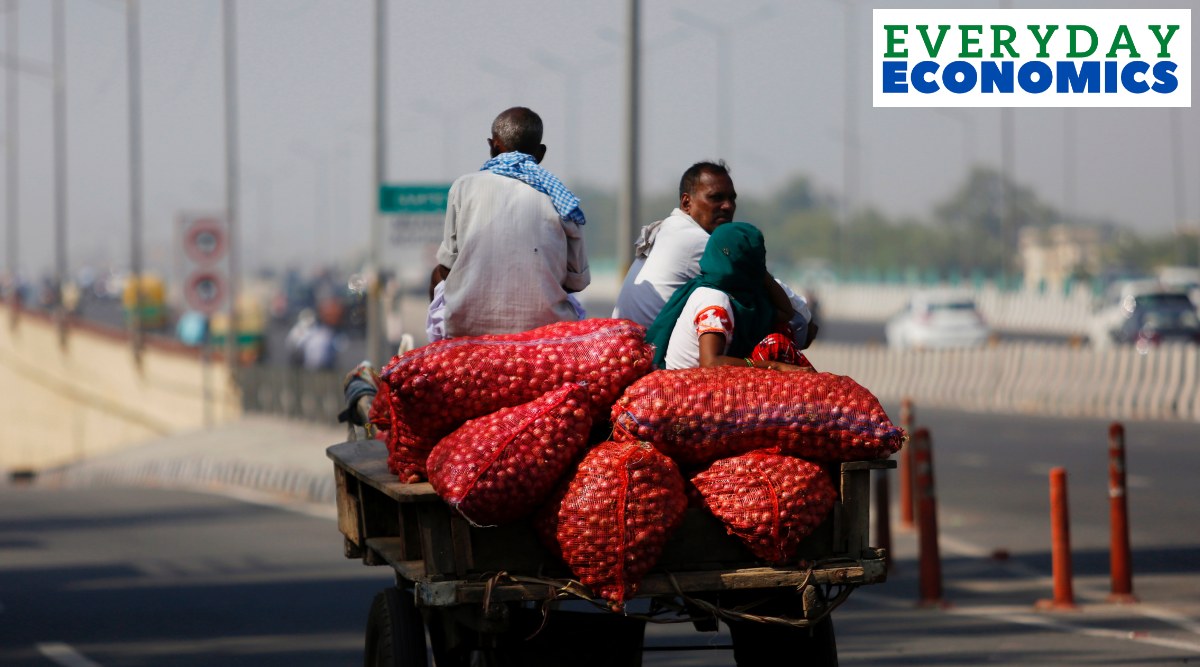

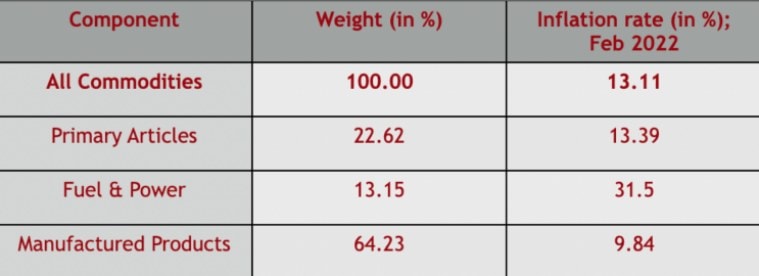 Table 1: Composition of Wholesale Price Index
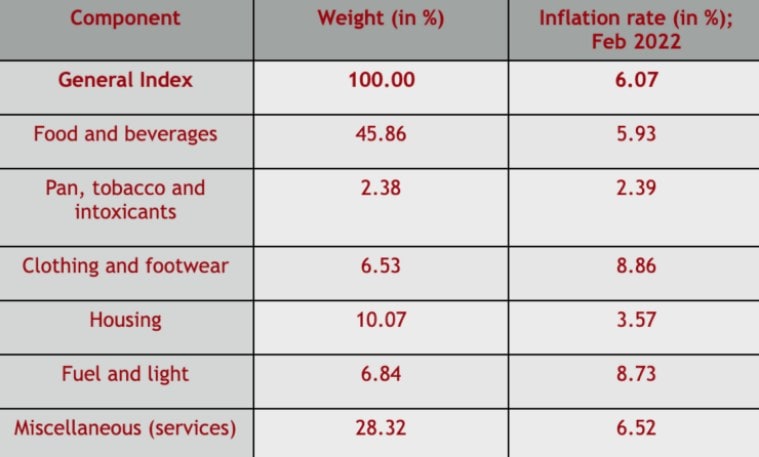 Table 2: Composition of Consumer Price Index