Premium
This is an archive article published on February 24, 2022

Explained: What are MSPs, and how are they decided?

Typically, MSPs create the benchmark for farm prices not just in those commodities for which they are announced, but also in crops that are substitutes.

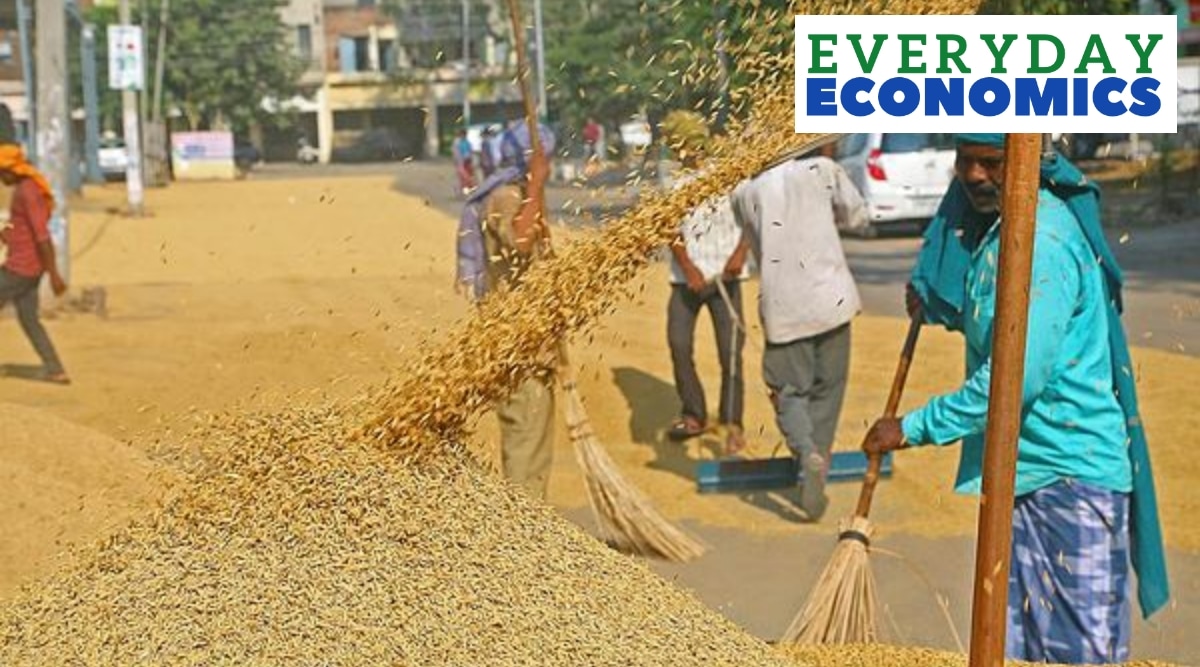
MSP explainedMSPs provide a floor for market prices, and ensure that farmers receive a certain "minimum" remuneration so that their costs of cultivation (and some profit) can be recovered. (File)

Round the year, India’s farmers produce a host of agricultural commodities such as paddy (rice) in the kharif season (in which sowing happens in June and harvesting in November) or wheat in the rabi season (in which sowing happens in November and harvesting in March). For the most part, farmers sell their produce in the market.

But what if the prices in the market are too low to adequately remunerate farmers?

This can often happen if there is a bumper crop that season, or if the international prices of a particular commodity are quite low (and as such imports are very cheap).

In such a scenario, India’s farmers, who are already some of the poorest citizens of the country, will struggle to make ends meet. Apart from their individual troubles, if farmers give up farming as a result of low prices, it can even put the country’s food security at risk.

The so-called minimum support prices or MSPs announced by the government each year are a way to preempt such an eventuality.

Support prices

During each cropping season, the government announces minimum support prices for 23 crops. Simply put, the MSP for a crop is the price at which the government is supposed to procure/buy that crop from farmers if the market price falls below it.

As such, MSPs provide a floor for market prices, and ensure that farmers receive a certain “minimum” remuneration so that their costs of cultivation (and some profit) can be recovered.

Story continues below this ad

The MSPs serve one more policy purpose. Using them, the government incentivises the production of certain crops, thus ensuring that India does not run out of staple food grains.

Typically, MSPs create the benchmark for farm prices not just in those commodities for which they are announced, but also in crops that are substitutes.

Crops covered

Crops covered by MSPs include:

* 7 types of cereals (paddy, wheat, maize, bajra, jowar, ragi and barley),
* 5 types of pulses (chana, arhar/tur, urad, moong and masur),
* 7 oilseeds (rapeseed-mustard, groundnut, soyabean, sunflower, sesamum, safflower, nigerseed),
* 4 commercial crops (cotton, sugarcane, copra, raw jute)

How much?

Story continues below this ad

Who decides what the MSP would be and how? The MSPs are announced by the Union government and as such, it is the government’s decision. But the government largely bases its decision on the recommendations of the Commission for Agricultural Costs and Prices (CACP).

While recommending MSPs, the CACP looks at the following factors:

* the demand and supply of a commodity;
* its cost of production;
* the market price trends (both domestic and international);
* inter-crop price parity;
* the terms of trade between agriculture and non-agriculture (that is, the ratio of prices of farm inputs and farm outputs);
* a minimum of 50 per cent as the margin over the cost of production; and
* the likely implications of an MSP on consumers of that product.

Newsletter | Click to get the day’s best explainers in your inbox

All produce?

Story continues below this ad

The government does not procure all farm produce at MSPs. Actual procurement (at MSP) varies with crop and geography. Also, MSPs have no statutory backing — a farmer cannot demand MSP as a matter of right. The farmer unions who led the yearlong agitation that led to the repeal of the three farm laws, want the government to enact legislation conferring mandatory status to MSP, rather than just being an indicative or desired price.

Udit Misra is Senior Associate Editor at The Indian Express. Misra has reported on the Indian economy and policy landscape for the past two decades. He holds a Master’s degree in Economics from the Delhi School of Economics and is a Chevening South Asia Journalism Fellow from the University of Westminster. Misra is known for explanatory journalism and is a trusted voice among readers not just for simplifying complex economic concepts but also making sense of economic news both in India and abroad. Professional Focus He writes three regular columns for the publication. ExplainSpeaking: A weekly explanatory column that answers the most important questions surrounding the economic and policy developments. GDP (Graphs, Data, Perspectives): Another weekly column that uses interesting charts and data to provide perspective on an issue dominating the news during the week. Book, Line & Thinker: A fortnightly column that for reviewing books, both new and old. Recent Notable Articles (Late 2025) His recent work focuses heavily on the weakening Indian Rupee, the global impact of U.S. economic policy under Donald Trump, and long-term domestic growth projections: Currency and Macroeconomics: "GDP: Anatomy of rupee weakness against the dollar" (Dec 19, 2025) — Investigating why the Rupee remains weak despite India's status as a fast-growing economy. "GDP: Amid the rupee's fall, how investors are shunning the Indian economy" (Dec 5, 2025). "Nobel Prize in Economic Sciences 2025: How the winners explained economic growth" (Oct 13, 2025). Global Geopolitics and Trade: "Has the US already lost to China? Trump's policies and the shifting global order" (Dec 8, 2025). "The Great Sanctions Hack: Why economic sanctions don't work the way we expect" (Nov 23, 2025) — Based on former RBI Governor Urjit Patel's new book. "ExplainSpeaking: How Trump's tariffs have run into an affordability crisis" (Nov 20, 2025). Domestic Policy and Data: "GDP: New labour codes and opportunity for India's weakest states" (Nov 28, 2025). "ExplainSpeaking | Piyush Goyal says India will be a $30 trillion economy in 25 years: Decoding the projections" (Oct 30, 2025) — A critical look at the feasibility of high-growth targets. "GDP: Examining latest GST collections, and where different states stand" (Nov 7, 2025). International Economic Comparisons: "GDP: What ails Germany, world's third-largest economy, and how it could grow" (Nov 14, 2025). "On the loss of Europe's competitive edge" (Oct 17, 2025). Signature Style Udit Misra is known his calm, data-driven, explanation-first economics journalism. He avoids ideological posturing, and writes with the aim of raising the standard of public discourse by providing readers with clarity and understanding of the ground realities. You can follow him on X (formerly Twitter) at @ieuditmisra           ... Read More


Latest Comment
Post Comment
Read Comments
Advertisement
Advertisement
Advertisement
Advertisement