Premium
This is an archive article published on July 29, 2021

Explained: Covishield vaccine study shows breakthrough impact

Perhaps the largest study on vaccine effectiveness — on 1.59 million armed forces personnel — shows a 93% reduction in breakthrough infections.

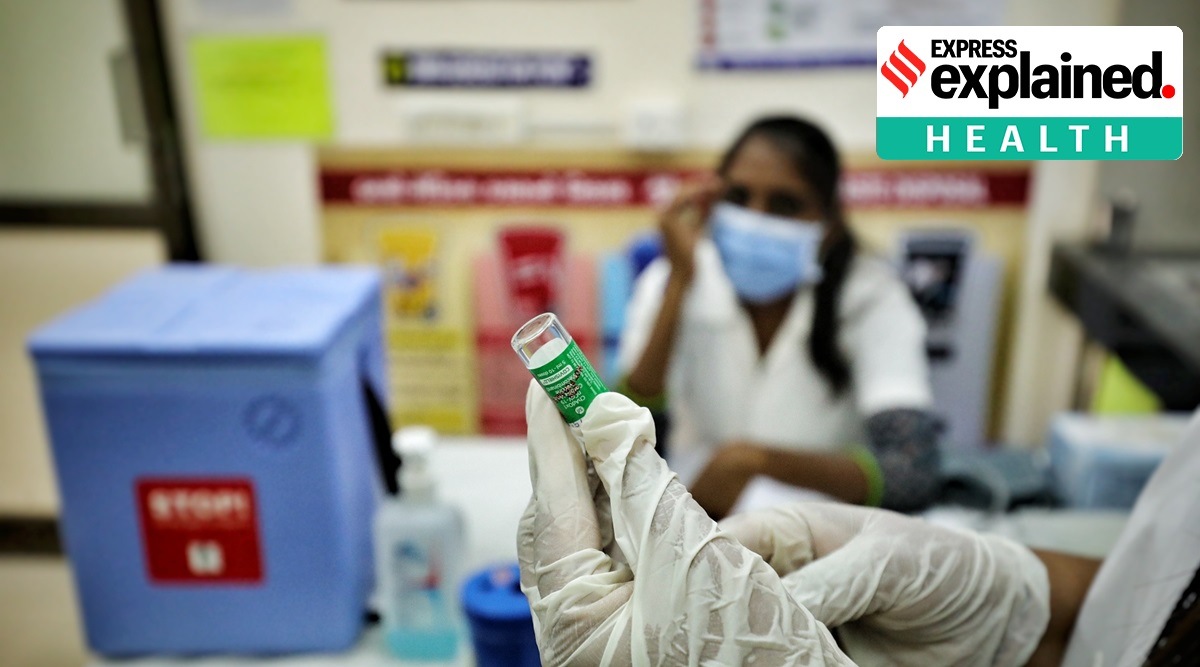
The corrected vaccine effectiveness of Covishield was 91.8-94.9% against infections. (Express Photo: Nirmal Harindran, File)The corrected vaccine effectiveness of Covishield was 91.8-94.9% against infections. (Express Photo: Nirmal Harindran, File)

Interim results from a study of 1.59 million healthcare and frontline workers of the Indian armed forces — among the largest studies carried out anywhere in the world — have showed a 93 per cent reduction in breakthrough infections after vaccination with Covishield.

Covishield, the made-in-India variant of Oxford-AstraZeneca’s AZD-1222 formulation, is the predominant vaccine being used in India’s mass immunisation programme against SARS-CoV-2, the Covid-19 virus.

The results of the study (‘Covishield (AZD1222) Vaccine effectiveness among healthcare and frontline Workers of Indian Armed Forces: Interim results of VIN-WIN cohort study’), published in a special issue of the peer-reviewed Medical Journal Armed Forces India on Tuesday, underline the strong benefits of vaccination against breakthrough infections and deaths, and reiterate the message ‘Get Vaccinated, Stay Safe’, the researchers said.

A very large study

“This is the largest study from India evaluating Covid vaccine effectiveness so far,” the researchers have said. Air Cmde Subramanian Shankar, corresponding author of the study, told The Indian Express: “Other studies have a sample size under 1 million. Hence we believe that VIN-WIN cohort is possibly one of the largest studies worldwide on vaccine effectiveness, if not the largest.”

Study and findings

Healthcare workers and frontline workers of the armed forces were among the first to get their jabs after India started vaccinating on January 16 this year. The study presents an interim analysis of vaccine effectiveness estimates of 1.59 million recipients until May 30.

“Data of 1,595,630 individuals (mean age 27.6 years; 99% male) over 135 days was analysed. Till 30 May, 95.4% and 82.2% were partially and fully vaccinated (respectively),” says the study.

Story continues below this ad

“The UV (unvaccinated), PV (partially vaccinated) and FV (fully vaccinated) compartments comprised 106.6, 46.7 and 58.7 million person-days respectively. The number of breakthrough cases in the UV, PV and FV groups were 10,061, 1,159 and 2,512; while the deaths were 37, 16, and 7 respectively. Corrected VE (vaccine effectiveness) was 91.8-94.9% against infections.”

The study used anonymised data from the existing Armed Forces Health Surveillance system which had been enhanced for monitoring Covid-19. The system had data for daily vaccinations with first and second doses, dates of testing positive for Covid-19, and Covid-related deaths. As the shift occurred from unvaccinated to partially vaccinated and then fully vaccinated, the numbers in each group changed daily. Since each individual stayed in the three groups (UV, PV, and FV) for varying lengths of time, the population at risk was measured in person days (100 person-days could be either one person for 100 days or 10 persons for 10 days each).

The crude rates were calculated by dividing infections/deaths by the population at risk, and corrections were made for the force of the pandemic’s second wave in April-May 2021, which was 600-1,000 times higher than in January, Air Cmde Shankar said.

Other studies

Story continues below this ad

A study from Scotland published in The Lancet in April this year analysed a cohort of 1.33 million people who were vaccinated between December and February to gauge the “real-world” effectiveness of first doses of the Pfizer-BioNTech and Oxford-AstraZeneca vaccines against hospital admissions. The results showed a vaccine effect of 91 per cent for Pfizer-BioNTech and 88 per cent for Oxford-AZ.

The study concluded that the “mass roll-out of the first doses of the…vaccines was associated with substantial reductions in the risk of hospital admission due to Covid-19”.

The VIN-WIN study mentions results of other Covishield vaccine effectiveness studies as well.

A case control study in the UK among 1.57 lakh people older than 70 years found reduced odds of 73 per cent in cases and 43 per cent in hospital admissions; an RCT study of 11,000-odd individuals older than 18 years in the UK, Brazil, and South Africa reported a reduction of 62% in cases; and an RCT study of 2,026 HIV-negative individuals aged 18-65 in South Africa reported a reduction of 22 per cent cases against the B.1.351 (Beta) variant of the virus.

Story continues below this ad

Earlier this month the Indian Council of Medical Research reported the findings of a study done by the police department of Tamil Nadu, ICMR-National Institute of Epidemiology, and Christian Medical College, Vellore, that showed 82 per cent effectiveness on personnel who had received a single dose, and 95 per cent on those administered both jabs.

In Maharashtra, a study across 20 government Covid centres under the director of medical education and research showed that 87.5 per cent of those hospitalised were not vaccinated.

Newsletter Click to get the day’s best explainers in your inbox

Challenges and limitations

Story continues below this ad

The VIN-WIN study was carried out at a time when the country was reeling from the second wave of the pandemic. “The study cohort, belonging to the tri services, was spread across the nation. Apart from constraints of terrain and location, data had to be collated at a central facility and updated on a daily basis. This required creating a novel surveillance system,” Air Cmde Shankar said.

“A conventional cohort study incurs significant cost. So the Armed Forces Medical Services team decided to innovatively use results of the natural experiment that was created with 1.59 million individuals moved from unvaccinated to partially to fully vaccinated groups. By tracking them in detail on a daily basis, researchers could use the individuals as their own ‘internal comparison’,” he said. “Researchers had to also take into account the changing dynamics of disease transmission in the form of the pandemic’s second wave.”

Among the limitations of the study, the authors have noted that “the cohort differed from the Indian population”. “While the mean age of this cohort (27.6 years) was similar to that of the Indian population, the confidence interval was much narrower as it did not represent almost 50% of the population (age <18 years ~40% and &gt;60 years~10% ).”

Also, it was a “predominantly male cohort comprising individuals with minimal co-morbidities”. Thus, the results “may not generalize across the entire population”, and “vaccine effectiveness may or may not be similar…”

Biggest takeaway

Story continues below this ad

Surg Vice Admiral Rajat Datta, Director General, Armed Forces Medical Services, and co-author of the study, said in a statement: “The study sends a clear message of vaccine efficacy… It would be an important step to help overcome vaccine hesitancy backed by scientific evidence.”

Air Cmde Shankar said the team would now follow this cohort over time to answer other questions; “one of the important ones would be to determine the ideal time for a third/booster dose”.

On Tuesday, Dr V K Paul, Member NITI Aayog (Health), spoke about the importance of the armed Forces study. “While no vaccine can guarantee against infection, it can prevent serious disease,” he said.

Anuradha Mascarenhas is a Senior Editor at The Indian Express, based in Pune. With a career spanning three decades, she is one of the most respected voices in Indian journalism regarding healthcare, science and environment and research developments. She also takes a keen interest in covering women's issues . Professional Background Education: A gold medalist in Communication and Journalism from Savitribai Phule Pune University and a Master’s degree in Literature. Author: She authored the biography At The Wheel Of Research, which chronicles the life and work of Dr. Soumya Swaminathan, the former Chief Scientist at the WHO. Key Focus: She combines scientific accuracy with storytelling, translating complex medical research into compelling public and human-interest narratives. Awards and Recognition Anuradha has won several awards including the Press Council of India's national award for excellence in journalism under the gender based reporting category in 2019 and the Laadli Media award (gender sensitivity -2024). A recipient of the Lokmat journalism award (gender category-2022), she was also shortlisted for the RedInk awards for excellence in journalism-2021. Her debut book At The Wheel Of Research, an exclusive biography of Dr Soumya Swaminathan the inaugural chief scientist of World Health Organisation was also nominated in the Popular Choice Category of JK Paper AUTHER awards. She has also secured competitive fellowships including the Laadli Media Fellowship (2022), the Survivors Against TB – New Research in TB Media Fellowship (2023) and is part of the prestigious 2025 India Cohort of the WomenLift Health Leadership Journey.” Recent Notable Articles (Late 2025) 1. Cancer & Specialized Medical Care "Tata Memorial finds way to kill drug-resistant cancer cells" (Nov 26, 2025): Reporting on a breakthrough for triple-negative breast cancer, one of the most aggressive forms of the disease. Discipline, diet and purpose; How a 97-year-old professor defies ageing'' (Nov 15, 2025) Report about Prof Gururaj Mutalik, the first Head of Department at Pune's B J Government Medical College who at 97 credits his longevity to healthy habits and a strong sense of purpose. 2. Environmental Health (The "Breathless Pune" Series) Long-term exposure even to 'moderate' air leads to chronic heart, lung, kidney issues" (Nov 26, 2025): Part of an investigative series highlighting that even "safe" pollution levels are damaging to vital organs. "For every 10 µg/m3 increase in PM2.5 level, there was 6-8% jump in medicine sales" (Nov 23, 2025): Using commercial data to prove the direct link between air quality and respiratory illnesses in Pune. 3. Lifestyle & Wellness News "They didn't let cancer, diabetes and heart disease stop them from travelling" (Dec 22, 2025): A collaborative piece featuring survivors who share practical tips for traveling with chronic conditions. At 17, his BP shot up to 200/120 mmHG; Lancet study flags why child and teen hypertension doubled between 2000 and 2020'' (Nov 12,2025)--A report that focusses on 17-year-old-boy's hypertensive crisis and reflects the rising global trend of high blood pressure among children and adolescents. 4. Scientific Recognition & Infrastructure For promoting sci-comm, gender diversity: IUCAA woman prof highlighted in Nature" (Nov 25, 2025): Covering the global recognition of Indian women scientists in gender studies and physics. Pune researchers find a spiral galaxy like the Milky Way from early universe'' (December 3, 2025)- A report on how Indian researchers discovered a massive galaxy that existed when the universe was just 1.5 billion years old , one of the earliest to have been observed so far. Signature Beat: Health, Science & Women in Leadership Anuradha is known for her COVID-19 reportage, where she was one of the first journalists to provide detailed insights into the Covishield and Covaxin trials. She has a dedicated interest in gender diversity in health and science, often profiling women researchers who are breaking the "leaky pipeline" in STEM fields. Her writing style is scrupulous, often featuring interviews with top-tier scientists and health experts from various institutions.   ... Read More


Latest Comment
Post Comment
Read Comments
Advertisement
Advertisement
Advertisement
Advertisement