9 min read
© The Indian Express Pvt Ltd



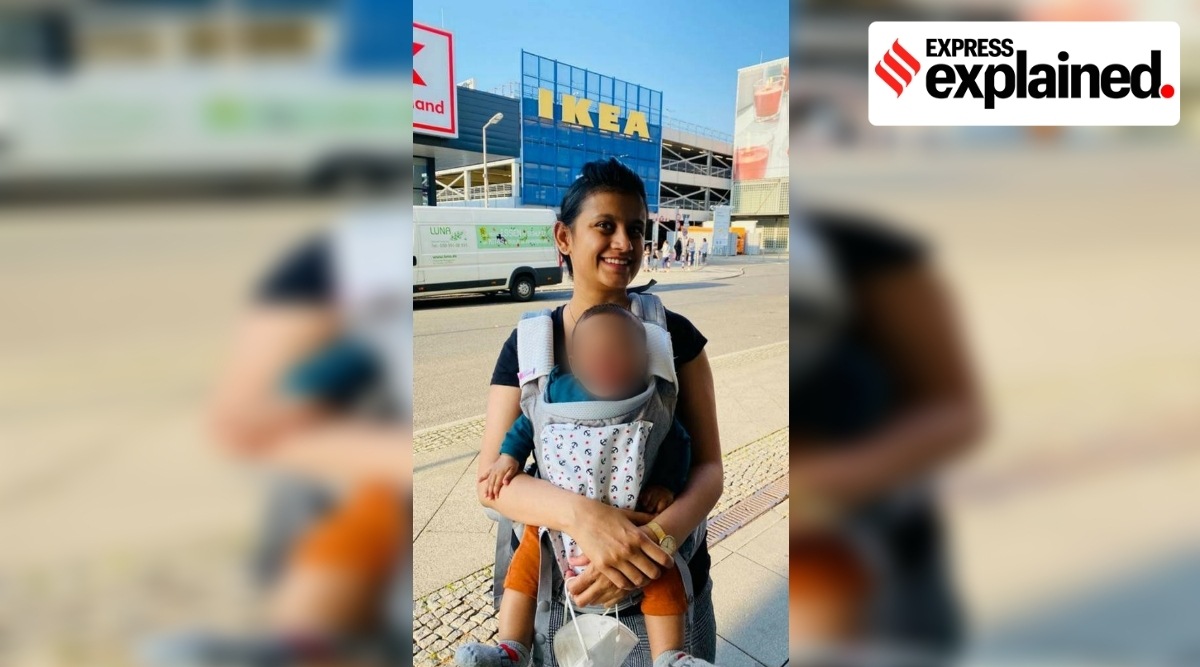 A German court has held that “the parents are no longer authorised to decide on the whereabouts of their child”, handing over Ariha's custody to the Jugendamt instead. (Twitter/@Ariha_Mother)
 A district court in Pankow, Germany, has in two judgments dated June 13, denied the custody of Ariha Shah — the 28-month-old — to her biological parents and handed her over to the Jugendamt, the German youth services.
Rejecting the application of Dhara and Bhavesh Shah to return the child to them directly or at least hand her over to the Indian Welfare Services, the court ruled that “the parents are no longer authorised to decide on the whereabouts of their child”, citing two injuries that she had suffered in 2021.
On June 3, MEA spokesperson Arindam Bagchi had urged German authorities to hand over Ariha Shah’s custody at the earliest, reiterating that she “is an Indian national and her nationality and socio-cultural background is the most important determinant of where her foster care is to be provided.”
Previously, in a rare show of cross-party unity, 59 MPs cutting across 19 political parties had written a joint letter to Philipp Ackerman, the German ambassador in New Delhi, asking him to do everything possible to ensure that Ariha Shah is repatriated to India at the earliest. Signatories included MPs from Congress, BJP, DMK, NCP, TMC, SP, RJD, AAP, CPM, Akali Dal, BSP, Shiv Sena, CPI and National Conference.
Ariha Shah has been in foster care in Germany since September 23, 2021 – when she was barely seven months old. At the time, German authorities had alleged that Ariha’s parents – Dhara and Bhavesh – had abused her.
This case has been noted for having some parallels to that of Sagarika Chakraborty. In 2011, Norwegian authorities took her two children away and placed them in foster care after accusing her of “improper parenting”. Rani Mukherjee’s recent film Mrs Chatterjee vs Norway was based on Chakraborty’s struggle to get her children back.
Bhavesh Shah, a Gujarati software engineer, moved to Berlin with his wife, Dhara, in 2018. Ariha was born in the German capital in 2021. All was going well till the fateful day in September when Ariha was abruptly taken by the Jugendamt, German childcare services.
Speaking to the media, Dhara said that Ariha’s grandmother had visited Berlin to see her recently-born granddaughter. Unfortunately, she “accidentally hurt the child”, causing injury to her “outer genital area”. When she was taken to a hospital, authorities were alerted of what was suspected to be a case of “sexual assault”.
This prompted the Jugendamt to take swift action, immediately taking the child away to foster care, with her parents allowed to visit once every fortnight or so. The authorities also registered a case of child sexual abuse against the parents.
What has happened since Ariha Shah was taken from her parents?
After an investigation, the assault charges were dropped but authorities accused the parents of negligence instead. However, the case against the parents was closed in February 2022, without any formal charges being filed against them.
Despite this, the baby was not returned to her parents. Instead, the Jugendamt filed a civil custody case for the termination of parental rights and permanent custody of the child. Since then, the parents have been fighting a legal battle for the custody of their child, who now is over two years old.
Over the course of 2022, a court-appointed psychologist conducted a thorough psychological evaluation of the parents. This evaluation was completed in 2022, with the expert recommending that the child should be placed with either parent in a parent-and-child facility, with the other parent regularly visiting her.
While this would be impractical since Bhavesh’s visa is about to expire, even before a court order came in on the issue, the Jugendamt shifted Ariha to a facility for children with special needs, where she remains, as of now.
The court has denied giving custody of Ariha to her parents or to the Indian Welfare Services, instead, making the Central Youth Welfare Office of Berlin Ariha’s provisional guardian. While the parents had initially sought Ariha’s custody, they later withdrew the request instead appealing that the child be given to the Indian Welfare Services, with the understanding that she would be moved to the foster home run by Ashok Jain in Ahmedabad.
However, the court reasoned that parental care was to be denied so as to “avert the existing danger to the child”, citing two injuries that she had suffered — a head and back injury in April 2021 that happened while she was being bathed and a genital injury in September 2021. The court noted that it had come to the conviction “that the mother and/or father (had) intentionally caused the serious genital injuries of the child” and that the parents were unable to “explain the events in question in a sufficiently consistent manner”.
The district court also did not accede to the parents’ request for daily visitation. The court said that the parents already have “the right and duty” for visitation twice a month “on the first and third Tuesday of each month for 60 minutes (of) accompanied contact”. It reasoned that while continued contact with her parents was essential so that Ariha is able to form a constant picture of her parents in her further development, “on the other hand, the development of a bond was no longer in the foreground”.
What now?
Expressing his disappointment with the verdict, father Bhavesh Shah said “We plan to appeal in a higher court in Germany, but have little hope of getting a fair trial. We were expecting a verdict like this. They did not opine on the reports of experts who defended us, and just gave a one-sided verdict.”
Mother Dhara noted that she was unsure whether the Jugendamt will continue or permit visitation once Ariha turns 3-year-old. “And once we lose visitation, if we want to bring her back to India, Ariha herself may not remember us or understand what India is and may refuse to come back. The visitation that has been allowed now is supposed to apply until Ariha settles in with her new foster parents.”
What are the various issues surrounding this case?
First and foremost is the issue of custody itself. Despite no formal charges ever being filed against the parents and the court-appointed psychologist recommending parental supervision of some form, the parents have been denied Ariha’ custody. While the latest court order indicated that the parents were responsible for Ariha’s injuries, it did not formally charge them for the same.
Second, is the issue of Ariha being moved around, especially to a facility for children with special needs. As the MPs’ letter from earlier this month put it, “Ariha is not a special needs child. Shifting her around from one carer to another will cause deep and damaging trauma to the child. The parents are allowed only fortnightly visits. The videos of these meetings are heart wrenching and they reveal the deep bonds the baby has with her parents and the pain of separation.”
Then there is also the issue of the specific upbringing Ariha is receiving in Germany. The MPs pointed out that Ariha belongs to a Jain family who are strictly vegetarian. Nonetheless, she is being fed non-vegetarian food in foster care. “We have our own cultural norms. The baby belongs to a Jain family who are strict vegetarians. The baby is being brought up in an alien culture, being fed non-vegetarian food. Being here in India, you can better appreciate how unacceptable this is to us,” the MPs wrote.
This is part of a larger question of cultural differences and upbringing, a theme that repeatedly emerged in the case of Sagarika Chakraborty’s children as well.
As Arindam Bagchi pointed out, the child’s best interests “can be fully realised only when she is in her home country where her socio-cultural rights can be safeguarded.”
This was also acknowledged by German foreign minister Annalena Baerbock when she visited New Delhi last December. At the time, she had said that Germany was “also bearing in mind the cultural identity of each child that is taken care of by the youth offices in Germany.”