


Click here to follow Screen Digital on YouTube and stay updated with the latest from the world of cinema.
Premium
This is an archive article published on December 12, 2014
Shying Away
With OMG: Oh My God! being the only successful mainstream Hindi film on religion, Bollywood’s experiments with spirituality and philosophy has been few and far between. Screen explores the reasons why film-makers are hesitant to explore this genre
Mumbai | December 12, 2014 01:00 AM IST 10 min read
10 min read


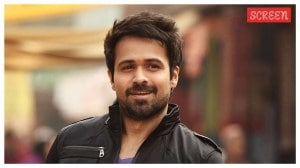
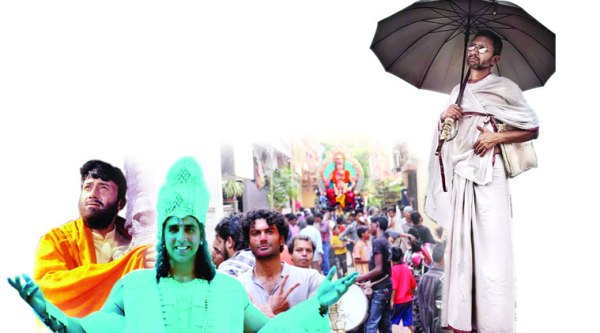 Representational pic
By Kanika Rajani
Recently, the International Goa Film Festival saw Guillermo Arriaga’s Words with Gods. The anthology consisted of eight short films which represented eight different cultures across the globe. One of those, namely, The Temple Room was directed by Mira Nair. The American-Indian director’s film features a Hindu family debating about the location of the prayer room in their new duplex flat. The film which is currently doing the rounds at festivals before its release was also screened at the Venice Film Festival and the Los Cabos Film Festival in Mexico.
Be it The Reluctant Fundamentalist, or The Namesake, Nair has been known for her keen interest in socio-cultural issues that concern the South Asian diaspora. The same cannot be said about mainstream Bollywood film-makers who seem to steer clear from making films on the subject of religion, spirituality and philosophy. In comparison to other genres, this genre has almost been neglected. Few are even aware that Bhavna Talwar’s Dharm (2007) which dealt with communalism won the Nargis Dutt Award for Best Feature on National Integration. According to trade analyst N.P. Yadav the Hindi film industry which churns out about 200 films in a year, only 1.5 per cent are made on the subject. One of the chief reasons could be that our film industry is very superstitious and wary of being part of films based on these subjects.
“It’s true. Several film-makers are very superstitious and God fearing and are wary of making films on this subject. Celebrities too are very spiritual and religious, and they are not convinced, how can anyone make a film on the topic. Stars observe so many rituals, believe in numerology etc. So, how can they then tell people not to believe in these rituals or superstitions,” said Yadav.
Besides, there is almost always some controversy or the other that is attached to films of such genres. The most prominent being the possibility of threats from extremists, religious or other pressure groups that deters Bollywood film-makers from considering making a film on the topic.
The most recent example is Umesh Shukla’s OMG: Oh My God! which was based on the popular Gujarati play Kanji Virudh Kanji. Though the film won several awards and even got the nod of approval from film critics and intellectuals alike, not many know that Shukla was at the receiving end of threats from the religious mafia. “They wanted me to make a film, stating that only Lord Krishna exists and they even offered to finance it. I was told that I’d have to face the consequences, ” he said.
A scene that features Paresh Rawal questioning people why they use the word Moriya when they don’t understand its meaning, and how is it any different calling Ganpati, Ting tong. To make matters worse, the film was releasing around Ganesh Chaturthi. Shukla wisely gave in and removed the scene. “The Censors passed the film, because it was a well balanced film and not anti-God. When films with such subjects are made, they shouldn’t be offensive, illogical and made to unnecessarily sensationalise things. There is no point in provoking people; besides you can’t change people’s beliefs.” said Shukla whose film did not release in Islamic states like Malayasia, UAE and Pakistan.
While Shukla was needlessly harassed, the film that met the worst fate was undoubtedly Deepa Mehta’s Water (2005) about the plight of widows in pre- Independent India. The film’s shooting which originally took place in 2000 in Varanasi was stalled by fundamentalists who stormed in to wreck the sets, six weeks into the film’s shooting. This was despite the Uttar Pradesh government granting them prior permission to shoot. Not only was the film resisted by right wing fractions, but was also banned from being shot in India as it was considered anti-Hindu. Later, it was filmed in Sri Lanka and its original cast that included Shabana Azmi and Nandita Das as the protagonists were replaced by Seema Biswas and Lisa Ray. But not many film-makers are as resilient as Mehta who re-shot her film.
Nitish Bhardwaj, director of the Marathi film Pitruroon, however feels that religion is a common theme in mainstream films, “Om Shanti Om was based on the idea that a soul never dies, while Lagaan depicts farmers drawing strength from the song O Paalanhaare.”
While religion is a common theme in films, most film-makers refrain from sharing their perspective on the topic. Idol worship, marriage sequences, devotional songs are common features of films, but sequences concerning any religious activity or festivals have usually been glorified. Protagonists are often featured turning to God during the time of a crisis, thanking the almighty for fulfilling their wishes and so on. Guide, starring Dev Anand which depicted him as a saint and Amitabh Bachchan’s character in the seventies too, often questioned God, but films that offer a different take on the subject are few and far.
There are no dearth of mythological films like Jai Santoshi Maa, Shirdi Ke Sai Baba, but such films compel viewers to believe in God and uphold the theory of a divine force. Presently, Bollywood films are leaning more towards making rom-coms, action thrillers and horror films as compared to films on religion, spirituality and philosophy.
Those film-makers who use these as a prominent theme in their film have to be extremely careful about not crossing certain unwritten boundaries. Despite using the Ganpati festival as a narrative tool in his film Shor In The City, Raj Nidimoru had to re-shoot the film’s climax. “My last shot in Shor… was of the Ganpati idols washed ashore after Anant Chaturthi. It was vital for me to show what happens after Ganesh idols are immersed; that was my love letter to the city. I hate it when these things happen. It’s like how you love your mother, but loathe her for doing certain things. I like expressing certain perspectives on spirituality and philosophy. In Shor… when the Ganpati is bought home, everybody is excited initially, but it soon gets messy after which people wait for it to get over. My film also shows visitors harassing the lead, and how his life becomes chaotic during the festival.”
While Nidimoru is dismayed at the prospect of directors not being given as much freedom as they deserve, he still feels that, “You have to be smart about it and try to make your point by staying within the boundaries,” advises Nidimoru.
Talwar, whose Dharm (2007) is about a Brahmin priest who discovers that his adopted son is a Muslim child, believes that the film should be as close to reality as possible. “In Dharm, I kept the journey personal about a man seeking out his son. I did not make any judgements about one religion or the other. I presented things the way I saw it without any bias. But the moment you get personal and pass judgements then certain sections of society become defensive and feel the need to fight.” Talwar belongs to a minuscule category of film-makers who believe that such subjects need to be handled in a sensitive manner.
Apart from resistance from various bodies and star’s own belief systems, the audience seeks entertainment when they go to the movies. “The consumption of moviegoers has changed. A subject like spirituality is slow and a commercial film attracts more people. The small screen has a host of such channels. This subject is also partly neglected as people seek spiritual content by reading a book or talking to a spiritual person.”
Although, Nidimoru is keen to foray into this genre, he is wary about certain factors like the audience tastes, religious content shown on the small screen and most important of all, receiving threatening ultimatums from religious groups.
So, when most Indians are struggling to make ends meet, the last thing they want to see is content that is exceptionally evocative. This explains why Ship of Theseus did not find many takers in urban areas and was mostly appreciated by the intellectuals.
“Societies that have not yet managed to provide basic necessities will not have the privilege to collectively introspect. They will go on producing culture that talks to man’s primitive needs, as society has yet not moved past its physiological needs,” says Anand Gandhi, director of Ship of Theseus. Delving into the debate about why such films are scarce, he further states, “Sex is euphemised and replaced with love, while violence is rephrased by patriotism, or some kind of justified primitive revenge. The emotional need for the hero to take that revenge will be justified. Philosophy comes at the epitome of other needs being satisfied.”
Gandhi’s explaination is even psychologically supported by none other than Abraham Maslow’s Hierarchy of Needs which state man’s physiological needs as his foremost needs; these consist of food, clothing, shelter, sex and homeostasis. Self-actualisation which includes accepting facts, being unprejudiced is only possible when a person is at peace with themselves. That is the very last need and finds itself on the uppermost level of the pyramid. This explain why viewers frown upon films that are complex and merely want to sit back and enjoy ‘the big picture’.
Reflections
Why do film-makers refrain from making films based on religion and spiritualism?
*Stars are very superstitious and consider this topic sacred which prevents them from acting in films on the subject.
* There is always the possibility of threats to film-makers from religious sects and the request to depict the subject positively, or edit or re-shoot their film.
* Presently the audience wants to watch films that are fast-paced and escapist.
*Societies, like India where citizens are struggling to fulfill their basic needs do not have the luxury to collectively reflect on life in cinema.
kanika.rajani@expressindia.com
Advertisement
Loading Taboola...


More Entertainment




Advertisement
PHOTOS

PHOTOS





Top Stories










Must Read







Advertisement
- 01
- 02
- 03
- 04
- 05
Advertisement
