This is an archive article published on May 1, 2015
Remembering legendary Shailendra – a great poet and lyricist
Remembering Shailendra, the poet who wrote in the common man’s language.
Written by Alaka SahaniUpdated: May 1, 2015 09:14 AM IST
3 min read
Whatsapp
twitter
Facebook
Reddit
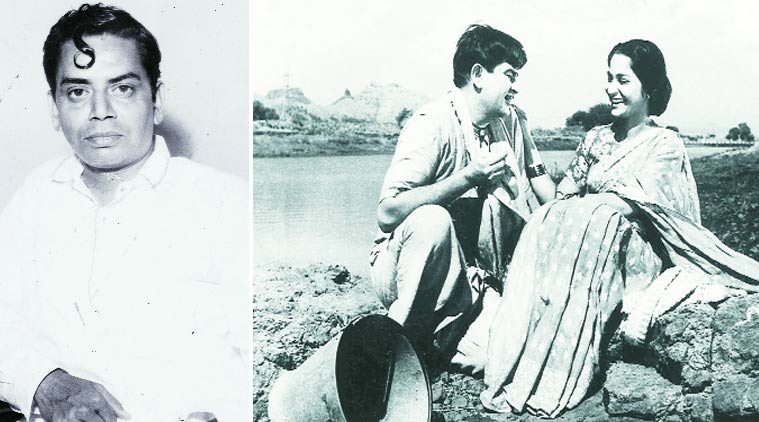
Shailendra; in Teesri Kasam’s Sajan re jhooth mat bolo, he was his unaffected self.
Wah Pushkin, what a song you have written”. Raj Kapoor was full of praise for his friend and lyricist Shailendra — whom the legendary filmmaker fondly called ‘Pushkin’ and ‘Kabiraj’ — and often barged into the latter’s home at night. Incidents such as these are etched in the mind of Amla Shailendra Mazumdar, daughter of the poet.
Shailendra not only possessed the felicity of language but also had an elusive combination of simplicity and depth, something which Kapoor admired. He wrote many title tracks of the actor-director’s movies, including Barsaat mein hum se mile tum from Barsaat (1949), and Awara hoon from Awara (1951). “Shailendra wrote in the common man’s language. He was economical in his use of words, yet his writing was very meaningful. Take for instance, Teesri Kasam’s Sajan re jhooth mat bolo. One does not have to stretch the imagination to fathom its meaning. What’s easily understandable, lives on,” says Mumbai-based musicologist Kushal Gopalka.
In the second edition of Cine Music, Beyond Entertainment, the work of the lyricist, popularly called Kavi Shailendra, will be presented as “A Case Study” in Mumbai. The two-day long seminar, organised by Gopalka on May 1 and 2, will take an academic and in-depth look at Hindi film music. Amla will present a rare personal insight into the lyricist’s life and work.
[related-post]
Shailendra penned lullabies, bhajans, love songs and even item numbers with equal ease and panache. He began his career by writing fiery poems as a member of Indian People’s Theatre Association (IPTA). It was during an IPTA event that Kapoor heard him read his poem on Partition, Jalta hai Punjab. Impressed, the actor asked the poet to write lyrics for his directorial debut, Aag (1948). Shailendra, who then worked with the Indian Railways, declined. Later, he went back to Kapoor during the making of Barsaat to make extra money as his first child was on the way.
Both the songs he wrote for the films — title song Barsat mein and Patli kamar hai — were hits. This kickstarted a successful collaboration of actor-director Kapoor, singer Mukesh, music composer Shankar-Jaikishan and Shailendra that created many evergreen songs. Equally successful was his partnership with SD Burman and Salil Chowdhury.
Amla, however, offers a different dimension. “I would remove the tags of great poet, lyricist and personality attached to him. I would like to remember him just as my Baba — a simple man who even at the height of fame never let us forget our roots,” says the daughter, of her father, who passed away at the age of 43 on December 14, 1966.
Alaka Sahani is a prominent film critic and journalist based in Mumbai. With a career spanning over two decades, she has established herself as one of India’s most authoritative voices in cinematic journalism, known for an analytical approach and insights that transcend the standard cycle of celebrity journalism.
Expertise & Accolades
In 2014, Alaka was honoured with the National Film Award for Best Film Critic. Her Swarna Kamal (Golden Lotus) citation specifically lauded her for "highlighting facets of cinema beyond glamour and gossip" and for her ability to delve into the contemporary relevance of iconic filmmakers. Her commitment to journalistic integrity was further recognised in 2019 with a Special Mention at the Red Ink Awards for her investigative feature, 'In Search of a Star'. Her article titled 'People Like Us', published in The Indian Express on March 27, 2022, was shortlisted for Red Ink Award, 2023.
Global Industry Leadership
Alaka’s expertise is sought after by major international and domestic film bodies:
Golden Globes: In 2025, she joined the international voting body for the 83rd Annual Golden Globes.
National Film Awards: She served on the prestigious jury for the 68th National Film Awards, helping select the finest contributions to Indian cinema.
Global Perspective: Her work consistently bridges the gap between commercial Bollywood A-listers and emerging independent talents, offering nuanced insights into both Indian regional cinema and international film trends.
Focus & Vision
Beyond the screen, Alaka is a dedicated observer of Mumbai’s vibrant theatre scene and the historical evolution of the moving image. Through her long-form articles and deep-dive interviews, she continues to challenge "tried-and-tested" templates, providing readers with a deep understanding of the artistic and systemic workings of the Indian and global film industry. ... Read More


 3 min read


 Shailendra; in Teesri Kasam’s Sajan re jhooth mat bolo, he was his unaffected self.