This is an archive article published on October 12, 2022
IISc retains top position, 8 IITs in overall list: THE World University Rankings
Globally, the University of Oxford has emerged as the best institute among 1,799 universities from 104 countries, according to a statement issued by THE.
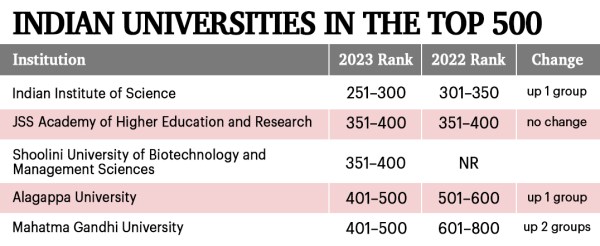
While it is first among Indian institutions, overall, the IISc is placed in the 251-300 band. Globally, the University of Oxford has emerged as the best institute among 1,799 universities from 104 countries, according to a statement issued by THE.
The second position among Indian institutions has been taken by the Shoolini University of Biotechnology and Management Sciences (351-400 overall), which made its debut in the rankings. The Himachal Pradesh-based private university is ranked 96th in the National Institutional Ranking Framework (NIRF) 2022 in the universities category.
Shoolini University, however, shares the spot among Indian institutes with JSS Academy of Higher Education and Research, another private university which is based in Karnataka. Tamil Nadu’s Algappa University, a public institution, has come out third in India (401-500).
Last year, the second place in the Indian category had been bagged by IIT Ropar, which has in this year’s edition of THE slipped to the sixth position, and to the 501-600 band globally from last year’s 351-400.
Among the other IITs which took part in the rankings, IIT Indore is placed in the 601-800 band, followed by IIT Patna and IIT Gandhinagar in the 801-1000 band.
In total, eight IITs feature in this year’s rankings by THE, its spokesperson told The Indian Express.
Story continues below this ad
It was not immediately clear as to how many IITs participated in the rankings process. The complete list will be released Wednesday.
The parameters based on which the institutes are ranked are: teaching (30%), research (30%), citations (30%), international outlook (7.5%), and industry outcome (2.5%). In teaching and research, 15% weightage each is based on a “reputational survey”.
The spokesperson added that the organisation held talks with the “IITs (and other institutions) on several occasions and continue to welcome discussions with them” on ironing out the differences.
“As mentioned, we have given a detailed explanation of our rankings methodology, and have listened to their input. In the next edition of the ranking, to be launched next year, we have incorporated some of their suggestions,” the spokesperson said.
Story continues below this ad
However, IIT Bombay and IIT Delhi maintained that the rankings suffer from a lack of transparency. IIT-B director Prof. Subhasis Chaudhury said, “There is no improvement in the transparency factor in their process. Directly a rank is allotted to the institute. We should know what the process is. There is no reason to participate without knowing what exactly we are participating in.”
The last time major IITs participated in THE rankings was in 2019 — the report (released as THE 2020 list) had placed IIT Bombay and IIT Delhi in the 401-500 overall band, behind the Ropar and Indore campuses.
Pallavi Smart is a Principal Correspondent with The Indian Express, Mumbai Bureau. Her reporting is singularly focused on the education sector, demonstrating exceptional Expertise and Authority across the entire spectrum of learning, from foundational schooling to advanced higher education. She is a highly Trustworthy source for policy, institutional developments, and systemic issues affecting students, teachers, and parents in Maharashtra.
Expertise
Senior Role: As a Principal Correspondent at The Indian Express, her designation reflects her seniority, specialized knowledge, and the editorial rigor applied to her reporting.
Core Authority & Specialization: Pallavi Smart is the definitive voice for Education news in the region. Her coverage scope is comprehensive:
Policy and Regulatory Changes: Reports on major shifts in educational policy, including the restructuring of entrance exams (e.g., MHT-CET adopting the JEE Main model), the draft regulatory framework for coaching classes, and revised teacher recruitment processes.
Higher Education Institutions (HEIs): Provides in-depth reporting on prestigious institutes like IIT Bombay and TISS (Tata Institute of Social Sciences), covering institutional initiatives, administrative debates (e.g., renaming IIT Bombay), and student welfare programs (e.g., mandatory mental health courses).
Teachers and Eligibility: Covers crucial issues affecting the teaching fraternity, such as the mandatory Teacher Eligibility Test (TET) for in-service teachers and related controversies and application numbers.
Student Welfare & Rights: Focuses on issues concerning students, including the rollout of government scholarships, the financial strain on schools due to midday meal reimbursement delays, and instances of child rights violations (e.g., the Powai studio hostage crisis).
Admissions and Vacancy: Tracks the outcome of centralized admission processes (e.g., MBBS, BPharm) and analyzes vacancy concerns, providing essential data-driven insights for parents and students.
Credentials & Trustworthiness
Dedicated Beat: Her consistent focus on the "KG to PG" education beat allows her to develop unparalleled subject matter knowledge, ensuring her reports are accurate, detailed, and contextualized.
Proactive Reporting: Her articles frequently break news on policy and institutional planning, providing the public with timely, essential information about a sector that directly impacts millions of families.
She tweets @Pallavi_Smart ... Read More


 4 min read