5 min read

Click here to join Express Pune WhatsApp channel and get a curated list of our stories
© The Indian Express Pvt Ltd



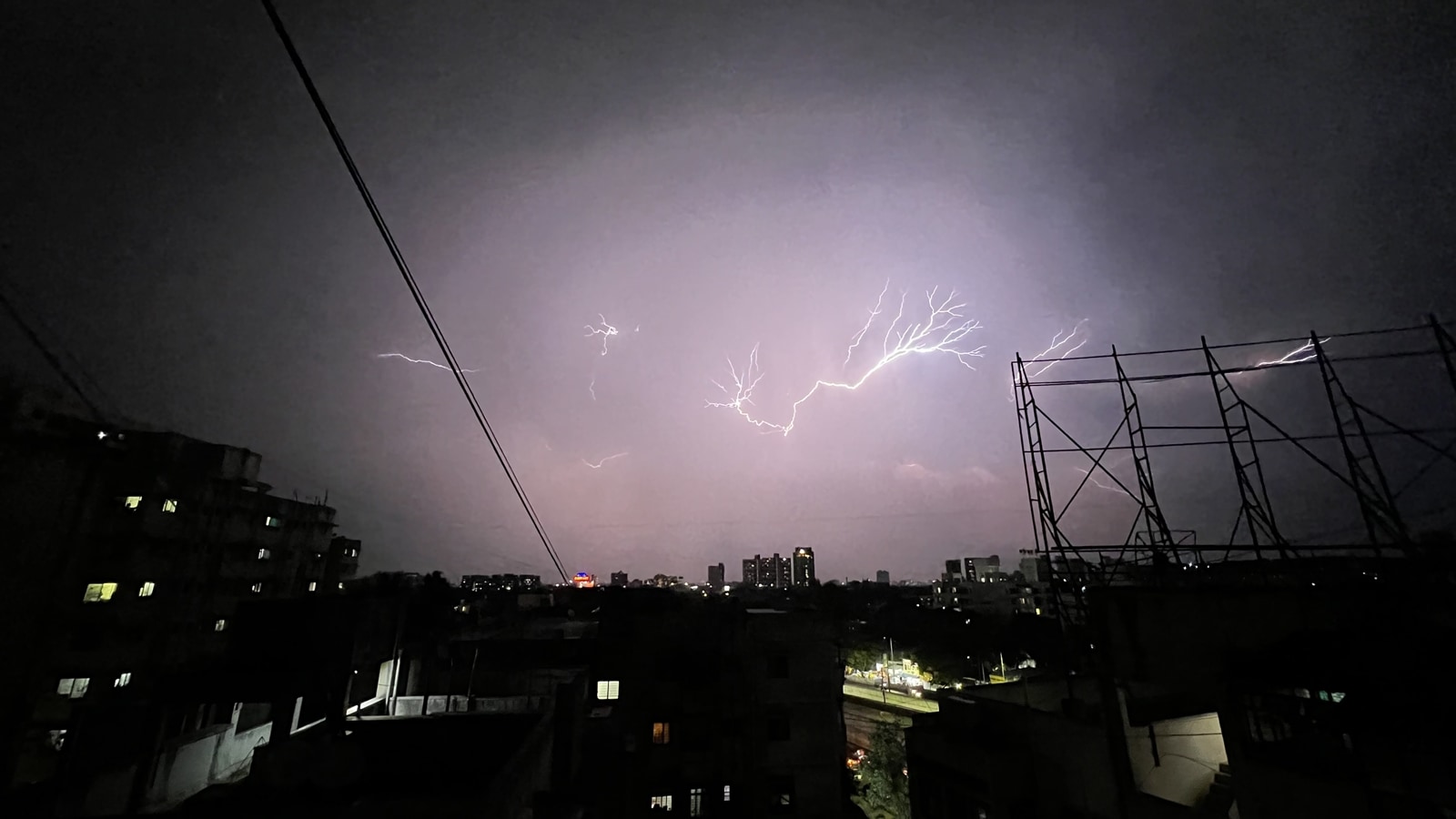 On an average, the world reports around 50 lightning flashes per second, each lasting for less than a second. (Express Photo by Pavan Khengre)
On December 1, Raju Jaibhai, a 28-year old farmer from the village of Gojegaon in Aundha (Nagnath) taluka in Hingoli district, rushed to cover his harvested kapas (seed cotton) from the untimely rains which started late at night. Jaibhai never came back home. “The next morning, his charred body was found near the tin shed on his field where he had kept his kapas–lightning had struck the shed and it seemed he must have died instantly,” said Sandeep Nagre, his cousin. Jaibhai was the sole breadwinner of his family and on his death he left behind a newly married wife, a handicapped brother and his widowed mother.
“The local weather station had pushed out a warning for rains and thunderstorms in Hingoli but he ignored it due to the fear of his crops getting destroyed, and that proved fatal,” said Nagre.
One of the most spectacular of atmospheric phenomena, lightning is also the cause of the largest number of deaths due to ‘Forces of Nature’ in India.
National Crime Records Bureau (NCRB)’s Crimes in India Report, 2022 shows that of the 8,060 deaths caused by forces of nature, 2,887 deaths were due to lightning–which accounts for 35.8 per cent of the deaths. Death by lightning is far higher than deaths in torrential rains and landslides (358 deaths). In sheer numbers, Madhya Pradesh has the highest number of deaths (496) followed by Bihar (329) Maharashtra (239) and other states. In fact, for the NCRB’s report goes on to say lightning was the dominant cause of death due to forces of nature for Tamil Nadu ( 89 out of the 93 deaths), Chhattisgarh (210 of the 248), West Bengal (161 out of 195) and Karnataka (96 out of 140 deaths).
For meteorologists and physicists, the atmospheric phenomenon called lightning involves electric discharge of high voltage between cloud and ground or between clouds themselves, accompanied by a bright flash and often thunder-lightning. On an average, the world reports around 50 lightning flashes per second, each lasting for less than a second. Across the world, lightning is a major cause of concern, given the extremely high fatality. The genesis of this atmospheric phenomenon is the moisture-laden clouds around 1-2 km from the surface of the Earth. Due to the potential difference between the upper and middle sections of the cloud, electric current starts flowing in the cloud. Earth is a good conductor of electricity, but tends to be electrically neutral. However, it is positively charged as compared to the mid-section of the cloud and this potential gradient is responsible for flowing of around 20-25 per cent of the current flowing towards the Earth. It is this current flow, which is in common parlance is called a lighting strike, that causes extensive damage to life and livelihood.
But the exceptionally high number of deaths due to lightning, KM Hosalikar, head, Climate Research and Service of Indian Meteorological Department (IMD) explained, was due to a variety of reasons. “Studies have shown that while North East India reports the maximum number of lightning strikes, most of the deaths were reported from Central India. This is because of the timing of the event,” he said. Most of the lightnings in North East India, he said, were reported during the early mornings, while in Central India it occurred in the afternoon. “Unfortunately, afternoons are peak work time for farm-related work and they are caught unawares,” he said.
Hosalikar went on to explain how most lightning strikes are accompanied by thunderstorms. “Often people try to shelter under trees or small structures on fields. Lightning always falls on the tallest structure and thus those who are sheltering under such structures fall victim,” he said.
What Hosalikar said resonates in the death of Sudhir Bidkar (36), a farmer from Dhanora village in Morshi taluka of Amravati district who died of lightning on October 26. His brother Kalidas said his brother was busy working on the fields and had taken shelter under a tree when he was struck. “There was no way he could have survived– he died on the spot,” sighed Kalidas.
On its part, the Ministry of Earth Sciences , IMD and the Pune-based Indian Institute of Tropical Meteorology (IITM) have been working on ways to reduce deaths due to lightning. One such initiative is the Damini App which sends out warnings before lightning. But unlike floods or torrential rains, the lead time–the time before the occurrence of an event– is around 30-40 minutes. This, experts said, was not enough for people to take suitable measures. Hosalikar talks about installation of lightning catchers and increased awareness to bring down the deaths. “Lightning always aims for the tallest object. Thus, on fields we should have structures which can attract lightning. Awareness about lightning and measures to be taken to avoid them should also be taken,” said Hosalikar.
For the families of Bidkar and Jaibhai, such installations would come too late. But maybe the lives of many others could still be saved.