4 min read
Stay updated with the latest - Click here to follow us on Instagram

Journalism of Courage



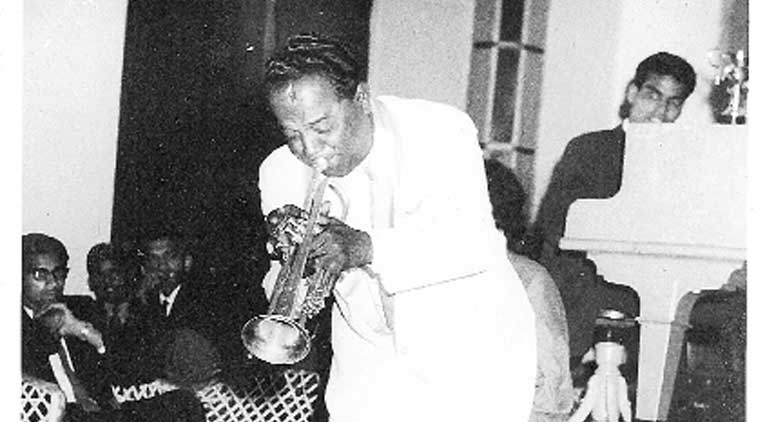
On the cover of an album named Jazzmine, an excited Pt Ravi Shankar in his 30s is cajoling an invisible piano, an instrument one has never really seen the sitar maestro play, while trumpet player Frank Fernand is seen embracing Anandji — one half of the Bollywood composer duo Kalyanji-Anandji. Soon enough, we spot the famous Goa-based trumpeter Antonio Vaz aka Chic Chocolate, bent forward on his trumpet, the muscles in his face contorted, working up those lungs. This, in the ideal jazz world, would have been followed by his raspy voice, the one that made him the Louis Armstrong of India. At the art gallery in India International Centre, all these legends of jazz have come together on huge panels with text woven in for context.
Among all the polyrhyth-ms, melodies and harmonies, there was one ardent jazz fan named Niranjan Jhaveri. His passion for American jazz had him invite some of the finest artistes to the country and nurture the ones in India. Jhaveri wrote and published extensive jazz appreciation and criticism before combining forces with a young lawyer Soli Sorabjee and businessman Jehangir Dalal to organise “Jazz Yatras” across the country. Along the way Jhaveri’s collection of records, autographed phonodiscs, photographs, album covers, photographs and pamphlets kept growing, all of which was lying in boxes in his Mumbai house. It was later voluntarily given away by his family to AIIS Archives for Research and Ethnomusicology in Delhi earlier this year. The 70 boxes resulted in “Jazz in India”, an exhibition produced by Shubha Chaudhuri, Associate Director General of American Institute of Indian Studies (AIIS) and curated by journalist and author Naresh Fernandes. Fernandes’ research material for his book Taj Mahal Foxtrot (Roli Books, Rs 1,495) is also a part of the collection.
“It was a really large collection and the Jhaveri family was keen that it gets out. What took time was the process of digitisation over the last three months. Most things were moulding away because of humidity in Mumbai. Apart from photographs, we had almost 1,000 audio recordings out of which 600 have been made available at the kiosks located at the exhibition,” says Chaudhuri.
The exhibition is a peep into the jazz age of India. Apart from audio tracks of many artistes such as Asha Puthali, the exhibition demonstrates a sort of jazz revolution in India, mostly in Bombay. It’s hard to miss over 30 Mario Miranda drawings, the ones created when the cartoonist would sit in the front row of jazz concerts.
The story of jazz may have been born in New Orleans but it travelled far and wide through the length and breadth of Mississippi and finally reached the shores of Bombay. Not even in his wildest of the dreams had pianist Teddy Weatherford — the one “whose arms stretched so wide across the keyboard, he was called a seagull” — thought that after playing alongside a legend like Armstrong, he would make India his home and give its people a form of discipline and improvisation that they would fall in love with. Jazz was sexy, complex and closest to Indian classical music. Fernandes says, “People knew the tunes, even if they didn’t know what was the genre called. Songs with jazz influences — Eena meena deeka and Chinchinchoo — were playing at nightclubs. Jazz was music that people all over the world were listening to at the same time, thanks to the advent of the gramophone. Also, there were cantonments. So you would have a jazz band in the middle of Bihar. It was everywhere. It was world pop,”
The exhibition is on at IIC till November 30. Contact: 24619431
Stay updated with the latest - Click here to follow us on Instagram