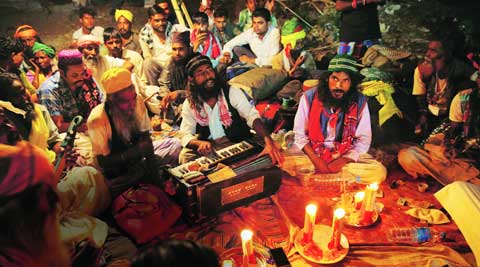
For the niche crowd that reggae draws in Delhi, Zorawar Shukla and his bandmates are stars.
You don’t go to a Reggae Rajahs show for a quiet evening. With them, you punch the air, thump the floorboards and shake every muscle to Caribbean beats. For the niche crowd that reggae draws in Delhi, Zorawar Shukla and his bandmates are stars. It is less known that Shukla — called Mr Herbalist in the band — is also a filmmaker, who has worked on Midnight’s Children with Deepa Mehta, and an anthropology enthusiast with a stint at the Smithsonian in Washington DC under his belt. Both these interests converged in 2012 in a short film titled A Prayer for Aliyah, about a tribal community in the Northeast that claims to be the lost tribe of Israel. This year, Shukla will release his second film, Sulh-e-Kul (Peace to All), an exploration of Khwaja Moinuddin Chishti’s dargah at Ajmer Sharif.
“The two films are about communities with immense belief in a higher power, whether it is the Manipuri Jews who practise orthodox Judaism or the thousands of people who live around Khwaja Gharib Nawaz and Ajmer Sharif,” says Shukla. Sulh-e-Kul was commissioned by the Public Service Broadcasting Trust, a Delhi-based organisation that had also produced A Prayer for Aliyah.
Though the dargah is one of the most visited shrines in India, its history and sociocultural impact are largely unknown. The 49-minute film sets off to cover these points by taking the viewer to Ajmer Sharif, literally.
Sulh-e-Kul begins with a ritual journey called Chhariyon ka mela, which is made by the faithful on foot, from Bilaspur in Haryana, 350 km or 13 days away. While the pilgrims travel, the film unspools a number of narratives using expert interviews, maps, paintings and enacted scenes. It traces the life of Khwaja Moinuddin Chishti from his birth and loss of his parents, and gives a glimpse of the Hindustan of his time as a feudal society with a deep economic divide and rigid caste system (“He gave those who had no position in society a chance to feel human,” says Salman Chisty, Shrine Custodian, in the film).
Religion and commerce entwine in a series of shots of business establishments called KGN Sweets, Gharib Nawaz Restaurant, KGN Kulfi Centre and Gharib Nawaz Meat Shop while interviews with foreigners indicate how passion can blur national and cultural borders. The film also highlights the importance of the langar that has been prepared for the last 800 years. “I learnt a lot about Khwaja Sahib and Sufism in South Asia. The most interesting fact I found out during my research was that not a single thing had been recorded about Khwaja Sahib for more than 200 years after he died. Whatever we know about him is from secondary sources, adding to the mystical aura around him and the place,” says Shukla.
Weaving the strands together is the music, from the azaan and the Chhariyon ka mela chants to the high-decibel songs of pilgrims walking from Bangladesh, and the heady qawwali at the shrine. “For me, spiritual music is the original trance music. There are no two ways about it. While I had heard plenty of bhajans, chants and qawwali before, it never touched me as deeply as during this shoot. I realised that the environment has a huge effect on the impact music can have. Listening to spiritual music in a posh Delhi auditorium is not the same as experiencing it in its natural environment,” says Shukla, whose travelled with four crew members and used DSLR cameras that are not intrusive.
Five years ago, Shukla had visited the dargah for the first time “for no reason, just to see what it was all about” and had come away unimpressed. As he worked on the film, however, Shukla found himself captivated. “My journey with the fakirs from Delhi to Ajmer was life-altering,” he says. Sulh-e-Kul attempts to capture that magic.
Dipanita Nath is a Senior Assistant Editor at The Indian Express, based in Pune. She is a versatile journalist with a deep interest in the intersection of culture, sustainability, and urban life.
Professional Background
Experience: Before joining The Indian Express, she worked with other major news organizations including Hindustan Times, The Times of India, and Mint.
Core Specializations: She is widely recognized for her coverage of the climate crisis, theatre and performing arts, heritage conservation, and the startup ecosystem (often through her "Pune Inc" series).
Storytelling Focus: Her work often unearths "hidden stories" of Pune—focusing on historical institutes, local traditions, and the personal journeys of social innovators.
Recent Notable Articles (December 2025)
Her recent reporting highlights Pune’s cultural pulse and the environmental challenges facing the city during the winter season:
1. Climate & Environment
"Pune shivers on coldest morning of the season; minimum temperature plunges to 6.9°C" (Dec 20, 2025): Reporting on the record-breaking cold wave in Pune and the IMD's forecast for the week.
"How a heritage tree-mapping event at Ganeshkhind Garden highlights rising interest in Pune’s green legacy" (Dec 20, 2025): Covering a citizen-led initiative where Gen Z and millennials gathered to document and protect ancient trees at a Biodiversity Heritage Site.
"Right to breathe: Landmark NGT order directs PMC to frame norms for pollution from construction sites" (Dec 8, 2025): Reporting on a significant legal victory for residents fighting dust and air pollution in urban neighborhoods like Baner.
2. "Hidden Stories" & Heritage
"Inside Pune library that’s nourished minds of entrepreneurs for 17 years" (Dec 21, 2025): A feature on the Venture Center Library, detailing how a collection of 3,500 specialized books helps tech startups navigate the product life cycle.
"Before he died, Ram Sutar gave Pune a lasting gift" (Dec 18, 2025): A tribute to the legendary sculptor Ram Sutar (creator of the Statue of Unity), focusing on his local works like the Chhatrapati Shivaji statue at Pune airport.
"The Pune institute where MA Jinnah was once chief guest" (Dec 6, 2025): An archival exploration of the College of Agriculture, established in 1907, and its historical role in India's freedom struggle.
3. Arts, Theatre & "Pune Inc"
"Satyajit Ray, Ritwik Ghatak were not rivals but close friends, says veteran filmmaker" (Dec 17, 2025): A deep-dive interview ahead of the Pune International Film Festival (PIFF) exploring the camaraderie between legends of Indian cinema.
"Meet the Pune entrepreneur helping women build and scale businesses" (Dec 16, 2025): Part of her "Pune Inc" series, profiling Nikita Vora’s efforts to empower female-led startups.
"How women drone pilots in rural Maharashtra are cultivating a green habit" (Dec 12, 2025): Exploring how technology is being used by women in agriculture to reduce chemical use and labor.
Signature Style
Dipanita Nath is known for intellectual curiosity and a narrative-driven approach. Whether she is writing about a 110-year-old eatery or the intricacies of the climate crisis, she focuses on the human element and the historical context. Her columns are often a blend of reportage and cultural commentary, making them a staple for readers interested in the "soul" of Pune.
X (Twitter): @dipanitanath ... Read More


 4 min read


 For the niche crowd that reggae draws in Delhi, Zorawar Shukla and his bandmates are stars.