5 min read
Stay updated with the latest - Click here to follow us on Instagram

Journalism of Courage



 The hospital was inaugurated on the anniversary of the viceroyalty of Gilbert John Elliot-Murray-Kynynmound, the fourth Earl of Minto who consented to have the hospital named in his honour. (Express Photo by Jithendra M.)
 “The ‘Victoria Hospital’ with which my mother’s name will always be associated is an institution which we are all justly proud and is a splendid monument in memory of the great Queen Empress, whose name it bears, but there are branches of the healing art which cannot be properly studied or developed without special hospitals of their own, and foremost among them is the branch of Ophthalmic Medicine and Surgery, and I am glad that it has been possible for my Government by sanctioning the erection of a new Eye Hospital.”
These were some of the words spoken by Krishnaraja Wodeyar, the Maharaja of Mysore, on December 17, 1910, as he laid the foundation stone of an institution in Bengaluru that continues to function till date – the Minto Ophthalmic Hospital.
The hospital itself was inaugurated on the anniversary of the viceroyalty of Gilbert John Elliot-Murray-Kynynmound, the fourth Earl of Minto who consented to have the hospital named in his honour. A photograph of him from the time remains just at the entrance of the hospital. The Lord and Lady Minto seem to have been well-known to the Maharaja, having paid a visit to him in Mysore two years earlier.
 Facilities of the Minto Hospital were pressed into service to help deal with the Covid pandemic more recently. (Express Photo by Jithendra M.)
However, the history of the hospital begins in the late 1800s. According to Bangalore historian Arun Prasad, with the increasing population of Bengaluru, after it became a cantonment, dispensaries started coming up to manage the health needs of the people. Larger and more specialised institutions, including a lunatic asylum, started showing up.
The predecessor of Minto hospital was a small eye dispensary in 1896 in the crowded Chickpete area, headed by Dr Ramaswamy Iyengar, whose portrait hangs near the entrance to this day with the other heads. Though the facility started off modestly with nine patients on the first day, it soon became apparent that more space was required. Within a few months, a shift was made to a 16-bed facility in the vicinity of Lal Bagh that was later enlarged as the Lalbagh lodge. The building also served as a hub for the treatment of plague victims in 1898. In that sense, history has since repeated itself, as facilities of the Minto Hospital were pressed into service to help deal with the Covid pandemic more recently.
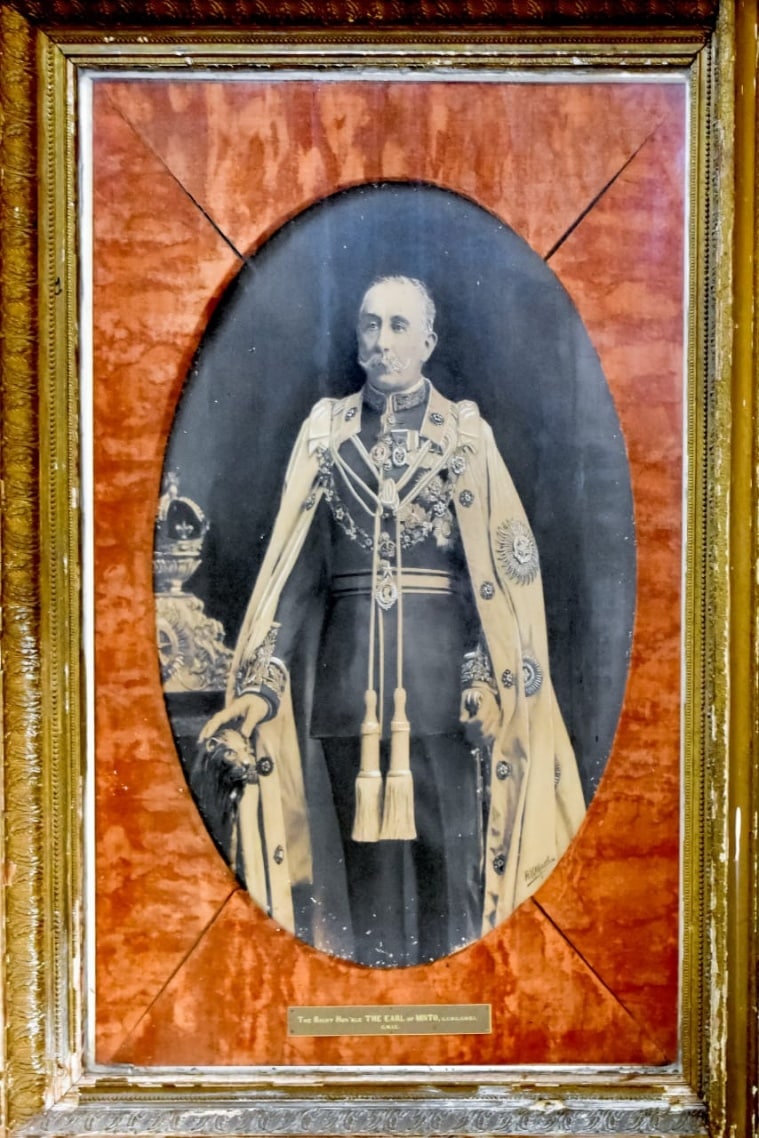 The hospital itself was inaugurated on the anniversary of the viceroyalty of Gilbert John Elliot-Murray-Kynynmound, the fourth Earl of Minto who consented to have the hospital named in his honour. A photograph of him from the time remains just at the entrance of the hospital. (Express Photo by Jithendra M.)
The plague seemingly added a new importance to medical institutions, such as the Victoria Hospital, which came up in 1901, as well as the Minto Hospital. By 1923, a children’s ward had also been added.
As such, the Minto Ophthalmic Hospital is one of the oldest such institutions in India. It is however predated by the Egmore Eye Hospital, which was itself founded in 1819, only 15 years after the establishment of the world’s first eye hospital in Britain – Moorfields.
 “The main building has been maintained in the original condition without changes since its construction, apart from basic painting and renovations,” said a hospital official. (Express Photo by Jithendra M.)
The Minto Hospital is also fascinating from an architectural perspective. Unlike the familiar colonial Pompeian red, its grey facade is built from well-fitted granite blocks. Prasad says, “The building is one of the few remaining examples of Victorian architecture which remain in Bengaluru. Interestingly, the stones from the hospital are said to be taken from the demolished portions of the Bangalore fort.” Visitors may observe the prominent position of the royal Gandaberunda sigil on both sides of the entrance porch, just beneath the sloped roof. The sigil can be seen throughout the hospital, even on the surviving railings and window bars of the era.
 The Minto Hospital is also fascinating from an architectural perspective. Unlike the familiar colonial Pompeian red, its grey facade is built from well-fitted granite blocks. (Express Photo by Jithendra M.)
“The main building has been maintained in the original condition without changes since its construction, apart from basic painting and renovations,” said a hospital official.
In its continued service, the hospital has perhaps given truth to the Maharaja’s closing remarks at the foundation: “I earnestly hope that it may do a good and noble work in the cause of suffering humanity and prove a worthy memorial of a statesman whose name will long be remembered as a wise and far-seeing ruler and a true friend to India and her people.”
Stay updated with the latest - Click here to follow us on Instagram