Journalism of Courage



 Justice Das submitted his report to the government on March 5 after probing the projects taken up by the five departments between July 26, 2019 and March 31, 2023.
The Justice Nagamohan Das Commission has found that the ‘40 per cent commission’ allegation levelled by the Karnataka State Contractors’ Association (KSCA) during the previous BJP government in the state might not be “100 per cent true.”
The Commission flagged the 300 per cent increase in the value of tenders floated – worth Rs 1.5 lakh crore in 2022-23 – during the last year of the previous BJP government, and said the probe into public complaints into the tender process indicated corruption.
The one-man commission also flagged irregularities in the works and tenders floated by five key government departments probed by it.
A synopsis of the 20,000-page interim report of the Commission was accessed by The Indian Express.
“The allegations made by the contractors’ association might not be 100 per cent true. The association might have failed to prove its allegations. They might have been wary and anxious of being victimised. However, when public complaints were probed, the delay, violation of laws and nepotism before and after the tender process prima facie indicate corruption,” the commission said.
The one-man commission was set up by the Siddaramaiah government in August 2023 to probe the allegations of ‘40 per cent kickback’ and complaint of irregularities in works carried out by the Public Works, Water Resources, Urban Development, Rural Development and Panchayat Raj, and Minor Irrigation Departments.
Justice Das submitted his report to the government on March 5 after probing the projects taken up by the five departments between July 26, 2019 and March 31, 2023. The report was submited following scrutiny of tender documents and spot inspection of projects carried out during the previous BJP rule.
Last week, the Karnataka government set up a Special Investigation Team to probe the irregularities highlighted in the report.
During the period (July 26, 2019 to March 31, 2023), 4.7 lakh works were implemented by the five departments, of which 3.32 lakh works were completed. The Commission had selected 1,719 works for its probe.
Among its key findings was the massive spike in tenders in the 2022-23 fiscal, months before the BJP lost power to the Congress in Karnataka. The Justice Das Commission noted that while the five departments had invited tenders worth Rs 49,474 crore in the 2021-22 fiscal, the value increased to Rs 1,54,554 crore in the 2022-23 fiscal, “which was around 300 per cent more”.
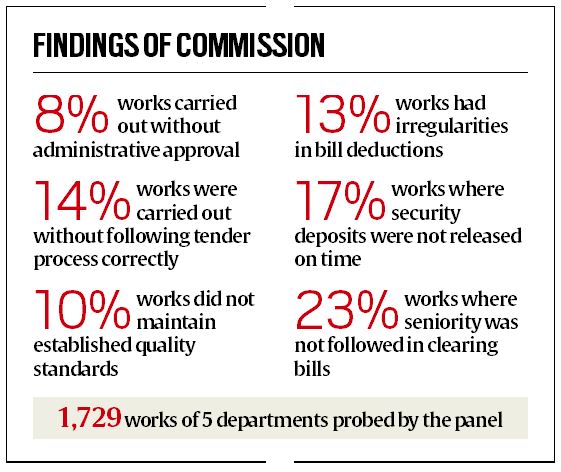
The commission found that eight per cent of the works were carried out without administrative approval; in 14 per cent of the projects, tender process was not followed correctly; 10 per cent of the works did not maintain established quality standards; 13 per cent of the works had irregularities in bill deductions; security deposits were not released on time in 17 per cent of the works; seniority was not followed in clearing bills, and payments were not made under correct account heads in 23 per cent of the works assessed.
In MNREGA, 12-14 per cent of the works were carried out without an action plan, administrative approval and technical approval, the report said.
The report has also flagged major irregularities in all works exceeding Rs 50 lakh assessed by it. Contrary to norms, only one to six per cent of the tenders awarded were uploaded in the state governments’ e-procurement portal.
The “40 percent commission” allegation by the KSCA had rocked the state during BJP rule. The Congress, then in the Opposition, had made it a campaign issue ahead of the Assembly elections in the state in 2023, accusing the then BJP government led by Basavaraj Bommai of widespread corruption in awarding tenders.
Recommendations
The commission has made several recommendations to the government. The Detailed Project Report prepared by private firms should undergo scrutiny at different levels by officials, it said. “If the cost of a project has a variation exceeding 15 per cent of the DPR, then the private company that prepared the DPR should be blacklisted,” the Commission recommended.
It also advised the government to ensure that the bills of works carried out are cleared compulsorily within 60 days as the Commission found that around 40 per cent of the bills for works completed took up to two years to be cleared.
The Defect Liability period should be set to three years, so that any shortcomings in the projects are addressed by the contractors themselves, Justice Das recommended.

 4 min read