8 min read

© The Indian Express Pvt Ltd



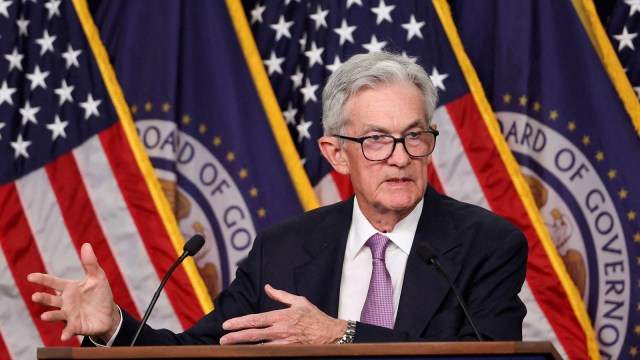 Powell said at Thursday’s briefing that it was too early to tell how the incoming administration's agenda might impact the US economy.
(Photo: Reuters)
Powell said at Thursday’s briefing that it was too early to tell how the incoming administration's agenda might impact the US economy.
(Photo: Reuters)The US Federal Reserve cut its benchmark interest rates by half a percentage point, its first interest rate cut since the early days of the Covid-19 outbreak. This was a bigger than expected cut that signalled the American central bank’s declaration of a victory over the inflationary surge that set in after the pandemic.
If the emergency rate reductions undertaken during Covid were to be discounted, the last time the FOMC or the Federal Open Market Committee – the American central bank’s rate setting panel — cut by half a percentage point was way back in 2008, during the global financial crisis.
This deep cut was in line with market expectations that had progressively shifted in favour of a half a point cut than the earlier expectation of a cut half that quantum. Wall Street rallied after the cut was announced, with Indian equities expected to take a cue.
“The US economy is in a good place and our decision today is designed to keep it there,” Fed chair Jerome Powell said at a press conference after announcing the decisions Wednesday.
“This recalibration of our policy stance will help maintain the strength of the economy and the labour market and will continue to enable further progress on inflation as we begin the process of moving towards a more neutral stance,” he said. Powell, however, underlined that the rates were not on a “preset” path and said that if inflation proved to be resilient, the central bank could “dial back policy restraint more slowly”. Also, he added that the Fed was ready to respond if the labour market weakened unexpectedly.
TEMPERING INFLATION
The US Fed’s modern statutory mandate, as prescribed in the 1977 amendment to the Federal Reserve Act, is to promote maximum employment and stable prices. These goals are commonly referred to as the American central bank’s dual mandate.
“The Committee has gained greater confidence that inflation is moving sustainably toward 2 per cent (inflation target), and judges that the risks to achieving its employment and inflation goals are roughly in balance,” the post-meeting statement said.
Significantly, the FOMC vote was 11-1, with Governor Michelle Bowman, who was formerly a state bank commissioner of Kansas before being sworn in governor, chose a quarter-point move. Bowman’s dissenting vote was the first by a US Fed governor since 2005, even as a number of regional presidents have cast dissenting votes during the period.
In addition to this latest cut, the committee indicated through its “dot plot” – that shows the 19 officials’ projections for the federal funds rate and gives investors a peek into the central bank’s expectations for the economy going forward – the possibility of 50 more basis points of cuts by the end of the year. The expectations pointed to another full percentage point in cuts by the end of 2025 and then a half point in 2026.
The European Central Bank, last week, had pruned its policy rate by 25 basis points to 3.50 per cent, close on the heels of a similar cut in June. The Bank of England, Norway’s Norges Bank and South Africa’s Reserve Bank are all slated to wrap up their central bank meetings Thursday. The Bank of Japan, which had surprised some market participants in July when it decided to hike borrowing costs, is set to announce its latest rate decision at the end of its two-day meeting Friday, bringing to an end what promises to be a busy week for central banks around the world. The Reserve Bank of India’s next MPC meeting is slated for early October (7-9).
MARKET EXPECTATION
The market expectation of the odds of a 50 basis-point cut by the Fed had sharply risen from last Friday’s 50 per cent to 57 per cent early this week, even as the probability of a 25 basis-point cut slid from 50 per cent to 43 per cent, according to futures contract data tracked by Chicago-based CME Group’s FedWatch Tool, a widely cited proxy for investor expectations. The CME group owns 27 per cent of S&P Dow Jones Indices.
The Fed took note of the fact that both the jobs picture and inflation in the US were softening. “Recent indicators suggest that economic activity has continued to expand at a solid pace. Job gains have slowed, and the unemployment rate has moved up but remains low. Inflation has made further progress toward the Committee’s 2 per cent objective but remains somewhat elevated,” the FOMC statement said after the two day meeting was wrapped up. It also asserted that “the Committee seeks to achieve maximum employment and inflation at the rate of 2 per cent over the longer run. The Committee has gained greater confidence that inflation is moving sustainably toward 2 per cent, and judges that the risks to achieving its employment and inflation goals are roughly in balance”. Going forward, it said the Committee “will continue to monitor the implications of incoming information for the economic outlook” and that its assessments “will take into account a wide range of information, including readings on labour market conditions, inflation pressures and inflation expectations, and financial and international developments”.
Prior to the cut, the Fed has kept its key lending rate at a two-decade high of 5.3 per cent since July last year, holding off on cuts that other central banks such as the ECB had already commenced months ago. Notably, the US has seen a recession – or a significant cooling of economic activity – after almost every time the Fed hiked interest rates in a sustained manner to control inflation. The expectation is that this time could well be different, with the possibility of a soft landing – the possibility of sustained high levels of inflation being brought down without setting off a recession – looks highly possible.
THE IMPACT
Like other central banks such as the RBI, as the US Fed conducts monetary policy, it influences employment and inflation primarily by using policy tools to control the availability and cost of credit in the economy. The Fed’s primary tool of monetary policy is the federal funds rate, changes in which influence other interest rates — which in turn influence borrowing costs for households and businesses, as well as broader financial conditions.
When interest rates go down in an economy, it becomes cheaper to borrow; so households are more inclined to buy more goods and services, and businesses have an incentive to borrow funds to expand operations, buy equipment or to invest in new projects. Improved demand for goods and services ends up pushing up wages, and helps rekindle the growth cycle. Even though the linkages of monetary policy to inflation and employment are not direct or immediate, monetary policy is a key factor in curbing runaway prices or stoking the growth impetus.
A cut in interest rates in the US could have a three-pronged impact. When the Fed cuts its policy rates, the difference between the interest rates of the two countries could widen, thus making countries such as India more attractive for the currency carry trade. The lower the rate in the US, the higher the arbitrage opportunity, till the time that the rate cut cycle starts in other economies as well.
A lower rate signal by the Fed would also mean a higher impetus to growth in the US, which could be yet positive news for global growth, especially when China is reeling under the impact of a real estate crisis and showing signs of slowing down. Lower returns in the US debt markets could also trigger a churn in emerging market equities, improving foreign investor enthusiasm. There is also a potential impact on currency markets, stemming from inflows of funds.
For the RBI, like other central banks, the likelihood of a future rate cut is somewhat predicated on the US Fed’s decision to cut rates. The RBI last cut the repo rate by 40 basis points to 4 per cent in May 2020 when the Covid pandemic raged across the country affecting the entire economy, leading to slowdown in demand, production cuts and job losses. Since then, the RBI has hiked the repo rate by 250 points to 6.5 per cent in order to tackle runaway inflation. The Indian central bank has a mandate to keep inflation at 4 per cent, with a cushion of 2 per cent on either side.
Indian markets, like markets elsewhere, opened strongly Thursday in the equities segment.