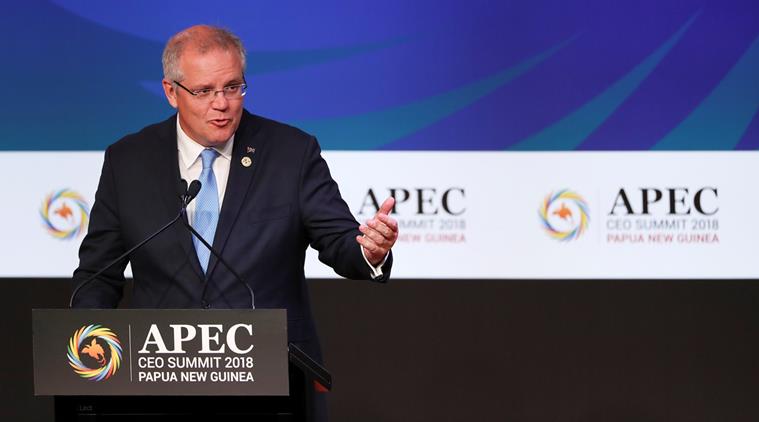
Prime Minister of Australia Scott Morrison reacts during the APEC CEO Summit 2018 at Port Moresby. (Reuters)
Australia and India are making “real progress” on the issue of uranium exports to India, Australia’s trade and investment minister Simon Birmingham has indicated.
This comes amid reports that two Australian companies BHP Billiton, the world’s biggest mining company, and Heathgate Resources, an affiliate of US company General Atomics, engaging with with the Department of Atomic Energy (DAE) for exporting uranium to India. Birmingham did not elaborate on the specifics of the case or the uranium vendors that are in the fray for potential supply contracts. “There has been real progress around this (on uranium) and we expect to make further progress,” Birmingham told a group of visiting Indian journalists.
According to a recent update on the issue readied by the DAE, a sales contract for enabling the transfer, which is part of the ongoing commercial negotiations between potential Australian uranium vendors and the DAE on fuel contracts for civil nuclear-power generation, is currently under discussion. Once the contract is wrapped up, Australian companies could potentially join utilities from four other countries that are already supplying nuclear fuel to India.
Incidentally, in July 2017, Australia had sent its first uranium shipment to India but that was “a small sample of uranium” transferred “purely for testing purposes”. Imported uranium from Australia, as and when despatches start, would be used to meet fuel requirements of Indian nuclear reactors that are under International Atomic Energy Agency (IAEA) safeguards, as is the case with fuel imports that have come in so far from Russia’s JSC TVEL Corp, Kazakhstan’s JSC NAC KazatomProm, France’s Areva and Canada’s Cameco.
In India, there are currently 22 reactors with an installed capacity of 6,780 MWe (mega watt electrical), of which, eight reactors with aggregate capacity of 2,400 MWe are fuelled by indigenous uranium while the remaining 14 with a capacity of 4,380 MWe are under IAEA Safeguards and qualify to use imported uranium.
A steady supply of uranium is positive news for the country’s nuclear power sector, something that is expected to boost the performance of Indian nuclear power plants, as well as of several fuel cycle facilities. Former Australian Prime Minister Tony Abbott had signed an agreement with Prime Minister Narendra Modi on civil nuclear cooperation in September 2014, clearing the way for uranium sales.
Ongoing discussions with Melbourne-based BHP and Adelaide-based Heathgate Resources are aimed at formalising commercial contracts to enable uranium shipments to India. Under the “separation plan” announced by the government in March 2006, negotiated after the July 2005 nuclear deal with the US, India was required to bring 14 reactors under IAEA safeguards in a phased manner. Thirteen of these reactors, including RAPS 2 to 6 at Rawatbhata, Rajasthan; KAPS 1 and 2 at Kakrapar, Gujarat; NAPS 1 and 2 at Narora, Uttar Pradesh; TAPS 1 and 2 at Tarapur, Maharashtra; Kudankulam 1 and 2 in Tamil Nadu; are already under IAEA safeguards, and eligible to run on
imported fuel.


 3 min read


 Prime Minister of Australia Scott Morrison reacts during the APEC CEO Summit 2018 at Port Moresby. (Reuters)