The American poet Emily Dickinson turned 195 this December. The celebrated author is one of the rare icons from the world of literature whose punctuation has a fan base. Most literary anniversaries invite reflections on themes, influence, maybe a new biography. Dickinson’s inspires a reconsideration of a contentious horizontal line.
The dash—her dash—continues to make trouble. Scholars study it, and editors accommodate it. Writers borrow it with the slightly embarrassed enthusiasm of people caught imitating a friend’s impeccable handwriting. And language models, those hoarders of textual habits, scatter it across their sentences, turning the layman ‘Dickinson’.

It is tempting to treat the dash as a quirk of Dickinson’s temperament, something like her preference for white clothing or a reluctance to leave the house. Yet in Inflections of the Pen: Dash and Voice in Emily Dickinson, Paul Crumbley makes clear that the dash in her manuscripts forms an entire ecosystem of marks—different lengths, different angles, and different attitudes toward the line of text they interrupt.
The poems, viewed in this light, resemble orchestral scores where each dash signals a shift in timbre or a new voice entering from the wings.
‘Doppelgänger’ of the punctuation world
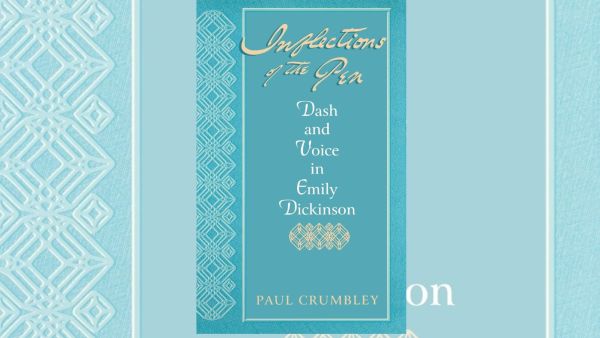
Inflections of the Pen: Dash and Voice in Emily Dickinson by Paul Crumbley.
Meanwhile, in Adam O’Fallon Price’s meditation on the em dash’s charms, the mark appears as punctuation’s great impersonator. It can pose as a comma, imitate a colon, step in for a parenthesis, and still manage to feel superior to all three. Price describes it as the “doppelgänger” of the punctuation world—able to mimic nearly anything but reluctant to commit to any single identity. Nabokov used it as a hinge, Antrim as a tremor.
Dickinson’s use is different, more architectural. Her dashes allow the poem to pause without losing altitude. They let the speaker reconsider the very sentence she is in. Remove the dashes, as early editors routinely did, and the poems flatten into something tidier, calmer, unsuitable for the person who wrote them. Insert them and the poems breathe again. The mind appears at work rather than simply displaying its results.
The em dash’s contemporary prominence owes something to digital writing, where attention spans and sentence structures share a fondness for detours. Kate Mooney, writing for The New Yorker, has observed its ubiquity across texts, tweets, articles, flirtations, and the occasional resignation letter.
Story continues below this ad
The Em dash divides
The mark has become a conversational gesture, an invitation to lean in slightly.
And then there is the influence of AI. Large language models, trained on oceans of prose, have absorbed our collective affection for the dash and now reproduce it indiscriminately. Users, encountering these habits repeatedly, start to adopt them too. The dash, once a sign of Dickinson’s defiance, now is being used ubiquitously.
What would Dickinson make of this? She might recognise a familiar pattern, a mark whose meaning comes alive through use, mis-use, overuse, and the uneasy sensation that language, once released, develops a life that bears only a loose relation to its origins.
At 195, she continues to alter the way sentences behave. Her poems remind us that punctuation is the system through which writing acknowledges second thoughts, alternate routes, and the possibility that the mind has more to say than the sentence can immediately bear. The dash is the gesture of a poet who understood that meaning moves sideways as often as it moves forward.
Story continues below this ad
It remains her most enduring signature. The line that interrupts, glints, waits.


 4 min read


 Inflections of the Pen: Dash and Voice in Emily Dickinson by Paul Crumbley.