Premium
This is an archive article published on February 10, 2022

Amarinder Singh interview: ‘Aligning with BJP is good for Punjab. We can’t function without a national party’

Amarinder Singh, 79, who shrugged off accusations of being inaccessible all through his term as CM is now on the road every day, meeting people and addressing concerns.

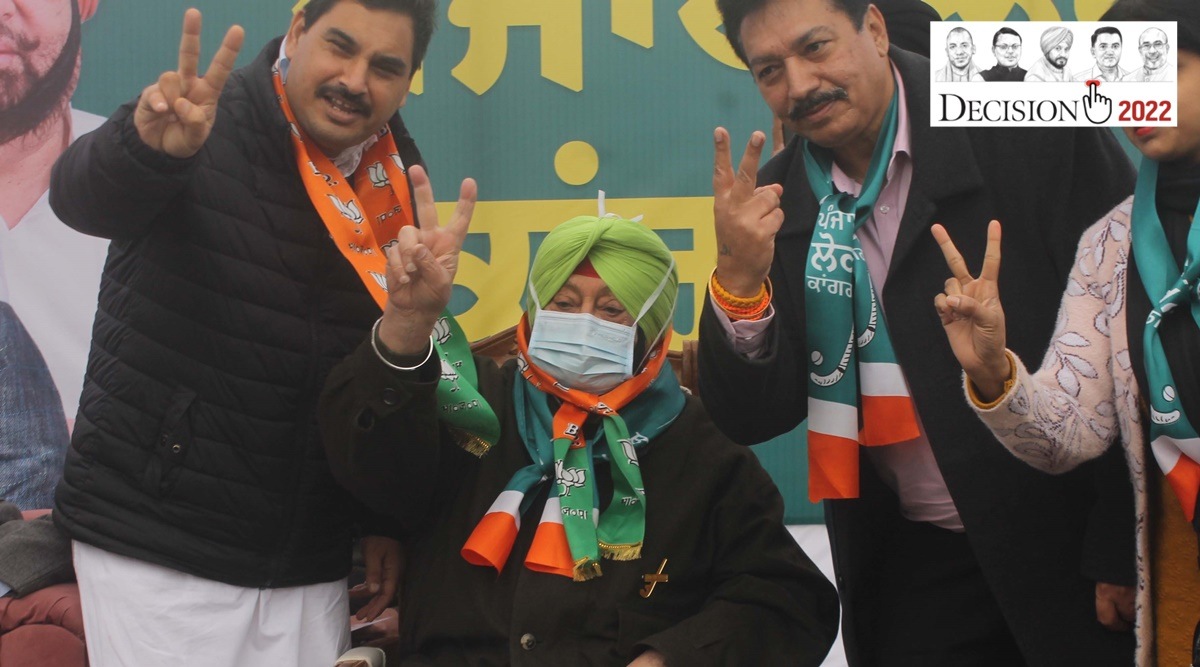
Former Punjab chief minister and PLC candidate from Patiala constituency, Capt. Amarinder Singh along with other party  workers during a campaign rally ahead of the upcoming Punjab Assembly Elections, in Patiala. (Express photo by Harmeet Sodhi)Former Punjab chief minister and PLC candidate from Patiala constituency, Capt. Amarinder Singh along with other party workers during a campaign rally ahead of the upcoming Punjab Assembly Elections, in Patiala. (Express photo by Harmeet Sodhi)

The stakes couldn’t be greater for Amarinder Singh, who walked out of the Congress fighting to stay on as Chief Minister, and must shoulder in the coming polls both his fledgling outfit and his new-found alliance with the BJP. The 79-year-old who shrugged off accusations of being inaccessible all through his term as CM is now on the road every day, meeting people and addressing concerns, till well past midnight. He speaks to Manraj Grewal Sharma at his sprawling Moti Bagh Palace in Patiala on a lunch break amidst one such hectic schedule:

What are the prospects of the alliance between the BJP and your party, the Punjab Lok Congress?

I am getting a very good response, last night I thought people would break the stage (such was the rush). There is a latent swing towards the BJP in Punjab thanks to welfare schemes such as Ujjwala, distribution of free ration, and other subsidies due to which the poor get Rs 2,000 a month. People often tell my daughter, who is going door-to-door, that ‘Vote Modi ko hi daalenge (We will vote only for Modi)’. I also did a lot for the poor during my tenure with the lal dora and basera projects for housing. Besides, I gave health insurance of Rs 5 lakh which allows every Punjabi the liberty of treatment at any private hospital.

Why did you choose the BJP?

Aligning with the BJP is good for Punjab. We can’t function without a national party. Without Central funds, we won’t even have the money to pay salaries. The BJP is being very good to me. I have had no trouble with them and the minister in-charge of Punjab, Gajendra Shekhawat, is open to everything. Also, remember, when I was elected Congress MP in 1980, my mother was the Rajya Sabha MP from the BJP.

What do you think of AAP?

I still don’t know whether it’s a political party or a movement. I know people are saying they want a change from traditional parties, but they said it last time too. Pollsters had predicted 100-plus seats for them yet they could get only 20. I don’t think they will do any better this time. SSM (Sanyukt Samaj Manch), the farmers’ party, will further dent their prospects. Let’s see where the Dera Sacha Sauda people go, they have many small farmers with them.

You said the Centre has all the financial powers. Whose fault is it?

Our Constitution has given us a federal structure, but everything has been centralised. The government of India has taken away all our powers, one by one. BJP to abhi aayi hai (The BJP has come only recently), all the centralisation was done by the Congress. The GST was the brainchild of former Prime Minister Manmohan Singh. It’s not shared equitably.

If the Congress comes to power in Punjab, and Charanjit Channi is the CM, will the Modi government treat the state differently?

I don’t think so. When we were in the Opposition and then PM Manmohan Singh was giving everything to the Akalis, I told him, ‘What are you doing, they are our opponents’. He said, ‘When I am in the chair, I am the PM of India’.

You keep expressing serious security concerns about the state.

I am concerned about the complete inundation by drones from across the border. China hooking up with Pakistan, and Afghanistan also coming into the picture, does not bode well for the state. Be it the military, Air Force or Navy, we are way behind them in weaponry, and this is Antony’s (former Defence Minister A K Antony) doing. For 10 years of Congress rule, he did nothing, at least these guys (the BJP) are buying weapon systems.

Story continues below this ad

Do you see any polarisation on the basis of caste and religion in the state?

This is utter nonsense. Seventy years on, we have started talking in terms of caste and religion. Why talk about Channi’s caste, merit alone should matter. Why try to polarise the community? I remember when I joined the NDA in 1959, and was asked to fill up the column on caste, I didn’t know what to write. ‘You foolish boy, write home and find out your caste,’ the instructor admonished me. By focusing on caste, ye mulk ko kharaab kar rahe hain (they are destroying the country).

I have never had any issue with any religion. In 1947, 40% of Patiala was Muslim. The chief minister of Pakistan Punjab was from Patiala and I had good relations with him. I have nominated two Muslim candidates, from Amargarh and Malerkotla. Punjab has seen a steep growth in the population of both Muslims and Christians. Earlier, the former had only two mohallas in Patiala, now they are spread all over.

Christianity is also spreading rapidly. In the previous Census, Christians and Muslims were each less than 2% of the population, their numbers must have doubled by now.

What are the poll issues? And why doesn’t climate change figure anywhere?

Jobs are the biggest issue here, though in the last four-and-a-half years, I created 22 lakh jobs through employment fairs. As for climate change, when my father built this palace, the water was at 40 feet depth, now it’s at 400 feet. During the farm agitation, I wrote to the PM, saying if you give me Rs 1 lakh crore over the next four years, I will invest Rs 25 lakh crore a year and make farmers switch from the water-guzzling paddy to lentils and pulses. This will save the country the expense of importing lentils worth Rs 2,50,000 crore every year. I believe he is looking at it.

Story continues below this ad

Looking back, how do you view your exit from the Congress?

I feel liberated. There is nothing holding me back. If I make a mistake, it is mine. But what rankles is that Mrs Gandhi knew me from the time she got married, Rajiv was my junior at Doon School, Priyanka and Rahul are like my kids, this could have been handled better.

Did the rift flow from a generational shift?

When Rahul Gandhi lost (the 2019 general elections), he asked us at the CEC meeting, ‘Which one of you supported me?’, and only a few raised their hands. He was upset that we did not amplify his ‘Chowkidar chor hai’ slogan. Priyanka Gandhi was always pushing for (Navjot) Sidhu. And since he had access to the family, other Congress leaders in the state ganged up behind him. I was their father’s generation, they didn’t know how to deal with me.

You have always positioned yourself as the saviour of Punjab, ready to take on your own government at the Centre on the issue of SYL canal.

I was ordered by PM Manmohan Singh on July 10, 2004, a Friday, that by Wednesday you have to hand over the SYL canal to the CPWD. I told my then irrigation secretary K R Lakhanpal that let’s go and visit Fali Nariman, a leading lawyer, in Delhi. Nariman said the only way out is to annul the treaty retrospectively.

I called my Cabinet at 10 am on Monday and Badal (Parkash Singh) at 11, and they agreed to my plan. I moved the Bill at 12 and it was passed at once. Then I went to the governor, Justice O P Verma, and he signed it, thinking that I must have got it cleared from the Centre. The next day I was summoned by the PM, who asked how could I do it. I said, it’s my state, my waters. Mrs Gandhi did not meet me for six months after this. But I told the PM that I was elected to safeguard the interests of the state and that is what I did.

Manraj Grewal Sharma is a senior journalist and the Resident Editor of The Indian Express in Chandigarh, where she leads the newspaper’s coverage of north India’s most politically and institutionally significant regions. From Punjab and Haryana to Himachal Pradesh and the Union Territory of Chandigarh, she oversees reporting at the intersection of governance, law, politics and society. She also reports on the diaspora, especially in Canada and the US. With a career spanning journalism across several countries, academia and international development, Manraj brings a rare depth of perspective to regional reporting. She is widely regarded as a leading chronicler of Punjab’s contemporary history and socio-political evolution, particularly its long shadow of militancy, federal tensions and identity politics. Her book, Dreams after Darkness, remains a definitive account of the militancy years and their enduring aftermath. Professional Background & Expertise A gold medalist in mass communication and a post-graduate in English literature, Manraj has a multifaceted career spanning journalism, academia, and international development. She was also awarded a fellowship by National Foundation of India and did several in-depth pieces on Manipur. Internationally, she has reported from Israel, US, UK, Myanmar, and Mauritius Her key focus areas include: Regional Politics, History, Agriculture, Diaspora, and Security. Of late, she has started focusing on Legal & Judicial Affairs: Much of her recent work involves reporting on high-stakes cases in the Punjab and Haryana High Court, ranging from environmental policy to civil rights. International Consulting: She previously served as a consulting editor for the Asia Pacific Adaptation Network and a publishing consultant for the Asian Development Bank (ADB) in Manila. Academia: For five years, she was the managing editor of Gender, Technology and Development, a peer-reviewed international journal at the Asian Institute of Technology, Bangkok. Recent Notable Articles (Late 2025) Her recent reportage focuses heavily on judicial interventions and regional governance: 1. Environment & Governance "‘NGT can’t test legality of policy’: HC hears challenge to Punjab’s ‘Green Habitat’ plan" (Dec 22, 2025): Covering a critical legal battle over whether the National Green Tribunal has the authority to strike down a state policy regularizing farmhouses on delisted forest land. "High court pulls up Punjab poll panel over audio clip probe" (Dec 10, 2025): Reporting on judicial concerns regarding the transparency and fairness of local body elections. 2. Legal Rights & Social Welfare "HC issues notice to Punjab, Haryana over delay in building old age homes" (Dec 22, 2025): Reporting on a contempt petition against top officials for failing to establish government-run homes for the elderly as promised in 2019. "Victims can appeal acquittals in sessions court without seeking special leave" (Dec 19, 2025): Highlighting a significant procedural shift in criminal law following a Supreme Court ruling. "HC upholds benefits for Punjab FCI officer acquitted in 20-year-old bribery case" (Dec 19, 2025): A report on the concept of "honourable acquittal" and its impact on employee benefits. 3. Human Rights & Identity "As Punjab denies parole to MP Amritpal Singh, HC asks it to submit ‘foundational material’" (Dec 1, 2025): Covering the legal proceedings regarding the radical preacher and sitting MP's request to attend Parliament. "Protecting life paramount: HC backs Muslim woman in live-in after verbal divorce" (Nov 6, 2025): Analyzing judicial protections for personal liberty in the context of traditional practices. Signature Beats Manraj is recognized for her ability to decode complex judicial rulings and relate them to the everyday lives of citizens. Whether it is a 30-year-old land battle in Fazilka or the political implications of Kangana Ranaut’s candidacy in Mandi, her writing provides deep historical and regional context. Contact @grewal_sharma on X manrajgrewalsharma on Instagram ... Read More

 

Latest Comment
Post Comment
Read Comments
Advertisement
Advertisement
Advertisement
Advertisement