9 min read
Stay updated with the latest - Click here to follow us on Instagram
© IE Online Media Services Pvt Ltd



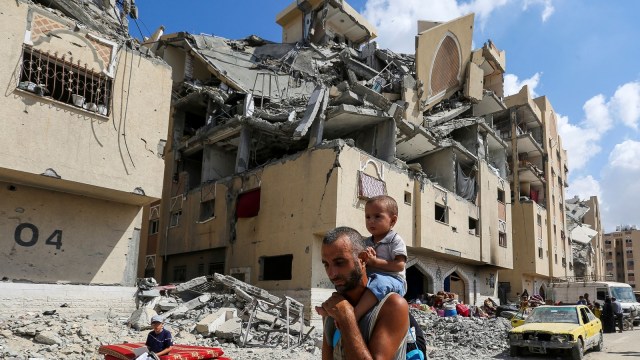 Displaced Palestinians make their way as they flee Hamad City following an Israeli evacuation order, amid Israel-Hamas conflict, in Khan Younis in the southern Gaza Strip August 11, 2024. (Photo: Reuters)
Leaders of France, Germany and Britain, in a joint statement Monday, endorsed the latest push by mediators United States, Qatar and Egypt to settle an agreement ending the ten-month long war between Israel and Hamas, news agency AP reported. They also called for the return of scores of hostages held by Hamas and the “unfettered” delivery of humanitarian aid to the survivors, the report stated.
US, Qatar and Egypt have spent months trying to get the two sides agree to a three-phase plan where Hamas would release the remaining hostages captured in its October 7 attack in exchange for Palestinians imprisoned by Israel, along with the withdrawal of Israel from Gaza.
Last week, leaders of the US, Egypt and Qatar urged Israel and Hamas to meet for negotiations on August 15 in either Cairo or Doha to finalize a Gaza ceasefire and hostage-release deal, news agency Reuters reported. The joint statement, signed by French President Emmanuel Macron, German Chancellor Olaf Scholz and British Prime Minister Keir Starmer, also called on Iran and its allies to refrain from any retaliatory attacks that would escalate regional tensions.
Prime Minister @Keir_Starmer issued a joint statement along with the leaders of the United States, France, Germany, and Italy on the situation in the Middle East. pic.twitter.com/zxoR4pXlB0
— UK Prime Minister (@10DowningStreet) August 12, 2024
Iran dismisses European calls for restraint
Iran’s Foreign Ministry, commenting on the statement by France, Germany and Britain, said that their calls on Iran and its allies to refrain from attacks against Israel, “lack political logic and contradict principles of international law,” Reuters reported.
“Without any objection to the crimes of the Zionist regime (Israel), the E3 statement impudently requires Iran not to respond to a violation of its sovereignty and territorial integrity,” Iran’s foreign ministry spokesperson Nasser Kanaani said. Kanaani said Tehran was determined to deter Israel and called on Paris, Berlin and London to “once and for all stand up against the war in Gaza and the warmongering of Israel”.
“The inaction of the United Nations Security Council and the extensive political and military support of Western governments to the Zionist regime (Israel) are the main factors behind the regional expansion of the Gaza crisis,” Reuters report quoted Kanaani.
The war began when Hamas launched a surprise attack into Israel in October last year, with Palestinian militants killing around 1,200 people, mostly civilians, and abducting around 250 others. Around 110 hostages are still being held in Gaza.
 People hold signs and pictures of hostages kidnapped during the October 7 attack on Israel by Hamas, during a protest against Israeli Prime Minister Benjamin Netanyahu’s government and call for the release of hostages in Gaza, amid the Israel-Hamas conflict, in Tel Aviv, Israel, August 10, 2024. (Photo: Reuters)
In Israel’s retaliation, as many as 39,897 have been killed so far, according to the Palestinian Health Ministry in Gaza. Moreover, Israeli strikes over the past 48 hours have killed 142 people and wounded 150 others. Overall, around 92,000 people have been wounded so far.
What is the three-phased plan?
According to a report by news agency AP, Washington’s three-phased deal, which Hamas has given initial approval, includes a “full and complete” six-week ceasefire that would see the release of a number of hostages, including women, the elderly and the wounded, in exchange for the release of hundreds of Palestinian prisoners.
During these 42 days, Israeli forces would also withdraw from densely populated areas of Gaza and allow the return of displaced people to their homes in northern Gaza, AP report quoted two officials on the conditions of anonymity.
Further, over that period, Hamas, Israel and the mediators would negotiate the terms of the second phase that could see the release of the remaining male hostages, both civilians and soldiers, the officials told AP. In return, Israel would also free additional Palestinian prisoners and detainees.
The third phase shall involve the return of any remaining hostages, including bodies of dead captives, and the start of a years-long reconstruction project.
What do countries have to say about the ceasefire?
United Nations
The United Nations Security Council will meet on Tuesday to discuss Gaza after the weekend strike on school-turned-shelter killed 31 Palestinian militants, AP report noted.
Secretary-General António Guterres called the strike “devastating,” and condemned “the continued loss of life in Gaza” in a post over X (formerly Twitter).
Meanwhile, Algeria has called for an urgent Security Council meeting after the attack on Saturday.
United Kingdom
United Kingdom Prime Minister Keir Starmer, over a phone call with Iranian President Masoud Pezeshkian, called on Iran not to attack Israel, and emphasised his commitment to immediate ceasefire, release of hostages and increase of humanitarian aid to Gaza, AP reported.
“The Prime Minister said that he was deeply concerned by the situation in the region and called on all parties to de-escalate and avoid further regional confrontation,” his office said in a statement. “He called on Iran to refrain from attacking Israel, adding that war was not in anyone’s interests.”
 Israelis demonstrate against Israeli Prime Minister Benjamin Netanyahu’s government and call for the release of hostages in Gaza, amid the Israel-Hamas conflict, in Tel Aviv, Israel, August 10, 2024. (Photo: Reuters)
The two leaders further agreed that constructive dialogue between UK and Iran was in both countries’ interests. Starmer said this could only happen if Iran stopped “destabilizing actions, including threats against individuals in the UK,” and did not provide any aid to Russia’s invasion of Ukraine.
United States
United States President Joe Biden held a call on Monday with the leaders of France, Germany, Italy and the United Kingdom to coordinate their responses to tensions in the Middle East.
The US has expected Gaza peace talks to move forward as planned, the State Department said on Monday, news agency Reuters reported. State Department deputy spokesperson Vedant Patel, speaking to reporters at a regular press conference, said the US fully expects talks to continue and it would continue to work with the parties involved, adding that agreement was still possible. “We fully expect talks to move forward, as they should. All negotiators should return to the table and bring this deal to conclusion,” Reuters quoted Patel.
Germany
German Chancellor Olaf Scholz appealed to Iran’s new president to do everything to prevent a further military escalation in the Middle East, according to an AP report. Scholz dialled up Pezeshkian and “expressed his great concern about the danger of a regional conflagration in the Middle East.” Scholz also underlined his call for a ceasefire agreement for Gaza to be finalized. His office said that “would be an important contribution to regional de-escalation.”
The Vatican
The Vatican too called on Iran to refrain “in every way” from fueling the Middle East conflict.
The Vatican secretary of state, Cardinal Pietro Parolin, appealed instead for Tehran to embrace dialogue, negotiation and peace, during a phone call Monday with Iran’s president, Pezeshkian, AP news reported.
 A displaced Palestinian kid sits as Palestinians make their way while fleeing Hamad City following an Israeli evacuation order, amid Israel-Hamas conflict, in Khan Younis in the southern Gaza Strip August 11, 2024. (Photo: Reuters)
According to a Vatican statement, Parolin “expressed the Holy See’s serious concern about what is happening in the Middle East, reiterating the need to avoid in any way the widening of the very serious conflict underway and preferring instead dialogue, negotiation and peace.”
According to AP, The Vatican has tried to maintain a balanced position on Israel’s war in Gaza. It has reaffirmed Israel’s right to defend itself and called for Hamas to release hostages but has also demanded a ceasefire, an end to the conflict and for humanitarian aid to reach Palestinians.
European Union
After Israel’s far-right national security minister Itamar Ben-Gvir called for cutting off aid to Gaza, European Union foreign policy chief Josep Borrell said his remarks constituted “incitement to war crimes,” adding that “sanctions must be on our EU agenda.”
Ben-Gvir, over a post on X, had said that instead of agreeing to a potential ceasefire deal, Israel should block the entry of humanitarian aid and fuel to Gaza until Hamas releases all of the hostages, saying that doing so would bring the militant group to its knees, AP report highlighted.
He has also, on multiple occasions, called for Israel to permanently reoccupy Gaza, rebuild Jewish settlements there and encourage the “voluntary” migration of Palestinians from the territory.
Borrell called on Israel’s government to “unequivocally distance itself from these incitements to commit war crimes,” and to engage “in good faith” with ceasefire negotiations mediated by the United States, Qatar and Egypt, AP news reported.
Stay updated with the latest - Click here to follow us on Instagram