21 min read

© IE Online Media Services Pvt Ltd



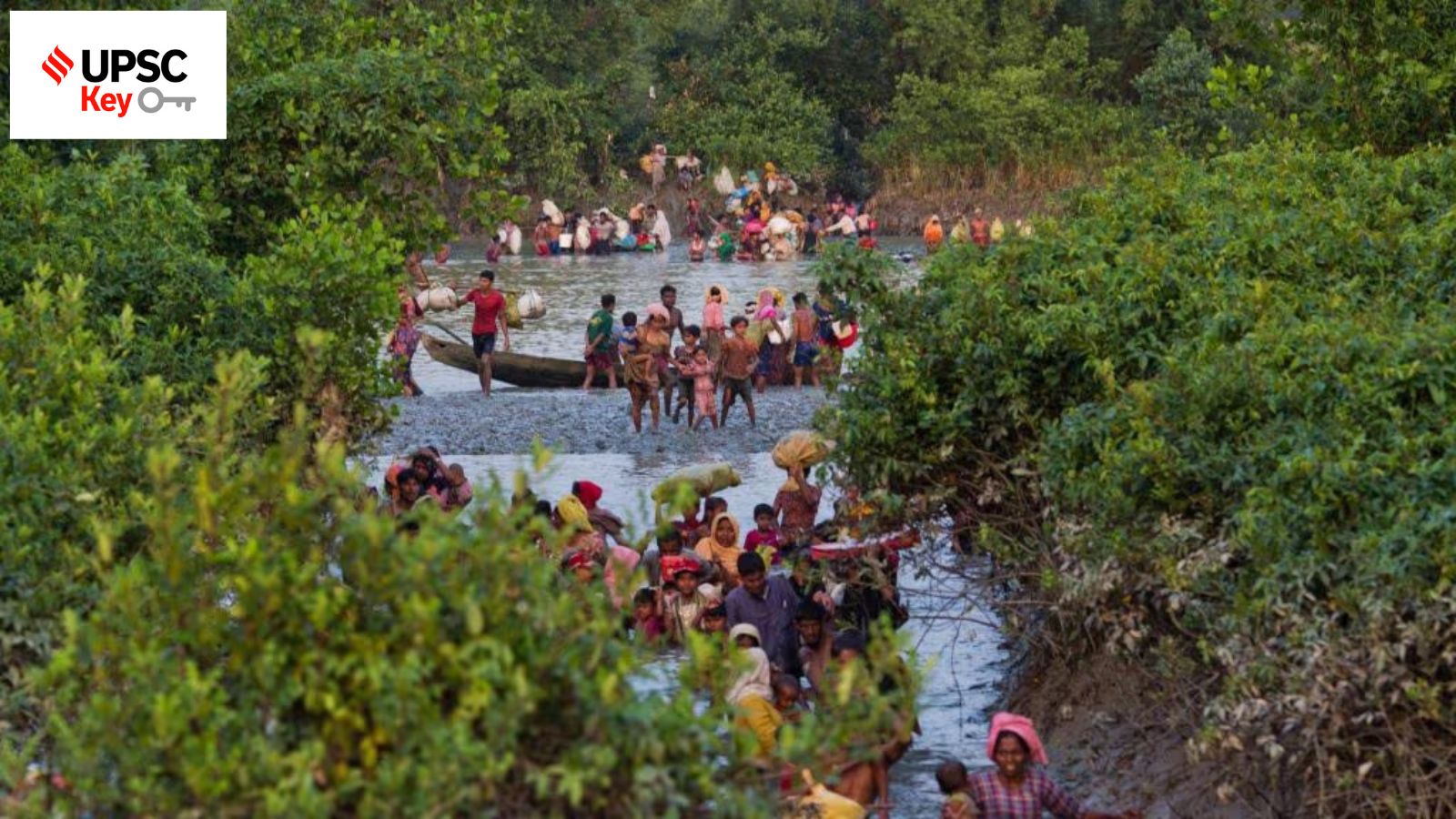 At least 150 civilians from Myanmar’s Muslim Rohingya minority may have been killed this week in an artillery and drone attack in the western state of Rakhine that is being blamed on the Arakan Army, a major force in the resistance to military rule. Know more in our UPSC Key. (AP Photo/Bernat Armangue)
🚨 Attention: UPSC Key is now all 7 Days a Week!🚨
Important topics and their relevance in UPSC CSE exam for August 11, 2024. If you missed the August 10th, 2024 UPSC CSE exam key from the Indian Express, read it here.
🚨 The Indian Express UPSC Essentials brings to you the July edition of its monthly magazine. Click Here to read. Share your views and suggestions in the comment box or at manas.srivastava@indianexpress.com🚨
UPSC Syllabus:
Preliminary Examination: Economic Development
Mains Examination: GS-II, GS-III: Government Policies and Interventions; Issues relating to intellectual property rights.
What’s the ongoing story- In what puts a question mark on the legality of lakhs of patent and trademark orders passed in the last two years by the Controller General of Patents, Designs and Trade Marks (CGPDTM), the Union Law Ministry and an Additional Solicitor General (ASG) of India have opined that these orders are “legally unenforceable” as they were “made by outsourced employees” in violation of the Trade Marks Act, 1999.
Prerequisites:
— What are Intellectual Property Rights (IPR)?
— What is the difference between “Trademark”, “Copyright” and “Patent”?
— Read about the office of the Controller General of Patents, Designs and Trademarks (CGPDTM) and World Intellectual Property Organization (WIPO).
Key takeaways:
— What has led to a chaos in the grant of intellectual property rights is the patent body’s decision to hire hundreds of employees “outsourced” through a single source, the Quality Council of India, an autonomous body, and not belonging to the Government of India. In the last one year itself, these employees granted patents and trademarks to companies in quasi judicial orders.
— The decisions by “outsourced employees appointed through any agency (and not by the Central Government) in any statutory proceeding can very well be challenged as null and void as these orders are passed by legally incompetent persons”, the Department of Legal Affairs said in a legal opinion April 25, 2024, sought by the Department for Promotion of Industry and Internal Trade (DPIIT) earlier that month. In her opinion on June 17, 2024, ASG Aishwarya Bhati suggested “annulment of decisions” made by the “unauthorised outsourced employees”.
— A week ago, the Calcutta High Court had also ruled that hiring contractual employees for “quasi-judicial functions” in the patents and trademark office was not legal.
— What’s the way out: Terming all patent orders illegal will mean reversing decisions taken over the last two years that have already impacted hundreds of businesses. The way out, as suggested by the ASG, could be an expert committee going over the merits of each order passed, and giving a stamp of approval.
For Your Information:
— Intellectual property right (IPR) is the right given to persons over the creations of their minds: inventions, literary and artistic works, and symbols, names and images used in commerce. They usually give the creator an exclusive right over the use of his/her creation for a certain period of time.
— A patent is an exclusive right granted for an invention, and under Patents Act 1970, a “patent is granted for any invention”. A patentee under the Act is defined as the person whose name is entered on the register of patents as the “grantee or proprietor of the patent”.
Points to Ponder:
— What are the different types of Intellectual Property Rights?
— What are the patent criteria in India?
— What are the issues related to Intellectual Property Rights in India?
— What are the initiatives taken by the government to provide a strong IPR regime in India?
(Thought Process: Read about the National IPR policy and other initiatives of government)
Post Read Question:
(1) Consider the following statements: (UPSC CSE 2019)
1. According to the Indian Patents Act, a biological process to create a seed can be patented in India.
2. In India, there is no Intellectual Property Appellate Board.
3. Plant varieties are not eligible to be patented in India.
Which of the statements given above is/are correct?
(a) 1 and 3 only
(b) 2 and 3 only
(c) 3 only
(d) 1, 2 and 3
Other Important Articles Covering the same topic:
UPSC Essentials: One word a day- Intellectual Property Rights (IPR)
UPSC Syllabus:
Preliminary Examination: History of India and Indian National Movement
Mains Examination: GS-I: The Freedom Struggle —its various stages and important contributors/contributions from different parts of the country.
What’s the ongoing story- Shyamlal Yadav writes— “The audacious act, famously known as the Kakori case or the Kakori train robbery conspiracy case, shook the British government and accelerated the freedom movement. This year marks the 100th year of the incident — on Friday, August 9, UP Chief Minister Yogi Adityanath launched the centenary celebrations.”
Prerequisites:
— What was the Kakori Train Action incident?
— Read about the Hindustan Republican Association.
Key takeaways:
— “The Kakori case was the first major action executed by the Hindustan Republican Association (HRA), a revolutionary outfit set up in 1924 by, among others, Ram Prasad Bismil, Ashfaqullah Khan and Sachindra Nath Bakshi.”
— “Bismil, who hatched the robbery plan, was joined in its execution by Ashfaqullah Khan, Rajendra Lahiri, Chandrashekhar Azad, Sachindra Nath Bakshi, Keshab Chakravarthy, Manmathnath Gupta, Murari Sharma, Mukundi Lal and Banwari Lal.”
— “While the revolutionaries only intended to rattle the British government, the death of a passenger named Ahmad Ali, when the Mauser gun of one of the revolutionaries accidentally went off, hurt their cause.”
— “Of the accused who were made to stand trial at the Special Sessions Court of Justice Archibald Hamilton, 19 persons were convicted. Bismil, Roshan Singh, Rajendra Nath Lahiri and Ashfaqullah Khan were sentenced to death while the others got varying jail terms, including a deportation to the infamous Kala Pani (Cellular Jail in Port Blair) for five of them.”
— “While the sum stolen was paltry, the act was an audacious snook at the British Raj, whose response to Kakori was to set an example for future revolutionaries and restore British authority in the minds of the people.”
For Your Information:
— The Hindustan Republican Association (HRA) was founded by a group of young men who were disillusioned by Gandhi’s tactics and what they felt was zealous preaching of “non-violence.”
— Ram Prasad Bismil and Ashfaqulla Khan, both poets, were among the group’s founding members. Sachindra Nath Bakshi and trade unionist Jogesh Chandra Chatterjee were among the others. The HRA would also include figures such as Chandra Shekhar Azad and Bhagat Singh. Their manifesto, Krantikari (Revolutionary), was published on January 1, 1925.
Points to Ponder:
— What is the significance of Kakori Train Action in the Freedom struggle of India?
— What happened to the HRA after the Kakori Train Action?
— What were the contributions of revolutionaries in the Indian freedom struggle?
Post Read Question:
(2) With reference to the Kakori Train incident, consider the following statements
1. The train robbery at Kakori was the HRA’s first major action which took place in 1925.
2. The objective was to fund the HRA and garner public attention for their work and mission.
3. The only major leader of HRA at this time who evaded arrest was Ram Prasad Bismil.
How many of the statements given above are correct?
(a) Only one
(b) Only two
(c) All three
(d) None
Other Important Articles Covering the same topic:
How young revolutionary leaders executed the Kakori Train Robbery
UPSC Syllabus:
Preliminary Examination: Current events of national and international importance
Mains Examination: GS-II: India and its neighbourhood- relations, bilateral, regional and global groupings and agreements involving India and/or affecting India’s interests.
What’s the ongoing story- External Affairs Minister S Jaishankar Saturday met Maldives President Mohamed Muizzu and other top leaders and assured them that New Delhi attached top priority to its multifaceted relationship with Male and was determined to further its developmental cooperation with the country.
Prerequisites:
— What is the history of bilateral ties between India and the Maldives?
— What is the India Out campaign?
— What is the significance of Maldives for India?
— Map work: Location of Maldives, Atolls in news in Maldives, Lakshadweep’s Minicoy Island.
Key takeaways:
— Jaishankar is on a three-day official visit to Maldives to reset the bilateral relationship, the first high-level trip from India after the archipelago nation’s pro-China president Muizzu assumed office last year.
— Jaishankar’s trip to the Maldives comes weeks after President Muizzu’s visit to India in June to attend the swearing-in ceremony of Prime Minister Narendra Modi’s government.
— Muizzu reaffirmed his administration’s full commitment to strengthening the historic and close connections between the Maldives and India. He stated India has always been one of the closest allies and invaluable partners, facilitating and providing aid whenever Maldives has needed it.
— Muizzu highlighted that India’s initiatives would provide significant economic benefits, boost the local economies, and together contribute to the nation’s prosperity.
For Your Information:
— The Maldives is an essential ally for India, helping to protect its maritime borders and monitor the wider Indian Ocean region, where China is waging war. The archipelago is located about 300 nautical miles (560 km) off the west coast of India and about 70 nautical miles (130 km) from Minicoy Island in Lakshadweep.
— The Chinese influence in the Maldives has progressively expanded over the last few decades. The island nation is a component of China’s Belt and Road Initiative, which has resulted in an influx of Chinese money and a deepening of the two countries’ relationship—at the expense of India.
Points to Ponder:
— What are the areas of cooperation between India and the Maldives?
— What are the major challenges to India-Maldives relations?
— What steps can be taken by India to strengthen bilateral relations with the Maldives?
— What is the significance of India for the Maldives?
(Thought Process: Mention the essentials that India supplies to the Maldives, India’s support in the Maldives’ education system, the economic dependence of the Maldives on India—tourism—and India’s significant role during disasters.)
Post Read Question:
Prelims
(3) India and Maldives are separated by which of the following channels?
(a) Eight Degree Channel
(b) Nine Degree Channel
(c) Seven Degree Channel
(d) Ten Degree Channel
Mains
Discuss the political developments in Maldives in the last two years. Should they be of any cause of concern to India? (UPSC CSE 2013)
Other Important Articles Covering the same topic:
India-Maldives ties: Amid row, why the two countries need each other and what is at stake
UPSC Syllabus:
Preliminary Examination: Polity, Science and Technology
Mains Examination: GS-II, GS-III: Government policies and interventions; Science and Technology- developments and their applications; Awareness in the fields of IT.
What’s the ongoing story- Chief Justice of India DY Chandrachud Saturday said the transition to Artificial Intelligence (AI) would augment efficiency without impacting the foundational skills of the legal profession, and emphasised strengthening infrastructure in the courts to deal with pendency in cases.
Prerequisites:
— What is artificial intelligence (AI)?
— What are the areas of AI application?
— What are the different categories of AI?
Key takeaways:
— He said modern technology like AI was being used to translate court verdicts in regional languages. “I believe the transition to Artificial Intelligence will mirror the earlier embrace of technology by lawyers.” the CJI said.
— Justice Chandrachud said, “Sophisticated legal argumentation continues to remain in the exclusive realm of human lawyers. However, several routine tasks such as case law research, filing pleadings, reviewing contracts, and conducting due diligence can deeply benefit from artificial intelligence and automation. Relegating such tasks to artificial intelligence leaves lawyers with more time and bandwidth. They can focus on high-value activities such as legal strategy, innovative argumentation and personalised client services.”
For Your Information:
— Artificial Intelligence (AI) is the ability of machines, especially computers, to perform tasks that typically require human intelligence. These tasks include things like understanding language, recognising patterns, solving problems, and making decisions.
— Essentially, AI enables machines to think and learn from experience, just like humans do, but often at a much faster pace with access to vast amounts of data. Today, AI continues to evolve, integrating into various industries, driving innovation, and transforming everyday life.
Points to Ponder:
— What is India’s artificial intelligence (AI) Mission?
— Is there any legal framework for AI regulation globally and nationally?
— What are the advantages and disadvantages of AI?
Post Read Question:
Prelims
(4) With the present state of development, Artificial Intelligence can effectively do which of the following? (UPSC CSE 2020)
1. Bring down electricity consumption in industrial units
2. Create meaningful short stories and songs
3. Disease diagnosis
4. Text-to-Speech Conversion
5. Wireless transmission of electrical energy
Select the correct answer using the code given below:
(a) 1, 2, 3 and 5 only
(b) 1, 3 and 4 only
(c) 2, 4 and 5 only
(d) 1, 2, 3, 4 and 5
Mains
Elucidate the relationship between globalisation and new technology in a world of scarce resources, with special reference to India. (UPSC CSE 2023)
Other Important Articles Covering the same topic:
What is Artificial Intelligence, how is it revolutionising healthcare
UPSC Syllabus:
Preliminary Examination: Current events of national and international importance
Mains Examination: GS-II: India and its neighbourhood- relations.
What’s the ongoing story- A drone attack on Rohingya fleeing Myanmar killed many dozens of people, including families with children, several witnesses said, describing survivors wandering between piles of bodies to identify dead and injured relatives.
Prerequisites:
— Who are the Rohingya?
— What is the Rohingya crisis?
— Know India-Myanmar bilateral relations in detail
Key takeaways:
— Four witnesses, activists and a diplomat described drone attacks on Monday that struck down families waiting to cross the border into neighbouring Bangladesh.
— A heavily pregnant woman and her 2-year-old daughter were among the victims in the attack, the single deadliest known assault on civilians in Rakhine state during recent weeks of fighting between junta troops and rebels.
— A spokesperson for the United Nations High Commission for Refugees said the agency was “aware of the deaths of refugees from the capsize of two boats in the Bay of Bengal” and it had heard reports of civilian deaths in Maungdaw but that it could not confirm the numbers or circumstances.
For Your Information:
— Monojit Majumdar writes— “The Rohingya have suffered systematic discrimination, disenfranchisement, and targeted persecution for decades — and small and large groups have been coming to Bangladesh from at least the 1970s following violence in Rakhine. Before 2017 — when the Myanmar military unleashed a brutal response to alleged attacks by a group called the Arakan Rohingya Salvation Army — waves of Rohingya had come to Bangladesh in 1978, 1992, 2012, and 2016.”
Points to Ponder:
— How does illegal transborder migration pose a threat to India’s security?
— What is the Free Movement Regime on the India-Myanmar Border?
— What is the significance of Myanmar for India?
— Since the coup in Myanmar, What has been India’s diplomatic approach to Myanmar?
Post Read Question:
(5) Consider the following pairs: (UPSC CSE 2016)
| Community sometimes mentioned in the news | In the affairs of | |
| 1. | Kurd | Bangladesh |
| 2. | Madhesi | Nepal |
| 3. | Rohingya | Myanmar |
Which of the pairs given above is/are correctly matched?
(a) 1 and 2
(b) 2 only
(c) 2 and 3
(d) 3 only
Other Important Articles Covering the same topic:
UPSC Syllabus:
Preliminary Examination: Environment and General Science
Mains Examination: GS-III: Environment
What’s the ongoing story- Across 100,000 acres in the vast agricultural heartland of Australia, an unusual approach is taking root to slow down the wrecking ball of climate change. Farmers are trying to tap the superpowers of tiny subterranean tendrils of fungus to pull carbon dioxide out of the air and stash it underground.
Prerequisites:
— Read about the fungi.
Key takeaways:
— It’s part of a big bet that entrepreneurs and investors around the world are making on whether dirt can clean up climate pollution. They are using a variety of technologies on farmland not just to grow food but to also eat the excess carbon dioxide produced by more than a century of fossil fuel burning and intensive agriculture.
— Why fungus? Because fungi act as nature’s carbon traders. As they sow crops, farmers are adding a pulverized dust of fungal spores. The fungus latches on to the crop roots, takes carbon that is absorbed by the plants from the air and locks it away in a form that may keep it underground for much longer than the natural carbon cycle.
— It’s still early days for most of these ventures, and exactly how much excess carbon they can remove and how long they can keep it underground remains contested. But their side benefits may be equally profound. They are all aimed at restoring the health of soils that have been degraded by decades of intensive agriculture by restoring microbes and minerals that they once contained.
For Your Information:
— The carbon removal potential of soils is huge. Soils hold three times more carbon than the atmosphere and they can potentially absorb more than 5 gigatons of carbon dioxide per year, or one-seventh of all the carbon dioxide that human activity injects into the atmosphere, according to the Intergovernmental Panel on Climate Change. That makes them the world’s second-largest carbon store, after oceans.
Points to Ponder:
— What is the significance of fungi in conservation?
— How fungi can help in tackling climate change?
Post Read Question:
(6) Consider the following organisms: (UPSC CSE 2013)
1. Agaricus
2. Nostoc
3. Spirogyra
Which of the above is/are used as biofertilizer/biofertilizers?
(a) 1 and 2
(b) 2 only
(c) 2 and 3
(d) 3 only
UPSC Syllabus:
Preliminary Examination: Economic development
Mains Examination: GS-II, GS-III: International relations, Economic development.
What’s the ongoing story- The Indian garment and knitted fabric sector is seeing a “bit of uncertainty” amid the ongoing political developments in the neighbouring country of Bangladesh, Finance Minister Nirmala Sitharaman said on Saturday.
Prerequisites:
— What is the ongoing conflict in Bangladesh?
— What is the status of India-Bangladesh trade ties?
— What is the status of the textile sector in India?
Key takeaways:
— “I have held discussions on our textile garment investments in Bangladesh, many of which are from Tamil Nadu. The investments went there in good faith and they did well having gone there; exports from Bangladesh had also increased. The garment and knitted fabric sector is currently seeing a bit of uncertainty,” she said at the media briefing held after the Central Board of Directors of the Reserve Bank of India (RBI).
— Ready-made garments represent more than 85 per cent of Bangladesh’s merchandise exports and over 70 percent of its total exports. In trade terms, Bangladesh is India’s biggest partner in the subcontinent, and India is Bangladesh’s second biggest partner in Asia after China. Their total bilateral trade amounted to $13 billion in the financial year 2023-24, according to the Commerce Ministry.
For Your Information:
— Earlier this week, political turmoil happened in Bangladesh when Sheikh Hasina resigned as the Prime Minister and fled the country. Soon after Parliament was dissolved leading to the creation of an interim government. Nobel laureate Muhammad Yunus took oath on Thursday as the head of the interim government.
— In trade terms, Bangladesh is India’s biggest partner in the subcontinent, and India is Bangladesh’s second biggest partner in Asia after China. Their total bilateral trade amounted to $13 billion in the financial year 2023-24, according to the Union Ministry of Commerce.
Points to Ponder:
— What are the areas of cooperation and conflict between India and Bangladesh?
— How is the current political crisis in Bangladesh going to impact the India-Bangladesh bilateral trade?
— What is the significance of the textile sector in the Indian economy?
— What are the challenges faced by the textile industry in India?
— What are the key initiatives taken by the government of India with regard to the textile sector?
Post Read Question:
(7) Consider the following statements: (UPSC CSE 2020)
1. The value of Indo-Sri Lanka trade has consistently increased in the last decade.
2. “Textile and textile articles” constitute an important item of trade between India and Bangladesh.
3. In the last five years, Nepal has been the largest trading partner of India in South Asia.
Which of the statements given above is/are correct?
(a) 1 and 2 only
(b) 2 only
(c) 3 only
(d) 1, 2 and 3
Other Important Articles Covering the same topic:
| ALSO IN NEWS | |
| Somanathan, who cleaned up finances of govt, is new Cabinet Secy | The government Saturday appointed 1987-batch Tamil Nadu cadre IAS officer TV Somanathan as the next Cabinet Secretary of India. He will have a two-year tenure beginning August 30. He will take over the charge from Rajiv Gauba, a 1992-batch IAS officer, who has been the Cabinet Secretary since 2019. |
| Bangladesh Chief Justice resigns after 2-hour ultimatum by students | Bangladesh’s Chief Justice Obaidul Hassan and five other judges of the apex Appellate Division on Saturday tendered their resignation, five days after the fall of Sheikh Hasina’s regime amid massive street protests and students marching towards the apex court demanding a revamp of the judiciary. |
| Russia evacuates over 76,000 in Kursk region amid Ukraine incursion | More than 76,000 people have been evacuated from areas bordering Ukraine in Russia’s Kursk region, the local emergency ministry was quoted by the Tass news agency as saying on Saturday, following Ukraine’s incursion into the region this week. |
| Prelims Answer Key |
| 1. (c) 2. (b) 3. (a) 4. (b) 5. (c) 6. (b) 7. (b) |
Subscribe to our UPSC newsletter and stay updated with the news cues from the past week.
Stay updated with the latest UPSC articles by joining our Telegram channel – Indian Express UPSC Hub, and follow us on Instagram and X.
https://www.youtube.com/watch?v=NLF5t533dYo?si=Glo6Kyzz4b2HC68T

Read UPSC Magazine