30 min read

© IE Online Media Services Pvt Ltd



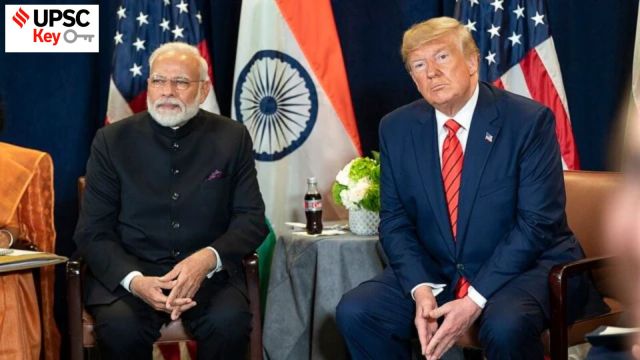 PM Modi speaks to Trump: PM Modi and US President Donald Trump reviewed the steady progress in India-US bilateral ties. Know more in our UPSC Key. (File Photo)
Important topics and their relevance in UPSC CSE exam for December 12, 2025. If you missed the December 11, 2025, UPSC CSE exam key from the Indian Express, read it here.
Syllabus:
Preliminary Examination: Current events of national and international importance
Mains Examination: General Studies-II: Bilateral, regional and global groupings and agreements involving India and/or affecting India’s interests.
General Studies-III: Indian Economy and issues relating to planning, mobilisation, of resources, growth, development and employment
What’s the ongoing story: AS THE two-day talks between the Indian and US trade teams in New Delhi drew to a close Thursday, Prime Minister Narendra Modi announced in the evening that he spoke with US President Donald Trump and they reviewed the progress of the India-US Comprehensive Global Strategic Partnership and discussed, among other issues, the importance of sustaining momentum in the efforts to enhance bilateral trade.
Key Points to Ponder:
— What is India-US Comprehensive Global Strategic Partnership?
— Track the history of India-US bilateral relations
— What is India-US COMPACT?
— What are the various issues between India and the US?
— What is the RCEP (Regional Comprehensive Economic Partnership)?
— What is the “China+1” strategy?
— What are the recent agreements signed between India and the US?
— What are the issues related to India-US trade deal?
Key Takeaways:
— This was their third phone conversation since the Trump administration imposed 50 per cent tariffs on India – they last spoke on October 22 when Trump called Modi to greet him on Diwali. “We talked about trade… He’s very interested in that,” Trump had said then.
— Following the phone conversation Thursday, a statement from the Prime Minister’s Office said “both leaders reviewed the steady progress in India-US bilateral relations and exchanged views on key regional and global developments”.
— “They exchanged views on expanding cooperation in critical technologies, energy, defence and security, and other priority areas central to the implementation of the India-US COMPACT (Catalysing Opportunities for Military Partnership, Accelerated Commerce and Technology) for the 21st century,” a source said.
— Soumya Bhowmick writes: The US has been India’s largest trading partner for four years, yet, after six rounds of talks, the two sides still lack a comprehensive pact.
— At stake is a trade relationship nearing $200 billion a year, growing steadily but still operating without a formal framework. Washington has taken a hard line on trade imbalances, imposing a cumulative 50 per cent tariff on Indian goods this year. New Delhi insists those duties must ease before any deal and has resisted US pressure to open the sensitive agriculture and dairy markets.
— For the US, meanwhile, farm lobbies want India to buy more American corn, soybeans, and other row crops as Washington seeks to diversify exports away from China. Just this week, President Trump threatened new tariffs on Indian rice, responding to complaints from US rice growers about alleged dumping, underlining how quickly domestic pressures can turn a delicate negotiation into a tug-of-war between market access and protection.
— Newer frictions lie in digital trade and labour mobility. India’s data localisation policies — and draft e-commerce rules that stress “digital sovereignty” and local storage — are seen by US companies as costly red flags.
— Visa and talent mobility add another layer, with Indian professionals powering the country’s IT-led services exports, yet US immigration rules remain tight. In September, Washington announced a steep US$100,000 fee on new H-1B petitions from abroad, widely viewed as prohibitive.
— Meanwhile, India’s own trade strategy has shifted markedly. After walking away from the RCEP (Regional Comprehensive Economic Partnership) mega-pact in 2019 over fears of import surges from China, New Delhi has leaned into a web of bilateral and mini-lateral deals tailored to its interests.
— The more challenging work in 2026 will be to move from damage control to rule-making, sequencing politically sensitive reforms on agriculture, data governance, and skilled mobility while keeping the process insulated from election cycles.
— If New Delhi and Washington can use this phase to co-design standards for critical technologies, critical minerals, and semiconductor supply chains, the trade framework will help shape the wider Indo-Pacific economic architecture; it will not erase every friction, but it can anchor the India-US partnership in shared prosperity, risk diversification, and long-term strategic stability.
— Anil Sasi writes: Americans seem increasingly frustrated with Trump’s handling of inflation and the cost of living, two issues key to his re-election last November. There is an irony here. Trump rode a wave of economic pessimism to re-election, but in New York, his ideological polar opposite, Zohran Mamdani, won on almost the same plank: Promising relief from high living costs, in Trump’s own home turf, New York.
— The immediate policy trigger for Trump’s slump is his tariff regime. After weeks of bluster, he was forced to backpedal, issuing executive orders in mid-November exempting a range of essential imports, including coffee, bananas and beef, from sweeping tariffs amid mounting public anger over rising prices. The latest is a flip-flop on high-end Nvidia chips to China.
— What is clear is that Republicans are recalculating. Fear of a primary challenge from Trump once kept them obedient. Now their greater anxiety may be the Democrat on the election ballot. Institutional pushback is also mounting.
Do You Know:
— After years of negotiating, in November 2019, India chose to stay out of the Regional Comprehensive Economic Partnership (RCEP) — a trade agreement that includes 15 countries accounting for 30 per cent of global GDP, and around a quarter of world exports.
— The CEO of Niti Aayog, BVR Subrahmanyam said that India is missing out on the “China plus one” opportunity and that it should consider joining agreements such as the RCEP and the Comprehensive and Progressive Agreement for Trans Pacific Partnership.
Other Important Articles Covering the same topic:
📍Niti Aayog CEO’s comment on RCEP: Call for a wider conversation
Previous year UPSC Mains Question Covering similar theme:
‘What introduces friction into the ties between India and the United States is that Washington is still unable to find for India a position in its global strategy, which would satisfy India’s National self-esteem and ambitions’. Explain with suitable examples. (UPSC CSE 2019)
Syllabus:
Preliminary Examination: Current events of national and international importance
Mains Examination: General Studies-II: Issues relating to development and management of Social Sector/Services relating to Health, Education, Human Resources.
What’s the ongoing story: The Supreme Court Thursday asked the director of AIIMS, New Delhi, to set up a secondary medical board to examine a 32-year-old man who has been in a vegetative state for the last 13 years so that it can take a call on his father’s request to allow passive euthanasia for his son.
Key Points to Ponder:
— What is euthanasia?
— How euthanasia is different from assisted dying?
— What is living will?
— What is passive euthanasia?
— Is euthanasia legal in India or any other country?
— Is the right to die with dignity, a fundamental right?
— What are the ethical issues concerning euthanasia?
Key Takeaways:
— A bench of Justices J B Pardiwala and K V Viswanathan directed that the report be submitted to it by December 17, and fixed it for hearing next on December 18. “We will have to do something now. We can’t allow him to live like this. That’s for sure,” said Justice Pardiwala.
— In 2018, a five-judge constitution bench of the SC recognised passive euthanasia and laid down conditions and safeguards regarding the execution of such a living will. In January 2023, the court modified the order to make it more workable and less stringent.
— On November 26, the apex court asked the Noida District Hospital to constitute a Primary Medical Board to examine Harish Rana so that it could decide his father Ashok Rana’s plea for permission to withdraw his medical facilities.
— Harish, who was a student of Punjab University, suffered head injuries after falling from the fourth floor of his paying guest accommodation in 2013. Since then, he has been completely bedridden, and on an artificial support system.
— This is the second time in as many years that his parents have approached the Supreme Court seeking passive euthanasia for Harish.
Do You Know:
— Euthanasia refers to the practice of an individual deliberately ending their life, oftentimes to get relief from an incurable condition, or intolerable pain and suffering. Euthanasia, which can be administered only by a physician, can be either ‘active’ or ‘passive’.
— Active euthanasia involves an active intervention to end a person’s life with substances or external force, such as administering a lethal injection. Passive euthanasia refers to withdrawing life support or treatment that is essential to keep a terminally ill person alive.
— In 2018, the Supreme Court recognised the legality of ‘passive euthanasia’ for terminally-ill patients, holding that the ‘right to die with dignity’ forms a part of the right to life under Article 21 of the Constitution of India.
— To enforce the right to die with dignity, the Supreme Court in its 2018 judgment laid down the framework for making advance medical directives or living wills. However, the process was complex, and the court simplified it in its 2023 judgment.
— Just like wills on how one’s property is to be distributed, living wills are written documents made by a person of age 18 years or older with decision-making capacity, expressing their will on how they would wish to be treated if they lose such capacity.
— The document should detail at least two surrogate decision-makers — anyone whom the person trusts, from family to neighbours, who can make decisions on behalf of the person if they lose decision-making capacity.
Other Important Articles Covering the same topic:
📍Knowledge Nugget of the day: Euthanasia
📍Explained: The law and the ground realities of passive euthanasia in India
Syllabus:
Preliminary Examination: Current events of national and international importance
Mains Examination: General Studies-II: Government policies and interventions for development in various sectors and issues arising out of their design and implementation.
What’s the ongoing story: In the wake of the massive disruption in IndiGo’s flight operations last week, India’s aviation regulator Directorate General of Civil Aviation (DGCA) has sacked four flight operations inspectors (FOIs) who were responsible for oversight on IndiGo and the airline’s preparation for the new pilot rest and duty duration rules.
Key Points to Ponder:
— What are the reasons for the recent crisis of Indigo flights?
— What are the Flight Duty Time Limitations (FDTL)?
— What is the status of the Indian civil aviation sector?
— What are the challenges of the civil aviation sector?
— What are the measures needed to strengthen India’s civil aviation sector?
Key Takeaways:
— Omkar Goswami writes: Now, consider a very different ball game where one firm, IndiGo, takes up more than 65 per cent of the market — with Air India accounting for less than 27 per cent. Here, it becomes a brutal duopoly, almost veering to a monopoly. There lies the heart of the issue.
— There is no doubt that IndiGo is an efficient and profitable airline. However, with its sheer scale and dominance, IndiGo always believed that rules could be bent in its favour. The DGCA initially introduced its Flight Duty Time Limitations (FDTL) in January 2024.
— The aviation industry, led by IndiGo, managed to get this rolled back on several occasions. Eventually, FDTL was implemented this year by the DGCA in two phases, July and November.
— The FDTL rules mandated: (i) 48 hours of weekly rest for crew — up from 36 hours; (ii) a longer night duty window (00:00-06:00); (iii) a sharp cut in night landings — only two per week per pilot; and (iv) a cap of eight flying hours at night.
— IndiGo believed, as before, that it could sidestep these rules. Instead of preparing for these by hiring more pilots and reducing the number of flights, it decided on a “dekha jayega” approach, convinced that it could get away with it. It couldn’t, and was struck with a monumentally embarrassing crisis that it chose not to comprehend.
— It will take over a month to get things back in place. But has IndiGo paid the price for intentionally creating this horrendous situation for its passengers? I would argue not.
— Why so? Because with over 65 per cent market share, IndiGo effectively calls the shots — with Air India as a convenient price taker. Will the DGCA seriously financially penalise IndiGo to a point where it hurts, as it hurt the hapless passengers? I bet not.
— The lesson is simple. When one player accounts for almost two-thirds of the passenger market and when it is often the only carrier to many airports, the shoe is firmly on IndiGo’s foot. Not the government’s, irrespective of what the DGCA may claim.
— IndiGo has become too big to regulate. It effectively calls the shots. So, in a duopoly where one player controls 65 per cent of the market, passengers will have to suck their thumbs. After its righteous noise-making, the DGCA will quieten down.
— Is there a near-term solution? I’m afraid not. This grossly one-sided duopoly isn’t going to disappear in the near or even medium term.
— Shelley Vishwajeet writes: Aviation is a very fragile sector. Beyond the glamour and allure, it is one of the most challenging businesses to run. No wonder that both globally and in India, we have seen many airlines biting the dust even as new ones took off. Very few airlines across the world have been able to develop a model that is both sustainable and profitable.
— Europe is currently witnessing record closures of airlines, one after another — almost one every month. India has been no exception to this fragility. In the past two decades, we have seen many national and regional airlines go under. And when everything appears to be under control, something unexpected crops up, disrupting the entire process.
— While India’s aviation sector has grown — and quite phenomenally — in the past 25 years, it has not really matured as an accountable and ethical aviation economy. With every crisis, whether the grounding of major airlines like Kingfisher or Jet Airways or smaller regional airlines, in hindsight, we have discovered that it was not only the airlines that were defaulting, but the watchdogs as well.
— The Directorate General of Civil Aviation (DGCA), the Ministry of Civil Aviation (MoCA), and financial institutions were caught either napping or conniving. Against the backdrop of the current disruption, questions should be asked about the DGCA and the MoCA. “Who will regulate the regulators?” becomes a burning question.
— The most important issue is this: Can India, at this juncture, afford a sacrificial goat — and that too its biggest success story in aviation?
— IndiGo is not only India’s biggest and most profitable airline, but also one of the most remarkable aviation stories globally in the past three decades. It is symbolic of India’s rise as an aviation superpower.
— IndiGo had the mind, machine and money to fill the vacant slots and catapult itself to the top. Without wishing to sound like an unsolicited solicitor of IndiGo, resentment against its current size and dominance is unjustified.
— But is this good enough to let IndiGo go off the hook? Not at all. IndiGo must realise that the weight of its success and size creates its own gravity that can pull it down. You can’t be a leader only in numbers; you have to lead by example, too.
— IndiGo needs to remember that the world is watching its conduct and practices. While admired for its amazing growth and financial successes, the world is also observing what lies in between — ethical conduct, corporate governance, and treatment of employees and flyers — something that will really make or mar IndiGo’s credibility and reputation.
Other Important Articles Covering the same topic:
📍As flight disruptions continue, how Indigo hit perfect storm: New rules, crew shortage
📍India should be viewed as an aviation value chain leader, not just a market, says PM Modi
Previous year UPSC Mains Question Covering similar theme:
Examine the development of Airports in India through joint ventures under Public–Private Partnership (PPP) model. What are the challenges faced by the authorities in this regard? (UPSC CSE 2017)
Syllabus:
Preliminary Examination: Indian Polity and Governance – Constitution, Political System, Panchayati Raj, Public Policy, Rights Issues
Mains Examination: General Studies-III: Various Security forces and agencies and their mandate.
What’s the ongoing story: US President Donald Trump’s tariff-led trade war does not seem to have slowed down China’s export-driven economy. Beijing’s record $1 trillion trade surplus with the rest of the world in 2025 simply brings back into focus Trump’s tariff-onslaught on global trade — purportedly wielded to correct “historical imbalances”, such as the trade deficit that America has with China — and its failure to achieve any of that rebalancing, at least for now.
Key Points to Ponder:
— What is trade surplus?
— What are the reasons for depreciation of a currency?
— How China became a manufacturing hub?
— What is the currency exchange rate?
— How significant is China for the global economy?
— What is dumping? Why is India cautious about dumping from China?
Key Takeaways:
— The trillion-dollar landmark is clearly a reaffirmation of China’s stranglehold over global merchandise trade and a stark reminder of the fact that while Trump’s tariffs may have thwarted some of its exports to the US this year, Beijing’s exports to South and Southeast Asia, Africa, and Latin America have correspondingly spiked.
— And the deluge may have only started, which some analysts say could be the beginning of a “second China shock”. This could potentially lead to economic and social consequences in countries such as Indonesia, Thailand, Malaysia and India, as well as much of Africa and Southeast Asia.
— There has been an evolving bipartisan consensus in Washington DC that China has gotten away with low cost manufacturing for too long.
— Clearly, no other country has had the same level of global dominance across product categories since the early 1970s as China. This is more significant now than in earlier decades, when trade represented a much lower share of global goods production and consumption.
— Weakening domestic demand, alongside export-facilitating policies in products, where China is the world’s dominant manufacturer, has led to prices collapsing globally and driving other national producers out of business.
— While the benefit of this has been a phase of sustained lower global inflation, China has created a progressive stranglehold over global manufacturing: a level of manufacturing dominance by a single country seen only twice before in world history…
— What makes China’s extraordinary dominance in manufacturing worse is the continuing weakness in domestic demand. That, too, comes from the problem of China’s unwillingness to vacate its earlier specialisation in low value-added manufactured products as it moved up the global value chain.
— This has concomitantly led to a weakness in Chinese domestic demand for imported goods, which was expected to rise if China had ceded the manufacture of low value-added manufactured goods as it moved up the value chain.
— So, more than Beijing’s export competitiveness, weak Chinese imports explain this continuing imbalance. Trump had ostensibly set out to address this imbalance early into his second term. While many might not have agreed with Trump’s solution, it’s difficult to wish away the problem he started out to address.
— Responding to the Chinese trade surplus, the International Monetary Fund linked China’s rising exports and growing trade imbalances in part to “a real depreciation of the yuan”.
— In the US and many other developed economies, consumers have enjoyed cheaper products as a result — but their manufacturers have struggled to compete. The subsequent political backlash has contributed to a growing appetite for tariffs and industrial policies in many advanced economies as they attempt to make their own manufacturing sectors more competitive in global markets, the CSIS study of January 2025 said.
— The view in India’s policy circles has been that the China-led trade imbalances need to be desperately corrected and that New Delhi is supportive of any global efforts towards that end. That was before Trump’s tariff onslaught ended hitting India and Brazil the most.
— More recently, the concerns here have started to focus on a potential deluge of Chinese goods that were originally intended for the US and could end up in India and other countries, especially as New Delhi has started to dismantle some of its protectionist quality control barriers that it had progressively erected across product groups over the last 36 months.
— Beijing’s view is that a trade surplus does not equate to “squeezing others out”; rather, China’s surplus “is the outcome of mutually beneficial cooperation among countries”. A significant portion of China’s exports, the Global Times editorial claimed, represents the model of “produced globally, assembled in China and sold worldwide.”
— According to data from the General Administration of Customs of China quoted by the publication, in the first 11 months of 2025 (calendar year), the import and export volume of foreign-invested enterprises accounted for 29 per cent of China’s total foreign trade value, while the import and export volume of processing trade, closely related to global division of labour and cooperation, accounted for nearly 19 per cent of China’s total foreign trade value.
Do You Know:
— The World Trade Organisation defines dumping as “an international price discrimination situation in which the price of a product offered in the importing country is less than the price of that product in the exporting country’s market”.
— Therefore, dumping is, in general, a situation of international price discrimination this unfair trade practice which has a negative impact on international trade.
— Simply put, when the goods are exported by a country to a foreign country at a price lower than the price it charges in its own home market is called dumping.
— Dumping is legal under World Trade Organization (WTO) rules if the foreign country can reliably show the negative effects the exporting firm has caused its domestic producers. In order to protect domestic producers from dumping, countries use tariffs and quotas.
Other Important Articles Covering the same topic:
📍UPSC Essentials: One word a day— Dumping
Previous year UPSC Prelims Question Covering similar theme:
(1) Belt and Road Initiative’ is sometimes mentioned in the news in the context of the affairs of (UPSC CSE 2016)
(a) African Union
(b) Brazil
(c) European Union
(d) China
Previous year UPSC Mains Question Covering similar theme:
The China-Pakistan Economic Corridor (CPEC) is viewed as a cardinal subset of China’s larger ‘One Belt One Road’ initiative. Give a brief description of CPEC and enumerate the reasons why India has distanced itself from the same. (UPSC CSE 2018)
Syllabus:
Preliminary Examination: History of India and Indian National Movement
Mains Examination: General Studies-I: Modern Indian history from about the middle of the eighteenth century until the present –significant events, personalities, issues
What’s the ongoing story: Nehru first prime minister: In responding to Congress leader Rahul Gandhi’s “vote chori” charge, Union Home Minister Amit Shah delved into India’s Independence-era politics, invoking what he described as a historical subterfuge in Jawaharlal Nehru’s elevation as independent India’s first prime minister.
Key Points to Ponder:
— Know about important Congress session of pre-independent India
— What is the role of the Indian National Congress in the freedom movement?
— What is the significance of the civil disobedience movement?
— What was the Cabinet Mission’s main goal?
— What was the role and responsibilities of the interim government?
— Understand the role of various national leaders in India’s independence: Mahatma Gandhi, Jawaharlal Nehru, Sardar Patel, Acharya J B Kripalani, and Mualana Azad
Key Takeaways:
— Shah argued that in 1946, when the Congress was choosing its president — a decision that would effectively determine the head of the interim government and later the first prime minister — the majority of state units backed Sardar Vallabhbhai Patel. Yet, Nehru became the consensus choice, a development Shah characterised as “vote chori”.
— With World War II drawing to a close, negotiations between the Indian National Congress and the British government over the transfer of power gathered pace. In this context, the Congress decided to hold internal elections — a routine annual affair that had been deferred for six years.
— Ordinarily, the Congress presidency did not carry great executive power. Gandhi’s towering presence meant organisational decisions flowed through him. The post was often more ceremonial than authoritative.
— But in 1946, the stakes were different. The Congress president would lead the interim government, making him the de facto head of the soon-to-be independent administration.
— The three official candidates for the election were Patel, Nehru and Acharya J B Kripalani. The incumbent president, Maulana Abul Kalam Azad, had hoped to continue and several provincial committees had proposed his name.
 Jawaharlal Nehru with members of the interim government in 1946. (Image source: Wikipedia)
— But days before the vote, both Kripalani and Patel informed the All India Congress Committee that they wished to withdraw, leaving Nehru the sole candidate.
— The story behind these withdrawals, however, was more complex. As Rajmohan Gandhi records in Patel: A Life, Gandhi had privately made it clear by April 20 that his preference was Nehru. When a newspaper suggested that Azad might be re-elected, Gandhi wrote to the Maulana expressing his reservations about another term.
— To honour Gandhi’s wishes, Kripalani proposed Nehru’s name at a Working Committee meeting, and members — including Patel — signed the proposal. Kripalani then withdrew his own nomination and drafted a withdrawal note for Patel as well.
— Patel showed the note to Gandhi. Gandhi, despite his clear preference, offered Nehru the opportunity to step aside since no provincial committee had backed him. Nehru remained silent, a silence interpreted as unwillingness to accept the second position. Gandhi then asked Patel to sign the withdrawal, which he did without protest.
— Nehru was thus elected unopposed. A month later, the Viceroy invited him to form the interim government. Nehru’s biographer Michael Brecher later wrote: “If Gandhi had not intervened, Patel would have been the first de facto premier of India.” The Sardar, he noted, “was robbed of the prize and it rankled deeply”.
— A year later, Gandhi publicly explained his stance. “Jawaharlal cannot be replaced today, whilst the charge is being taken from Englishmen,” he said. Gandhi believed that Nehru, a Harrow and Cambridge alumnus as well as a barrister, was better suited to negotiate with the British leadership.
Do You Know:
— Starting with the Cripps mission in 1942, a number of attempts were made by colonial authorities to form an interim government in India.
— In 1946, elections to the Constituent Assembly were held following the proposals of the British Cabinet Mission dispatched by the British Prime Minister Clement Attlee. In this election, the Congress obtained a majority in the Assembly, and the Muslim League consolidated its support among the Muslim electorate.
— Viceroy Wavell subsequently called upon Indian representatives to join the interim government.
— A federal scheme had been visualised under the Government of India Act of 1935, but this component was never implemented due to the opposition from India’s princely states. As a result, the interim government functioned according to the older Government of India Act of 1919.
— On September 2, 1946, the Congress party formed the government. On September 23, the All-India Congress Committee (AICC) ratified the Congress Working Committee’s decision.
— The cabinet after October 1946 was as follows:
* Vice President of the Executive Council, External Affairs and Commonwealth Relations: Jawaharlal Nehru
* Home Affairs, Information and Broadcasting: Vallabhbhai Patel
* Agriculture and Food: Rajendra Prasad
* Education and Arts: C. Rajagopalachari
* Defence: Baldev Singh
* Industries and Supplies: C. Rajagopalachari
* Labour: Jagjivan Ram
* Railways and Communications: Asaf Ali
* Work, Mines and Power: C.H. Bhabha
Other Important Articles Covering the same topic:
📍Explained: When India’s interim government was formed in 1946
Previous year UPSC Prelims Question Covering similar theme:
(2) With reference to the Cabinet Mission, which of the following statements is/are correct? (UPSC CSE 2015)
1. It recommended a federal government.
2. It enlarged the powers of the Indian courts.
3. It provided for more Indians in the ICS.
Select the correct answer using the code given below.
(a) 1 only
(b) 2 and 3
(c) 1 and 3
(d) None
(3) In the context of Colonial India, Shah Nawaz Khan, Prem Kumar Sehgal and Gurbaksh Singh Dhillon are remembered as (UPSC CSE 2021)
(a) leaders of Swadeshi and Boycott Movement
(b) members of the Interim Government in 1946
(c) members of the Drafting Committee in the Constituent Assembly
(d) officers of the Indian National Army
ALSO IN NEWS |
|
| Taking stock of Syria, a year after the civil war ended | A year after the fall of Bashar al-Assad, Syria faces multiple challenges as its terrorist-turned-statesman president picks up the pieces of 14-year-long civil war.
Al-Sharaa has the unenviable task of leading a country that is fractured on ethnic lines and left economically impoverished by the lengthy civil war. While the establishment of the national commissions for Transitional Justice (NCTJ) and for Missing Persons earlier this year has been hailed as a welcome step, much more still needs to be done. Since the fall of the Assad regime, there has been widespread ethnic violence, with Sunni groups aligned to the new regime targeting minority communities, notably, Shia Alawites (Assad’s community), the Druze, and Kurds. Al-Sharaa has been criticised for not doing enough to control this violence. India enjoyed robust ties with the Assad regime for over five decades. Even during the peak of the civil war, it maintained its embassy in Damascus. After the collapse, New Delhi called for a “peaceful and inclusive Syrian-led political process”. The first official outreach to the new regime came in July. |
| No fast track courts to hear honour killing cases in Delhi, HC to consult govt for their formation | With no designated special court or fast track court in the Capital to try honour killing cases, the Delhi High Court on Thursday directed a non-profit organisation (NGO) and the mother of an alleged victim of honour killing to make a representation to this effect to the administrative side of the HC as well as to the Delhi government. |
| Nearly 3,000 Indians died waiting for organs in 5 years; over 82,000 still on transplant waitlist | Nearly 3,000 Indians have died waiting for an organ transplant over the last five years, with the national capital accounting for nearly half of these deaths. Data provided by the Union health ministry in Parliament on Wednesday shows that 2,805 people died waiting for organs between 2020 and 2024. Of these, 1,425 patients were from Delhi, followed by 297 from Maharashtra, and 233 from Tamil Nadu.
Delhi conducts the highest number of transplants in the country, but most involve organs donated by living relatives, and not those from deceased donors. This trend is evident in the longer waiting lists in states such as Maharashtra, Gujarat and Tamil Nadu, where patients receiving organs from relatives are likelier to undergo transplants sooner. |
| PRELIMS ANSWER KEY |
| 1. (d) 2. (a) 3. (d) |
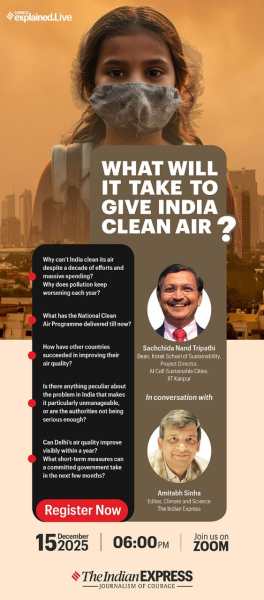
Explained.live – What will it take to give India clean air?
December 15th, 2025 | 6:00 PM | Zoom
Register Now: https://zoom.us/webinar/register/4917654535296/WN_hpnKkeTST2eXPITDCdsFrw
Subscribe to our UPSC newsletter. Stay updated with the latest UPSC articles by joining our Telegram channel – IndianExpress UPSC Hub, and follow us on Instagram and X.
🚨 Click Here to read the UPSC Essentials magazine for November 2025. Share your views and suggestions in the comment box or at manas.srivastava@indianexpress.com🚨

Read UPSC Magazine