13 min read





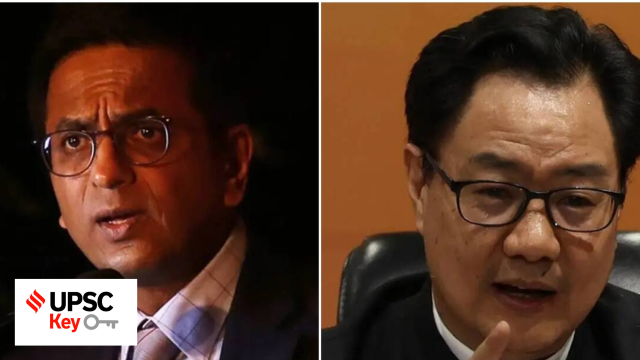 UPSC Key 2023: Here's what you should be reading from the January 17, 2023 edition of The Indian Express. (Express file photos)
Important topics and their relevance in UPSC CSE exam for January 17, 2023. If you missed the January 16, 2023 UPSC key from the Indian Express, read it here
FRONT PAGE
Govt wants nominee on panel to choose judges, Opp says bid to capture
Syllabus:
Preliminary Examination: Indian Polity and Governance
Main Examination: General Studies II: Structure, organization and functioning of the Executive and the Judiciary
Key Points to Ponder:
• What’s the ongoing story- Amid the tug of war between the Centre and Supreme Court Collegium over the appointment of judges, Union Law Minister Kiren Rijiju has written to Chief Justice of India D Y Chandrachud “suggesting” the inclusion of a government nominee in the decision-making process for shortlisting of judges.
• What is the role of the government in the decision-making process for the shortlisting of judges?
• What you understand by the term ‘Memorandum of Procedure’?
• Why is the government making suggestions on ‘Memorandum of Procedure’?
• Earlier, in an interview at the Times Now Summit 2022, Law Minister Rijiju Described the Collegium system as “alien” to the Constitution-what is your take for the collegium system?
• First of all, what is your understanding about the collegium system?
• What is the issue of conflict between Judiciary and Executive with respect to the appointment of Judges?
• Executive Vs Judiciary for appointment of judges in higher judiciary-Know in detail
• What is the sanctioned strength of Supreme Court Judges in India?
• Who appoints the Judges of the Supreme Court?
• What does the Collegium consider while making the recommendation?
• National Judicial Appointments Commission (NJAC) Act 2014-Know the key highlights
• Supreme Court on NJAC Act 2014 (99th Constitutional Amendment Act)-know in detail
• First Judges Case (1982), Second Judges Case (1993) and Third Judges Case (1998)-Know in detail
• What was the Supreme court’s ruling in the Second Judges case (1993), with respect to the appointment of a judge?
• Third Judges case (1998) and Supreme Court’s ruling in case of the appointment-What was the Supreme Court’s ruling?
• The National Judicial Appointments Commission Act of 2014 and the Collegium System-Compare and Contrast
• The Constitution has made certain provisions to safeguard and ensure the independent and impartial functioning of a Judges-Know in detail
Other Important Articles Covering the same topic:
📍Law Minister’s suggestion to CJI on MoP: the context and background
EXPRESS NETWORK
SC tells petitioner to move Uttarakhand HC
Syllabus:
Preliminary Examination: Indian and World Geography-Physical, Social, Economic Geography of India and the World.
Mains Examination:
• General Studies I: Important Geophysical phenomena such as earthquakes, Tsunami, Volcanic activity, cyclone etc., geographical features and their location-changes in critical geographical features (including water-bodies and ice-caps) and in flora and fauna and the effects of such changes.
• General Studies II: Government policies and interventions for development in various sectors and issues arising out of their design and implementation.
• General Studies III: Disaster and disaster management.
Key Points to Ponder:
• What’s the ongoing story-The Supreme Court Monday asked a petitioner who had approached it over the issue of land subsistence in Uttarakhand’s Joshimath to move the state High Court which is already looking into a similar plea.
• What is Land subsidence or subsidence of the land?
• Why Joshimath is sinking?
• What are the types of subsidence?
• What is the most common cause of subsidence?
• What is Article 225 of the Constitution?
• Map Work-Joshimath
• The appearance of cracks on many roads and houses across Joshimath, due to land subsidence, is neither a new phenomenon in this region-Why this region is more prone to land subsidence?
• “Today’s situation is a result of a variety of reasons, both natural and man-made,”-Can you tell what are the man-made reasons?
• What M C Mishra committee report said regarding the same?
• What experts says about Joshimath town-planning and construction work?
• ‘Relief and rescue efforts were intensified in Joshimath after it was declared a landslide and subsidence-hit zone’-What happens when a place is declared a landslide and subsidence-hit zone?
• How disaster management is done in the landslide and subsidence-hit zone?
• How do the Centre and state government ensure the safety and rehabilitation of residents?
Other Important Articles Covering the same topic:
📍Safety of people in areas affected by subsidence is top priority: PMO
Previous year UPSC Mains Question Covering similar theme:
📍 Describe the various causes and the effects of landslides. Mention the important components of the National Landslide Risk Management Strategy. (2021, GS3)
📍 Discuss the recent measures initiated in disaster management by the Government of India departing from the earlier reactive approach. (2020, GS3)
📍Vulnerability is an essential element for defining disaster impacts and its threat to people. How and in what ways can vulnerability to disasters be characterized? Discuss different types of vulnerability with reference to disasters. (2019, GS3)
📍Disaster preparedness is the first step in any disaster management process. Explain how hazard zonation mapping will help disaster mitigation in the case of landslides. (2019, GS3)
📍How important is vulnerability and risk assessment for pre-disaster management? As an administrator, what are key areas that you would focus on in a Disaster Management System?
(2013, GS3)
THE EDITORIAL PAGE
Syllabus:
Preliminary Examination: Current events of national and international importance.
Mains Examination: General Studies II: Salient features of the Representation of People’s Act.
Key Points to Ponder:
• What’s the ongoing story-S Y Quraishi writes: Getting political parties to agree on a “remote” machine is a tall order in view of the persisting questions even about the existing stand-alone EVMs. Acceptable: That’s the keyword that must be respected.
• What are the significant features of India’s electoral record?
• ‘While only 17 per cent were registered and 45 percent of them turned out to vote in 1951 in India’s first general election, in 2019, India’s latest general election, over 91 per cent of its eligible citizens were registered with 67 per cent of them coming out to vote, which is the highest voter turnout in the nation’s history’-know India’s election journey from 1951
• ‘A third of the eligible voters, a whopping 30 crore people, do not vote’-why?
• Do You Know-The Election Commission had earlier formed a “Committee of Officers on Domestic Migrants” to address this issue. The Committee’s report submitted in 2016 suggested a solution in the form of “remote voting”.
• “The Supreme Court, in a series of cases, has conclusively interpreted the freedom to access the vote as within the ambit of Article 19(1)(a)”-Analyse
• For Your Information-According to the 2011 Census, the number of internal migrants stands at 450 million, a 45 per cent surge from the 2001 census. Among these, 26 per cent of the migration (117 million) occurs inter-district within the same state, while 12 percent of the migration (54 million) occurs inter-state. Both official and independent experts admit that this number is underestimated. Short-term and circular migration could itself amount to 60-65 million migrants, which, including family members, could approach 100 million in itself. Half of these are inter-state migrants.
• Remote Electronic Voting Machine (RVM)-Know in detail
• “Migration based disenfranchisement is indeed not an option in the age of technological advancement”-Discuss
• Why Remote Electronic Voting Machine?
• Remote Electronic Voting Machine and Migrants enfranchisement-connect the dots
• What are the challenges associated with migrant voters?
• What does the term “domestic migrant” mean?
• Implementation of Remote Electronic Voting Machine-What are the Administrative, legal and technological challenges?
• What are the recent key electoral reforms proposed by Election Commission of India?
• System of Election- First past the post electoral system.
• How Elections are conducted in India?
Other Important Articles Covering the same topic:
📍ECI ready to pilot remote voting for domestic migrants; migrant voter need not travel back to home state to vote
EXPRESS NETWORK
New NCERT manual on transgender students silent on caste, patriarchy
Syllabus:
Preliminary Examination: Indian Polity and Governance-Constitution, Political System, Panchayati Raj, Public Policy, Rights Issues, etc.
Main Examination: General Studies II: Welfare schemes for vulnerable sections of the population by the Centre and States and the performance of these schemes; mechanisms, laws, institutions and Bodies constituted for the protection and betterment of these vulnerable sections.
Key Points to Ponder:
• What’s the ongoing story-Over a year after it removed a document on inclusion of transgender children in schools, following an objection by the National Commission for Protection of Child Rights (NCPCR) to suggestions on gender-neutral toilets and puberty blockers, the NCERT has released a fresh manual, which avoids the usage of not just those terms but also references to caste system and patriarchy that were highlighted in the previous one.
• ‘Integrating Transgender Concerns in Schooling Processes’-Know the highlights
• The previous draft manual “Inclusion of Transgender Children in School Education: Concerns and RoadMap” and now the proposed one “Integrating Transgender Concerns in Schooling Processes”-what are the differences between the two?
• How Transgender Persons (Protection of Rights) Act, 2019 defines Transgender person?
• What percentage of Indian population is transgender?
• Do you Know-India’s 2011 Census was the first census in its history to incorporate the number of ‘trans’ population of the country. According to the 2011 Census, the number of persons who do not identify as ‘male’ or ‘female’ but as ‘other’ stands at 4,87,803 (0.04% of the total population). This ‘other’ category applied to persons who did not identify as either male or female, and included transgender persons.
• “Sex is biologically determined but gender is a social construct”-Critically Analyse
• Transgenders in India are still discriminated even after the Supreme Court has held that the right to self-identification of gender is part of the right to dignity and autonomy under Article 21 of the Constitution-Why?
• A National Council for Transgender (NCT) persons-role and objectives
• What are the Yogyakarta Principles?
• Employment rates of transgender in India-Know the data’s and Statistics
• What was the Supreme Court’s verdict in National Legal Services Authority vs Union Of India, 2014?
• Decriminalisation of homosexuality was much needed for transgenders and Section 377-Connect the dots
Other Important Articles Covering the same topic:
📍Non-binary genders need more visibility in India’s Census 2021
EXPLAINED
Cancer in India: A status report
Syllabus:
Preliminary Examination: Economic and Social Development-Sustainable Development, Poverty, Inclusion, Demographics, Social Sector Initiatives, etc.
Mains Examination: General Studies II: Issues relating to development and management of Social Sector/Services relating to Health, Education, Human Resources.
Key Points to Ponder:
• What’s the ongoing story- Deaths due to cancer have declined by 33% in the United States since 1991, according to a report by the American Cancer Society released last week. This has translated into 3.8 million fewer deaths, the report said, and attributed the success to early detection, lower rates of smoking, and improvements in cancer treatment. This trend is yet to be reflected in India. Even with improvements in treatment, both the incidence of cancer and mortality continue to rise in the country.
• What is the incidence of cancer and mortality in India currently?
• Why are some cancers on the decline and others continue to rise?
• Have there been improvements in cancer treatments?
• What must be done to bring down overall mortality like in the US?
• What is the main cause of cancer?
• How common is cancer in India?
• Why India needs to put more emphasis on preventive healthcare?
Other Important Articles Covering the same topic:
📍Indigenous cervical cancer vaccine ready, set to be part of Govt’s immunisation drive
Syllabus:
Preliminary Examination: Current events of national and international importance.
Mains Examination: General Studies III: Awareness in the fields of IT, Space, Computers, robotics, nano-technology, bio-technology and issues relating to intellectual property rights.
Key Points to Ponder:
• What’s the ongoing story-The National Aeronautics and Space Administration (NASA) on January 11 announced that the James Webb Space Telescope has discovered its first new exoplanet. Researchers have labelled the planet as LHS 475 b, and it’s roughly the same size as Earth, the agency added. Located just 41 light-years away, the planet orbits very close to a red dwarf star and completes a full orbit in just two days.
• What are exoplanets?
• Why and how do we study them?
• How are exoplanets discovered?
• What are red dwarf stars?
Other Important Articles Covering the same topic:
📍Explained: NASA’s Webb Telescope and the first look at the universe from 13 billion years ago
ECONOMY
India’s exports drop 12.2% in December, trade deficit inches up
Syllabus:
Preliminary Examination: Economic and Social Development-Sustainable Development, Poverty, Inclusion, Demographics, Social Sector Initiatives, etc.
Mains Examination: General Studies III: Indian Economy and issues relating to planning, mobilization, of resources, growth, development and employment.
Key Points to Ponder:
• What’s the ongoing story-The impact of an incipient recession in the west on India’s foreign trade has become unmistakable. Merchandise exports shrank 12.2 per cent in December 2022 from a year before to $34.5 billion, the second contraction in three months, owing to a slowdown in demand from key markets in the wake of aggressive rate hikes by major central banks and unfavourable base. Goods exports had contracted by 16.65 per cent on year in October, while a flat growth was reported in November.
• What to look for in trade data?
• Have exports rebounded from the October contraction?
• What is causing the decline in exports growth?
• What about India’s imports?
• What about the trade deficit?
Other Important Articles Covering the same topic:
📍Explained: What is the Current Account Deficit, which widened in Q3 of the last FY?
For any queries and feedback, contact priya.shukla@indianexpress.com
The UPSC KEY Indian Express is now on Telegram. Click here to join our channel and stay updated with the latest Updates.

Read UPSC Magazine