22 min read

© IE Online Media Services Pvt Ltd



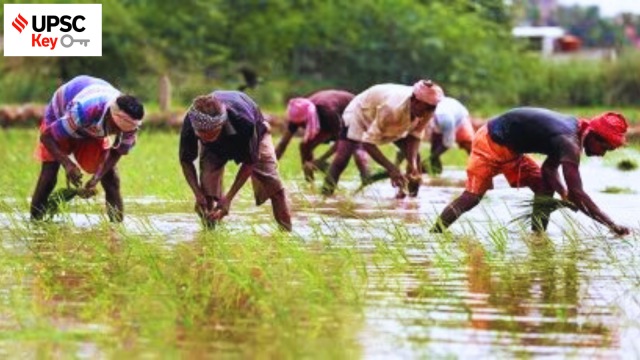 The DSR technique has a number of benefits when compared to traditional transplantation. Know more in our UPSC Key. (Representational Photo/File)
🚨 Attention: UPSC Key is now all 7 Days a Week!🚨
Important topics and their relevance in UPSC CSE exam for June 18th, 2024. If you missed the June 17th, 2024 UPSC CSE exam key from the Indian Express, read it here.
🚨 The Indian Express UPSC Essentials brings to you the June edition of its monthly magazine. Click Here to read. Share your views and suggestions in the comment box or at manas.srivastava@indianexpress.com🚨
UPSC Syllabus:
Preliminary Examination: Economy and Environment
Mains Examination: GS-III: Major crops-cropping patterns in various parts of the country, different types of irrigation and irrigation systems storage.
What’s the ongoing story- The Punjab government has been actively promoting the direct seeding of rice (DSR), or ‘tar-wattar’ technique, This can reduce water use by 15% to 20% (the traditional puddling method requires 3,600 to 4,125 litres of water to grow a single kilo of rice). Moreover, DSR requires less labour and matures 7 to 10 days faster, giving farmers more time to manage paddy straw.”
Prerequisites:
— What are the climatic requirements for rice cultivation?
— Is rice a Kharif crop or a rabi crop?
— What are the rice-producing states of India?
Key takeaways:
— Traditionally, paddy farmers prepare nurseries where seeds are first sown. After 25-35 days, the young seedlings are uprooted and replanted, in the flooded main field. While this method is labour and water-intensive, it is known to maximise yields and maintain better crop health.
— DSR, as the name suggests, requires no nursery preparation or transplantation. Paddy seeds are directly sown, roughly 20-30 days prior to when they would have been transplanted. The field is irrigated and laser leveled prior to the seeding process which is carried out using a seed drill or lucky seeder. Seed treatment is crucial, with seeds soaked in a fungicide solution for eight hours, then dried for half a day before sowing.
— Experts emphasise that soil suitability is crucial for the successful implementation of DSR. There are two factors here. First is the texture of the soil. Farmers should avoid DSR in light-textured soils — it is more suitable for heavy or medium-to-heavy-textured soils. This is primarily because light-textured soils do not retain water well. Heavy-textured soils contain more clay and less sand, whereas light-textured soils have less clay and more sand.
— The iron content of the soil also determines the suitability of DSR. Soil with severe iron deficiency and weed problems must not be cultivated using this technique.
— Experts recommend that soils with plant-available iron are ideal for DSR. In case iron supplements are being used, farmers should apply ferrace iron, which is green-coloured and not oxidised, rather than oxidised iron, which is brown in colour.
— Experts say that comprehensively educating farmers is key to enable the adoption of a new technique, and departure from age-old, tried and tested methods. They suggest that extensive training and a ready helpline be provided, to handhold the farmers through the whole process, from pre-sowing to harvesting. This can instill confidence among farmers regarding DSR’s efficacy.
Points to Ponder:
— How is DSR different from normal paddy transplantation?
— What are the concerns associated with the traditional method of rice cultivation?
— What are the benefits of DSR cultivation?
— What are the challenges to the DSR technique?
Post Read Question:
“System of Rice Intensification” of cultivation, in which alternate wetting and drying of rice fields is practiced, results in: (UPSC CSE 2022)
1. Reduced seed requirement
2. Reduced methane production
3. Reduced electricity consumption
Select the correct answer using the code given below:
(a) 1 and 2 only
(b) 2 and 3 only
(c) 1 and 3 only
(d) 1, 2 and 3
Other Important Articles Covering the same topic:
Explained: Despite incentives, why is DSR technique not gaining ground in Punjab?
UPSC Syllabus:
Preliminary Examination: General Science
Mains Examination: GS-II, GS-III: Government policies and interventions, Issues relating to Health, Science.
What’s the ongoing story- The US Supreme Court on Thursday (June 13) rejected a petition by anti-abortion groups seeking to undo the Food and Drug Administration’s (FDA) approval of a commonly available abortion pill, called mifepristone.
Prerequisites:
— What is abortion?
— What is progesterone?
Key takeaways:
— Mifepristone is part of the two-drug regimen used for medical abortion. A patient first takes mifepristone to induce an abortion and then misoprostol to empty the uterus.
— While mifepristone blocks progesterone — a hormone that supports menstruation and maintaining a pregnancy — misoprostol triggers uterine contractions, causing the body to expel the pregnancy as in a miscarriage.
— The regimen was approved for use up to 10 weeks of pregnancy by the FDA in 2000. Since then, more than six million people have used mifepristone for abortion. Currently, the pill is used in about two-thirds of abortions in the US.
Points to Ponder:
— What are the concerns related to abortion? What are the different schools of thought regarding abortion?
— What is India’s abortion law?
— What do you understand by the test of “foetal viability”?
— What is the Medical Termination of Pregnancy Act?
Post Read Question:
Is there a question of ‘foetal viability’ in abortion in India, and do the rights of an unborn child matter in the same way as in many jurisdictions abroad?
Other Important Articles Covering the same topic:
What is ‘foetal viability’ in abortion, and do the rights of an unborn child matter?
Abortion laws around the world
UPSC Syllabus:
Preliminary Examination: Economic and Social Development
Mains Examination: GS-III: Indian Economy and issues relating to planning, mobilisation of resources, growth.
What’s the ongoing story- In a few weeks from now, Finance Minister Nirmala Sitharaman will unveil the Union budget for 2024-25. The budget, the first of the newly sworn in government, will be presented against the backdrop of a continuing slump in household consumption and subdued private-sector investments.
Prerequisites:
— What are the different types of taxes in India?
— What is capital gains tax?
— What is the Goods and Services Tax (GST) and how does it work?
Key takeaways:
— The officials in the government are reportedly exploring the possibility of rationalising the tax structure, tinkering specifically with the tax rates for lower-income segments.
— There is an expectation that such a proposal would help boost household consumption, thereby pushing private capex in consumer-focused sectors, providing a fillip to economic activity. But, alongside such measures, there is also a need for a more comprehensive review of the tax systems in the country.
— Examining the existing capital gains tax regime would be one such imperative. Considering that currently the tax rates and the holding periods vary across asset classes, bringing about some alignment could be explored.
— Then there is the issue of GST rate rationalisation which, unlike changes in particular income tax slabs, affects a wider segment of the population. One possible option could be to merge some tax slabs. There is also the matter of bringing items such as petroleum products within the ambit of GST. However, any movement on these would require getting the state governments on board.
Points to Ponder:
— What steps has the government taken to increase the tax base, reduce the tax burden, and ease compliance?
— What are the pros and cons of the income tax rate cut?
— What are the challenges in India’s taxation system?
Post Read Question:
Consider the following items: (UPSC CSE 2018)
1. Cereal grains hulled
2. Chicken eggs cooked
3. Fish processed and canned
4. Newspapers containing advertising material
Which of the above items is/are exempted under GST (Good and Services Tax)?
(a) 1 only
(b) 2 and 3 only
(c) 1, 2 and 4 only
(d) 1, 2, 3 and 4
Other Important Articles Covering the same topic:
Govt looks at income tax rate cut to boost demand, trigger private investment
UPSC Syllabus:
Preliminary Examination: Economic and Social Development
Mains Examination: GS-I, GS-II, GS-III: Government policies and interventions, Social Justice, Indian Economy and issues relating to planning, mobilisation of resources, and growth, Poverty and developmental Issues.
What’s the ongoing story- Jyoti Thakur, Prabir Kumar Ghosh Writes- “A recent working paper of the World Inequality Lab has reignited discussion on the widening gap between the rich and poor. Inequality in India, however, transcends the dichotomy between the haves and the have-nots, as caste-based inequalities are among the defining features of the country’s socioeconomic framework”
Prerequisites:
— What is the Gini coefficient?
— What constitutional provisions provide safeguards against discrimination in India?
Key takeaways:
— “ Metrics like the Gini coefficient and percentile ratio serve as crucial tools for assessing economic inequality. By examining these metrics for the periods of 2017-18 and 2022-23, we explored the changes in consumption inequality both overall and within social groups such as the Scheduled Tribes (ST), Scheduled Castes (SC), Other Backward Classes (OBC), and the General category using the Periodic Labour Force data.”
— “The overall Gini coefficient decreased from 0.359 in 2017-18 to 0.309 in 2022-23, indicating a reduction in overall income inequality during this period by 0.050. The ST category saw its Gini coefficient decrease from 0.322 to 0.268, a 0.054 point drop, signalling improvement in the equitable distribution of consumption within this community.”
— “Nonetheless, digging deeper into consumption patterns reveals underlying economic disparities among India’s social groups, where ST and SC communities endure the most pronounced discrepancies.”
— “India has made remarkable strides in lifting millions out of multidimensional poverty, yet inequality among various caste groups persists. Despite the Constitution’s abolition of caste discrimination and the launch of affirmative action programmes, the shadow of caste continues to shape economic realities.”
— “The Centre has enacted numerous policies to mitigate these disparities, including reservation, rural development initiatives, and direct benefit transfers. While these measures have yielded some progress in narrowing the gap, substantial challenges remain.”
— “Disparities in consumption patterns among different socioeconomic groups reflect potential disparities in income, access to resources, or purchasing power. Efforts should concentrate on augmenting income generation and consumption abilities among the lower deciles, particularly within the ST and SC communities. This is also essential for fostering social harmony and economic stability across society.”
— “Continued monitoring of trends and targeted interventions addressing specific socio-economic challenges faced by different groups are necessary to ensure sustained progress towards greater economic equity.”
Points to Ponder:
— How is the Gini coefficient measured?
— What are the socio-economic challenges faced by different groups in India?
— What measures should be taken to ensure inclusive development and the upliftment of each section of society?
— What initiatives have been taken by the government to reduce inequality among various groups?
Post Read Question:
Has caste lost its relevance in understanding the multi-cultural Indian Society? Elaborate your answer with illustrations. (UPSC CSE 2020)
UPSC Syllabus:
Preliminary Examination: Indian Polity
Mains Examination: GS-II: Governance, Constitution and Polity
What’s the ongoing story- With the new Lok Sabha set to choose a Speaker on June 26, the ruling and Opposition coalitions are trying to reach a consensus on the post of the presiding officer.
Prerequisites:
— What are the constitutional provisions related to the Speaker?
— How are a Speaker and Deputy Speaker elected?
— What are the duties of the pro-tem Speaker?
Key takeaways:
— According to sources, the NDA is pitching for a consensus candidate and the Opposition parties agree but are pointing out that according to convention the Opposition should be offered the post of Deputy Speaker.
— Wednesday, June 26, is scheduled for the election of the Speaker if there is a contest. In case of a consensus candidate, the new Speaker will take charge without any contest the same day.
— The newly elected MPs will be sworn in by the pro-tem Speaker. According to convention, the most senior MP will be appointed as pro-tem Speaker.
For Your Information:
— The Constitution of India provides for the offices of the Speaker and Deputy Speaker who, according to Article 93, are to be elected “as soon as may be” after the commencement of the House.
— The Constitution neither sets a time limit nor specifies the process for these elections. It leaves it to the legislatures to decide how to hold these elections. In Lok Sabha and state legislatures, the President/Governor sets a date for the election of the Speaker, and it is the Speaker who decides the date for the election of the Deputy Speaker. The legislators of the respective Houses vote to elect one among themselves to these offices.
— The Speaker is elected by a simple majority in the House. The term ends with the dissolution of the House, unless the Speaker resigns or is removed from office before that.
— A motion of no-confidence can be moved against the Speaker with notice of 14 days as per Article 94 of the Constitution.
Points to Ponder:
— What are the roles and responsibilities of the Speaker and Deputy Speaker?
— What are the powers of the Speaker?
— What is the process for the removal of the Speaker?
— What are the issues associated with the office of the Speaker and its functioning?
Post Read Question:
With reference to the Speaker of Lok Sabha, consider the following statements: (UPSC CSE 2024)
While any resolution for the removal of the Speaker of the Lok Sabha is under consideration
1. He/She shall not preside.
2. He/She shall not have the right to speak.
3. He/She shall not be entitled to vote on the resolution in the first instance.
Which of the statements given above is/are correct?
(a) 1 only
(b) 1 and 2 only
(c) 2 and 3 only
(d) 1, 2 and 3
Other Important Articles Covering the same topic:
Explained: How are a Speaker and Deputy Speaker elected?
UPSC Syllabus:
Preliminary Examination: Economy
Mains Examination: GS-III: Economy
What’s the ongoing story- A near 60 times jump in silver imports during the last financial year from United Arab Emirates (UAE) is unusual since the West Asian country does not produce silver and the import jump may be indicative of a breach in rule of origin finalised by India and UAE under the free trade agreement that came into force in May 2022, a report by think tank Global Trade Research Initiative (GTRI).
Prerequisites:
— What are the major silver-producing countries?
— What is the Most Favoured Nation (MFN) status?
— What is a Comprehensive Economic Partnership Agreement (CEPA)?
— Map work: Locate important silver mines on the world map. (Refer Atlas)
Key takeaways:
— The think tank headed by former trade officer Ajay Srivastava said that Silver imports from the UAE increased by 5.853 per cent, from $29.2 million in FY23 to $1.74 billion in FY24, due to India charging an 8 per cent duty under UAE trade deal versus a 15 per cent MFN tariff on imports from other countries.
— “However, this trade is unusual because the UAE does not produce silver; it imports large silver bars, melts & converts these into silver grains. A check with global refiners will show that value addition in such a process is much less than 1 per cent as opposed to 3 per cent required under the FTA. Despite this, traders claim and the UAE authorities certify a 3 per cent value addition to meet CEPA rules of origin,” Srivastava said.
— GTRI said a robust monitoring mechanism should be established to track import volumes and values, ensuring quick policy responses to unusual spikes and rigorous verification of the claimed value addition by Dubai based refiners in gold and silver imports to ensure compliance with rules of origin under the trade deal.
For Your Information:
— Most Favoured Nation is a treatment accorded to a trade partner to ensure non-discriminatory trade between two countries vis-a-vis other trade partners. The importance of MFN is shown in the fact that it is the first clause in the General Agreement on Tariffs and Trade (GATT). Under WTO rules, a member country cannot discriminate between its trade partners. If a special status is granted to a trade partner, it must be extended to all members of the WTO.
— The WTO rules allow discrimination in certain cases like in cases when a country signs free trade agreements in a region. In that situation, a country may grant special favours and trade concessions to a country as compared to non-member countries of that group.
Points to Ponder:
— What is the volume of trade between India and UAE?
— What are the benefits of MFN status?
— What are the disadvantages of MFN?
Post Read Question:
What is the Most Favoured Nation status? What are its advantages and disadvantages?
Other Important Articles Covering the same topic:
Explained: What is Most Favoured Nation status?
UPSC Syllabus:
Preliminary Examination: Economy
Mains Examination: GS-II: Indian economy
What’s the ongoing story- The Finance Ministry and the Commerce and Industry Ministry are working on an institutional mechanism to verify tax refunds given to exporters under the government’s key duty remission scheme to steer clear of countervailing duties imposed by top importing countries such as the European Union and the US, a government official said.
Prerequisites:
— What are countervailing duties (CVDs)?
— What is the Remission of Duties and Taxes on Exported Products (RoDTEP) Scheme?
Key takeaways:
— This comes after the US and EU last year imposed countervailing duties (CVDs) on paper file folders, common alloy aluminium sheet and forged steel fluid following an anti-subsidy investigation. CVDs are tariffs on imported goods that are imposed to offset subsidies given by the exporting country’s government, aimed at protecting the domestic industry.
— The need for a new verification method emerged after the US sought clarity on India’s method for verification of the rates provided to the exporters under the government’s RoDTEP Scheme. The RoDTEP rates are decided by the commerce ministry based on the recommendation made by a committee headed by former Commerce and Home Secretary GK Pillai.
— The RoDTEP scheme, announced in January 2021, refunds embedded duties and taxes, such as VAT on fuel used in transportation, mandi tax and duty on electricity. It replaced the WTO-incompatible Merchandise Exports from India Scheme (MEIS) scheme, which had faced several challenges from WTO members.
— The RoDTEP scheme operates under a budgetary framework and for FY 23-24, Rs 15,070 crore was allocated to boost exports of items such as pharmaceuticals, organic and inorganic chemicals and articles of iron and steel among other items.
— Europe and the US are among India’s largest trade partners. India’s exports to the US in FY24 stood at $77 billion and about $86 billion to Europe.
Points to Ponder:
— What are the issues associated with the RoDTEP Scheme?
— What are the initiatives taken by the government to promote the export?
— What is the WTO’s Agreement on Subsidies and Countervailing Measures?
Post Read Question:
With reference to the international trade of India at present, which of the following statements is/are correct? (UPSC CSE 2020)
1. India’s merchandise exports are less than its merchandise imports.
2. India’s imports of iron and steel, chemicals, fertilizers and machinery have decreased in recent years.
3. India’s exports of services are more than its imports of services. 4. India suffers from an overall trade/current account deficit.
Select the correct answer using the code given below:
(a) 1 and 2 only
(b) 2 and 4 only
(c) 3 only
(d) 1, 3 and 4 only
Other Important Articles Covering the same topic:
No relook at duty remission scheme needed due to US, EU action: Official
UPSC Syllabus:
Preliminary Examination: Economy
Mains Examination: GS-III: Economy
What’s the ongoing story- Rajat Kathuria writes- “More than three decades after liberalisation, India continues to harbour protectionist tendencies. At a time when the country is positioning itself as a leading player in geopolitics, its reluctance to integrate with global value chains doesn’t work.”
Prerequisites:
— What were the economic crises of 1991 and the economic liberalisation reforms?
— What is protectionism?
— Check the list of countries with whom India has signed an FTA.
Key takeaways:
— “The Global Financial Crisis of 2008, the Euro Zone struggles of 2010 and the economic downturn as a result of the Covid-19 pandemic recently, all in close succession, have prompted many governments to rethink global engagements”
— “India faces a two-pronged challenge in this regard. One is to promote its ambition of an Atmanirbhar Bharat, to make India self-reliant by being “vocal for local”, that is, prioritising domestic goods over imports. This narrative sits uneasily with India’s other ambition of attaining $1 trillion worth of exports.”
— “India’s export ambition cannot be achieved without integrating with global value chains (GVC), which in turn requires a healthy prescription of openness, foreign direct investment (FDI) and import competition. An import tariff or rise in protection is akin to an export tax. India’s hard-earned lesson that export promotion and import substitution are conflicting policies looms large over its trade policy and economic agenda. The country needs to create a balance.”
— “India’s journey towards free trade and multilateralism has been fraught with challenges. It pursued an aggressive import substitution policy during the 1980s but found import substitution and export promotion to be quite contradictory. So, during and beyond the 1991 crisis, it adopted a liberal trade policy but subsequently remained reluctant to embrace second- or third-generation trade reforms.”
— “India’s economic isolationism strategy has since changed for the better. We have signed several FTAs including four FTAs since 2021 after nine years of no agreements.”
— “Despite this, we are ambiguous about regional trade agreements (RTAs), mainly the Regional Comprehensive Economic Partnership (RCEP) and Comprehensive and Progressive Trans-Pacific Partnership (CPTPP)….There is no doubt that we now recognise the importance of deepening penetration in global markets, as reflected in flagship programmes like Make in India. Such initiatives could be helped by bilateral trade agreements, but are likely to be adversely affected by India’s reluctance to join RTAs, underlining the enduring reluctance to embrace trade for its strategic advantage.”
— “ In April 2024, an RBI bulletin underscored strong investment demand and positive business and consumer sentiments as key drivers of economic growth. We urgently need to recognise that from an economic perspective, we need open global markets more than ever for exports and for creating efficiency and competition in domestic markets. But this is often couched in obscure language. Simply put, even after 25 years of the 1991 reforms, we are humouring protectionist tendencies. Counter to the dominant narrative, openness will also aid labour-intensive manufacturing and speak to one of India’s stubborn problems of productive job creation or lack thereof.”
Points to Ponder:
— What is the significance of the economic reforms of 1991?
— What is the Regional Comprehensive Economic Partnership (RCEP)?
— What measures should be taken for the better integration of the Indian economy with global value chains?
Post Read Question:
How globalization has led to the reduction of employment in the formal sector of the Indian economy? Is increased in formalization detrimental to the development of the country? (UPSC CSE 2016)
Subscribe to our UPSC newsletter and stay updated with the news cues from the past week.
The UPSC articles of Indian Express is now on Telegram. Join our Telegram channel- Indian Express UPSC Hub and stay updated with the latest Updates.
https://www.youtube.com/watch?v=wsnxUastCeM?si=DcLrJIaq8hLg_zFl

Read UPSC Magazine