24 min read

© IE Online Media Services Pvt Ltd



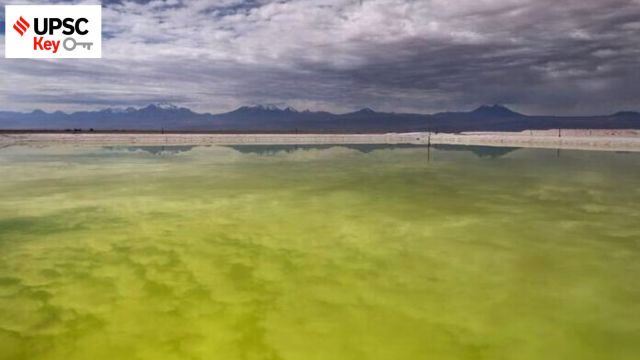 A brine pool reflects clouds at a lithium mine in the Atacama salt flat, close to San Pedro de Atacama area, Antofagasta region, Chile May 4, 2023. Know more in our UPSC Key. (REUTERS/Ivan Alvarado)
🚨 Attention: UPSC Key is now all 7 Days a Week!🚨
Important topics and their relevance in UPSC CSE exam for August 26, 2024. If you missed the August 25th, 2024 UPSC CSE exam key from the Indian Express, read it here.
UPSC Syllabus:
Preliminary Examination: Current events of national importance and environment
Mains Examination: GS-I, GS-III: Geography and environment
What’s the ongoing story- According to a new study, Chile’s Atacama salt flat is sinking at a rate of 1 to 2 centimetres per year due to lithium brine extraction — a process in which salt-rich water is pumped to the surface and into a series of evaporation ponds to eventually obtain lithium.
Prerequisites:
— Read about the lithium.
— What is lithium brine extraction?
— Read about the Atacama Desert.
Key takeaways:
— Lithium, also known as “white gold”, is one of the most sought-after metals on Earth. It is used in rechargeable batteries, which power not only laptops and mobile phones but also electric vehicles — a crucial part of the world’s plan to tackle climate change. However, over the years, research has shown that lithium mining has had severe environmental fallouts, especially in countries such as Chile which are the leading producers of the metal.
— For their study, the researchers at the University of Chile analysed the satellite data collected between 2020 and 2023 to see deformations in the Earth’s crust of Atacama salt flat — one of the largest sources of lithium in the world. The researchers noted that the worst affected areas are those where mining companies are doing most of their pumping of lithium-rich brine.
— The brine evaporation method used to produce lithium requires massive quantities of fresh water, which is already scarce, especially in the Atacama Desert. In the Atacama, it takes 2,000 tons of water to produce one ton of lithium, according to a 2020 study by Ingrid Garcés, a scientist at Chile’s University of Antofagasta. This leaves indigenous communities and wildlife living in the region parched.
— Chemicals such as sulfuric acid and sodium hydroxide that are used for lithium extraction contaminate soil and water, poisoning ecosystems and endangering species.
For Your Information:
— Argentina, Chile, and Bolivia form the “Lithium Triangle” and account for more than half of the world’s total lithium resources.
— India presently imports all of the lithium it requires. The domestic exploration effort extends beyond J&K exploration to include work to extract lithium from brine lakes in Rajasthan and Gujarat, as well as mica belts in Odisha and Chhattisgarh.
Points to Ponder:
— What is the significance of lithium?
— What are the leading lithium-producing countries?
— What are the issues and challenges associated with lithium mining?
Post Read Question:
(1) With reference to Lithium, consider the following statements:
1. The lithium Triangle comprises Argentina along with Brazil and Ecuador.
2. India and Argentina have signed for the first ever lithium exploration and mining project.
3. India is the third highest producer of lithium.
How many of the statements given above are correct?
(a) Only one
(b) Only two
(c) All three
(d) None
UPSC Syllabus:
Preliminary Examination: General issues on Environmental ecology, Bio-diversity and Climate Change
Main Examination: GS-III: Conservation, environmental pollution and degradation, environmental impact assessment.
What’s the ongoing story- Union Environment Minister Bhupender Yadav announced three new Ramsar sites in Tamil Nadu and Madhya Pradesh earlier this month, taking the total of such sites in India to 85.
Prerequisites:
— What are Ramsar Sites?
— What are wetlands?
— What are the different definitions of wetlands?
Key takeaways:
— The new additions are the Nanjarayan Bird Sanctuary and the Kazhuveli Bird Sanctuary in Tamil Nadu, and the Tawa Reservoir in Madhya Pradesh.
— Ramsar sites are also known as wetlands of international importance. The Ramsar convention, which led to their establishment, has been a landmark in raising awareness around this key ecosystem.
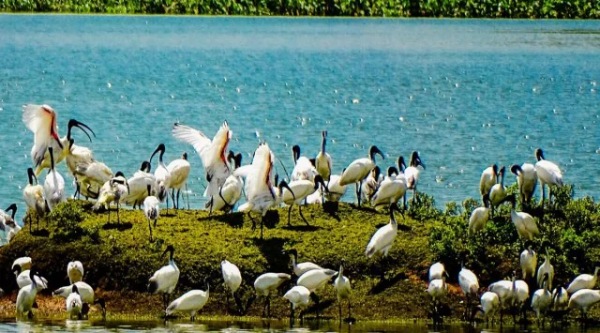 Tamil Nadu has the maximum number of Ramsar sites (14), followed by Uttar Pradesh (10). (Source: Twitter/Supriya Sahu IAS)
— According to the convention, wetlands are defined as “areas of marsh, fen, peatland or water, whether natural or artificial, permanent or temporary, with water that is static or flowing, fresh, brackish or salt, including areas of marine water the depth of which at low tide does not exceed six metres”.
— Wetlands help regulate climate conditions through carbon sequestration, that is, carbon storage from the atmosphere. The plant communities and soil in wetlands capture carbon instead of releasing it to the atmosphere as carbon dioxide, one of the major drivers of global warming.
— According to Wildfowl & Wetlands Trust, the main threats plaguing wetlands are: Unsustainable development, Pollution, Invasive species, and Climate change.
For Your Information:
— The Ramsar Convention is an intergovernmental treaty signed in 1971 in Ramsar, Iran. It encourages the protection and conservation of wetlands worldwide by designating them as such.
— Organisations like the International Union for Conservation of Nature, the World Wide Fund for Nature, and other environmental agencies are associated with the treaty. It also has 172 signatory countries. They are obligated to create wetland reserves and promote the wise use of wetland habitats. India joined it in 1982, initially designating the Chilika Lake in Orissa and Keoladeo National Park in Rajasthan. Today, the country has among the highest number of Ramsar sites in Asia.
Points to Ponder:
— Why are Wetlands important?
— What are the other Ramsar sites in India?
— What is the significance of the Ramsar listing?
— What are the threats to the wetlands?
Post Read Question:
(2) Consider the following pairs:
| Ramsar site | Location |
| Nanjarayan Bird Sanctuary | Gujarat |
| Kazhuveli Bird Sanctuary | Tamil Nadu |
| Tawa Reservoir | Maharashtra |
How many of the pairs given above are correctly matched?
(a) Only one pair
(b) Only two pairs
(c) All three pairs
(d) None of the above pairs
Other Important Articles Covering the same topic:
Explained: Ramsar Sites, and the significance of the listing
UPSC Syllabus:
Preliminary Examination: Current events of national importance
Mains Examination: GS-II: Government policies and interventions
What’s the ongoing story- The Union Cabinet on Saturday (August 24) approved the Unified Pension Scheme (UPS), which will provide government employees with assured pension after retirement. The scheme will be effective from April 1, 2025, according to the government’s announcement.
Prerequisites:
— What is Unified Pension Scheme (UPS)?
— Read about the National Pension Scheme (NPS) and Old Pension Scheme.
— What is Inflation indexation?
Key takeaways:
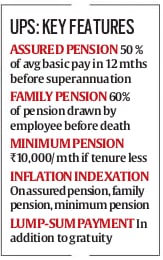
— The UPS promises retirees a fixed pension, unlike the NPS. This was one of the major criticisms of the NPS. According to the government’s notification, the UPS has five key features:
1. Assured pension
2. Assured minimum pension
3. Assured family pension
4. Inflation indexation
5. Lumpsum payment at superannuation
— The NPS replaced the OPS on January 1, 2004 as part of the Centre’s effort to reform India’s pension policies. Those joining government service after this date were put under the NPS.
— Under the OPS, pension to government employees both at the Centre and the states was fixed at 50% of the last drawn basic pay, like it is in the proposed UPS. In addition, there was Dearness Relief — calculated as a percentage of the basic salary — to adjust for the increase in the cost of living.
— The NPS was introduced by the Atal Bihari Vajpayee government because of a fundamental problem with the OPS — that it was unfunded, i.e., there was no corpus specifically for pension. Over time, this led to the government’s pension liability to balloon to fiscally unhealthy, if not unsustainable, levels. With better healthcare facilities leading to longer average lifespans, the OPS could not have continued in the long run.
— The NPS was different from OPS in two fundamental ways. First, it did away with an assured pension. Second, it would be funded by the employee himself/ herself, along with a matching contribution by the government.
For Your Information:
From The Editorial Page “Reframing Pension”
— While the UPS has incorporated elements from both the old and the new pension scheme, it has partially rolled back some of the more fiscally appealing, hard-won features of the National Pension System.
— Under the unified pension scheme, government employees will receive a “defined benefit” — a pension equivalent to 50 per cent of their average basic pay drawn in the year prior to retirement. To finance this, there will also be a “defined contribution” — the government will now contribute 18.5 per cent of the basic salary of employees, up from 14 per cent, while employees will continue to contribute 10 per cent.
— While this new scheme will be unlike the unfunded OPS, and may also benefit from greater clarity, assuring a “defined benefit”, a key feature of both the old pension scheme and the unified pension scheme raises the possibility of the fiscal burden on the government increasing as it will have to make up for any shortfalls.
— A return to defined benefits, which essentially involves providing generous benefits to only a tiny section of the labour force, runs the risk of not just increasing the burden on the exchequer, but also further constraining the space for spending on other avenues.
Points to Ponder:
— What was the basis for the opposition to NPS ?
— What are the benefits of UPS?
— What can be the impact of UPS on the long-term fiscal sustainability of the Indian economy?
Post Read Question:
(3) Consider the following statements:
(1) Unified Pension Scheme will be available to all those who have completed 25 years of service in the government.
(2) An assured minimum pension of Rs 10,000 per month would be given on superannuation after minimum 10 years of service to employees.
Which of the statements given above is/are correct?
(a) 1 only
(b) 2 only
(c) Both 1 and 2
(d) Neither 1 Nor 2
Other Important Articles Covering the same topic:
ExplainSpeaking | The need to reform India’s pensions system, beyond the OPS-NPS debate
UPSC Syllabus:
Preliminary Examination: Current events of national and international importance
Mains Examination: GS-II: Effect of policies and politics of developed and developing countries on India’s interests, Indian diaspora.
What’s the ongoing story- Ukraine President Volodymyr Zelenskyy has told Prime Minister Narendra Modi that India can be a possible venue for a peace summit, and New Delhi is examining the offer to bring together the warring parties of Russia and Ukraine, The Indian Express has learnt. This comes even as Zelenskyy said that he needed India on his side and “not balancing between US and Russia”.
Prerequisites:
— Read about the Ukraine-Russia war and its impact.
— What is the history of bilateral ties between India and Ukraine?
— Map work: Location of Ukraine, Czech Republic, Bulgaria, Hungary, Poland, Romania, and Slovakia, Important places in news related to the Ukraine-Russia war.
Key takeaways:
— Whether that summit will be the next one or later is a question that will be something South Block needs to weigh in the pros and cons. The inaugural peace summit was held at a resort near Lucerne in Switzerland in June and was attended by more than 90 countries and global institutions with a sole focus on bringing peace to Ukraine.
For Your Information:
From the Editorial Page- “Momentous in Kyiv”
— Prime Minister Narendra Modi’s talks with the President of Ukraine, Volodymyr Zelenskyy, in Kyiv must be seen as the beginning of a long overdue rebalancing in India’s relations with Russia and Ukraine.
— Quite clearly, India is no longer self-deterred by a presumed “Russian veto” in expanding engagement with Ukraine. That no Indian Prime Minister travelled to post-Soviet Ukraine, the second-largest nation in Europe, underlines Delhi’s self-imposed restraint in engaging Kyiv.
— The political deference to Russian sensitivities also played a role in limiting India’s engagement with former members of the Warsaw Pact. Modi is the first Indian Prime Minister to travel to Poland since 1979.
— That no Indian PM has travelled to the Czech Republic, Bulgaria, Hungary, Poland, Romania, and Slovakia since the dissolution of the Warsaw Pact in 1991 underlines the long and regrettable political neglect of these countries. In contrast, India’s high-level engagement with these nations was impressive during the Soviet era.
— Delhi’s political emphasis on sustaining the Moscow links and preventing Russia from engaging with Pakistan at the highest level since the turn of the 1990s may provide some context for this neglect. But it does not absolve its decision to abandon high-level engagement with Central Europe even as the region’s global salience grew after it broke away from Soviet Russia and drew closer to the European Union and the United States.
— Delhi’s rebalancing does not mean a downsizing of India’s relationship with Moscow, which will remain a major power in the neighbourhood and an important partner, but an elevation of its engagement with Ukraine and Central Europe. India’s rebalancing sends a clear signal that Delhi will no longer let the ideological inhibitions inherited from the 20th century guide its European policy in the 21st.
Points to Ponder:
— What is the significance of Ukraine for India?
— What is India’s stand on the Ukraine-Russia war?
— How has the global support for Ukraine and what peace efforts have been made so far.
— What are the challenges in the India-Ukraine bilateral ties?
— What is the significance of Central Europe for India?
Post Read Question:
In the evolving global landscape, India needs to reconsider its relationship with Russia and Central Europe. Comment.
Other Important Articles Covering the same topic:
PM Modi in Kyiv today: Deep concern, offer all cooperation in returning peace via talks
UPSC Syllabus:
Preliminary Examination: Current events of national and international importance
Mains Examination: GS-II, GS-III: Bilateral agreements involving India and/or affecting India’s interests; Effect of policies and politics of developed and developing countries on India’s interests
What’s the ongoing story- C. Raja Mohan writes— “India is arguably better placed than most of America’s partners to deal with the incipient political change of guard in Washington. Whether it is the Republican candidate, former President Donald Trump, or the Democratic nominee, Vice President Kamala Harris, who wins the November election, India’s relations are unlikely to face any disruption.”
Prerequisites:
— Read about the history of India-US bilateral ties.
— What are the areas of cooperation between India and the US?
Key takeaways:
— “India has strengthened its relationship with the US under both the Trump and Biden administrations. Delhi, therefore, has reasons to be confident about continuity in its ties with the US.”
— “India’s relations with the US have been on an upward arc since President Bill Clinton visited India in March 2000. Presidents George W Bush (Republican), Barack Obama (Democratic), Trump (Republican), and Joe Biden (Democratic) pushed the relationship forward. In India, Atal Bihari Vajpayee (BJP), Manmohan Singh (Congress), and Narendra Modi (BJP) have also been as committed to the deepening of the partnership.”
— “The US is now the most comprehensive and consequential partner for India. China is a large trading partner but it is also the biggest contributor to India’s trade deficit. Delhi is also locked in a semi-permanent military confrontation with Beijing on its long and contested border.”
— “Russia is a major military partner, but the relationship does not have the economic or technological weight of Delhi’s relationship with Washington.”
— “Europe is a major source of trade, technology and capital, but does not have America’s geopolitical heft that can contribute to India’s national security objectives. Cutting across all this is the hugely successful five million-strong Indian diaspora in the US.”
— “The Russian question will continue to be a complicating factor in India’s relations with the US. PM Modi’s visit to Kyiv last week underlines Delhi’s commitment and capacity to carefully traverse the Ukraine minefield between Russia, Europe, and America.”
— “China’s challenge to Asian security has been a major source of strategic convergence between Delhi and Washington in recent years. The shared interest in building a multipolar Asia became explicit under Trump and acquired greater traction under Biden.”
For Your Information:
— Moving to deepen their defence ties, India and the United States have agreed to advance priority co-production projects, including jet engines, unmanned platforms, munitions and ground mobility systems, under the US-India Roadmap for Defence Industrial Cooperation.
Points to Ponder:
— What are the challenges to India-US bilateral ties?
— What is QUAD?
— What are the key defence agreements signed between India and the US?
(Thought Process: Know about the Basic Exchange and Cooperation Agreement for Geospatial Intelligence (BECA), Logistics Exchange Memorandum of Agreement (LEMOA), Communication Compatibility and Security Agreement (COMCASA), and General Security of Military Information Agreement (GSOMIA).
— What steps should be taken to streghten India-US relations?
Post Read Question:
Europe is a major source of trade, technology and capital, but does not have America’s geopolitical heft that can contribute to India’s national security objectives. Considering this statement, analyse the importance of America for India.
Other Important Articles Covering the same topic:
Jet engines to munitions: India and US to speed up co-production
UPSC Syllabus:
Preliminary Examination: Indian Polity
Mains Examination: Parliament and State Legislatures
What’s the ongoing story- S Y Quraishi writes— “The issue of simultaneous elections, which has been hanging fire for over a decade, has now been placed on the precipice of the Red Fort by the Prime Minister in his Independence Day speech this year. He has renewed his resolve to implement the idea as soon as possible, most likely by the 2029 general elections.”
Prerequisites:
— Read the constitutional provisions related to the elections in India.
— What are Simultaneous Elections?
— Know about the Election Commission of India.
Key takeaways:
— “Several committees have gone into the subject and have not been able to find an acceptable solution. The last such effort is a high-level committee headed by the former president of India, Ram Nath Kovind. The mandate of this committee was not to debate the pros and cons of the proposal, but to suggest concrete ways to implement it.”
— “The committee presented a detailed report in record time, as mandated…It suggested a new article in the Constitution, namely 82A, which says, “notwithstanding anything contained in Articles 83 and 172, all the legislative assemblies constituted in any general election held after the appointed date shall come to an end on the expiry of the full term of the house of the people”.
— “In an explanation, the committee clarified that the expression “simultaneous elections” shall mean general election comprising Lok Sabha and all Vidhan Sabha elections together — leaving out Panchayat elections. For the latter, it proposes elections “within hundred days”.”
— “The report also says, “where any state legislative assembly is dissolved on account of no confidence motion, a hung house, or any other event, fresh elections will be held for such new house with tenure ending with that of the house of the people.” This doesn’t obviate a midterm poll. Imagine candidates spending crores of rupees on an election for a truncated term — as low as one to two years. This is certainly not a simultaneous election.”
— “The committee has, however, done well to re-emphasise the need for a single electoral roll, through amendment to Article 325, since the voters for all three tiers are the same. This virtually transfers the local bodies’ electoral rolls to the ECI “in consultation with State Election Commissioners” — certainly not an uncomplicated task.”
— “Those supporting simultaneous elections were of the opinion that separate elections cause a waste of resources. Though the majority of expert opinion held that amendments would need to be made to the Constitution and related laws, they emphasised that such amendments will not be anti-democratic or anti-federal, they will not be opposed to the basic structure of the Constitution, and will not result in a presidential form of government.”
Points to Ponder:
— What are the benefits of simultaneous elections?
— What are the issues and challenges associated with the simultaneous elections?
— What are the recommendations of the High-Level Committee (HLC) on “One Nation, One Election”?
— What electoral reforms have been introduced in India?
Post Read Question:
(4) With reference to the High-level Committee (HLC) on “One Nation, One Election”, consider the following statements:
1. In the event of a hung House, a no-confidence motion, or any such event, fresh elections should be held to constitute the new Lok Sabha or state Assembly.
2. The committee recommended the preparation of single electoral roll and electoral photo identity cards.
3. The Constitution should be amended to enable simultaneous elections.
How many of the above are the recommendations of the High-level Committee (HLC)?
(a) Only one
(b) Only two
(c) All three
(d) None
Other Important Articles Covering the same topic:
One Nation, One Election: Highlights of the Kovind panel’s recommendations
The 360° UPSC Debate | Does India Need Simultaneous Elections?
UPSC Syllabus:
Preliminary Examination: Economic and Social Development
Mains Examination: GS-II, GS-III: Government policies and interventions, Economic Development
What’s the ongoing story- Gourav Vallabh writes— “The Pradhan Mantri MUDRA Yojana (PMMY) was launched in 2015 by the Narendra Modi government. The initiative, which focused on igniting entrepreneurship, provided collateral-free micro-loans up to Rs 10 lakh and supported numerous small and microenterprises. The Union Budget 2024 has increased the loan amount to Rs 20 lakh.”
Prerequisites:
— What is the Pradhan Mantri MUDRA Yojana (PMMY)?
— What are the main objectivesof PMMY?
— What are the different categories of loans provided under the PMMY?
Key takeaways:
— “The Budget has targeted the scheme’s Tarun category for enhancement, doubling the upper loan limit to Rs 20 lakh. The move is set to benefit those who have already availed of and repaid previous MUDRA loans under this category. It is time to move towards a new version of the scheme – MUDRA 2.0.”
— “Its inclusive approach is a key feature of the scheme. About 69 per cent of the MUDRA loan accounts are held by women, and 51 per cent belong to SC/ST and OBC entrepreneurs.”
— “The initiative has also been crucial in creating jobs, especially in rural and semi-urban areas. It has encouraged self-employment and supported the development of small businesses.”
— “Despite its success, MUDRA 1.0 faced several challenges. One critical issue was ensuring that benefits reached the intended target groups, particularly the smallest and most marginalised entrepreneurs.”
— “Inadequate monitoring and implementation led to leakages and misuse of funds. The higher NPAs under the Shishu and Kishore categories are due to a lack of business knowledge and skills among early-stage entrepreneur…The limited financial literacy of beneficiaries was another significant challenge.”
— “In light of this experience, MUDRA 2.0 should widen its scope, improve its effectiveness, and establish a robust support system for micro-entrepreneurs. For this, a focused outreach and empowerment zone should be set up in rural and semi-urban areas.”
— “MUDRA 2.0 should introduce nationwide financial literacy programmes covering budgeting, savings, credit management, investment strategies, and digital literacy.”
For Your Information:
— Loans are classified as MUDRA loans under PMMY. Commercial Banks, RRBs, Small Finance Banks, MFIs and NBFCs can disburse these MUDRA loans. Three products namely ‘Shishu’, ‘Kishore’ and ‘Tarun’ were created under to signify the stage of development, funding needs of the beneficiary and also provide a reference point for the next phase of growth.
Points to Ponder:
— What are the key features of PMMY?
— What has been the impact of the PMMY on financial inclusion and employment generation in India?
— What are the issues and challenged associated with the PMMY?
— What initiatives have been taken by the Government for the financial inclusion and literacy?
Post Read Question:
(5) Pradhan Mantri MUDRA Yojana is aimed at ( UPSC CSE 2016)
(a) bringing the small entrepreneurs into formal financial system
(b) providing loans to poor farmers for cultivating particular crops
(c) providing pensions to old and destitute persons
(d) funding the voluntary organizations involved in the promotion of skill development and employment generation
Other Important Articles Covering the same topic:
30 cr MUDRA Yojana loans for women entrepreneurs: What is Pradhan Mantri MUDRA Yojana?
| ALSO IN NEWS | |
| SC panel stressed on environmental study for Gangotri route, BRO says not needed | The Border Roads Organisation (BRO) has told the Uttarakhand forest department and an Environment Ministry panel that the Chardham road project on the Gangotri-Dharasu route does not require either environment impact assessment (EIA) study or environmental clearance (EC), according to official records.The Gangotri-Dharasu route falls in the Bhagirathi Eco-Sensitive Zone (BESZ). |
| India, Singapore to identify new areas to elevate strategic ties | India and Singapore are going to hold the second round of ministerial roundtable Monday, which will review various aspects of their Strategic Partnership and identify new avenues to further elevate and broaden it. |
| Financial sector sees Rs 23k-cr pull out by FPIs on credit-deposit gap concerns | The financial services sector witnessed outflows to the tune of Rs 23,000 crore by foreign portfolio investors (FPIs) between July 16 and August 15, according to National Securities Depository Ltd (NSDL) data. Analysts said that selling by FPIs in the financial sector was mainly on concerns over slower deposit growth compared to loan growth, which can affect profitability of banks. |
| Prelims Answer Key |
| 1. (a) 2. (a) 3. (c) 4. (c) 5. (a) |
Subscribe to our UPSC newsletter and stay updated with the news cues from the past week.
Stay updated with the latest UPSC articles by joining our Telegram channel – Indian Express UPSC Hub, and follow us on Instagram and X.
https://www.youtube.com/watch?v=XhtsI_VXavI?si=ZzsLusr84JzgIVyp


Read UPSC Magazine