18 min read


© IE Online Media Services Pvt Ltd



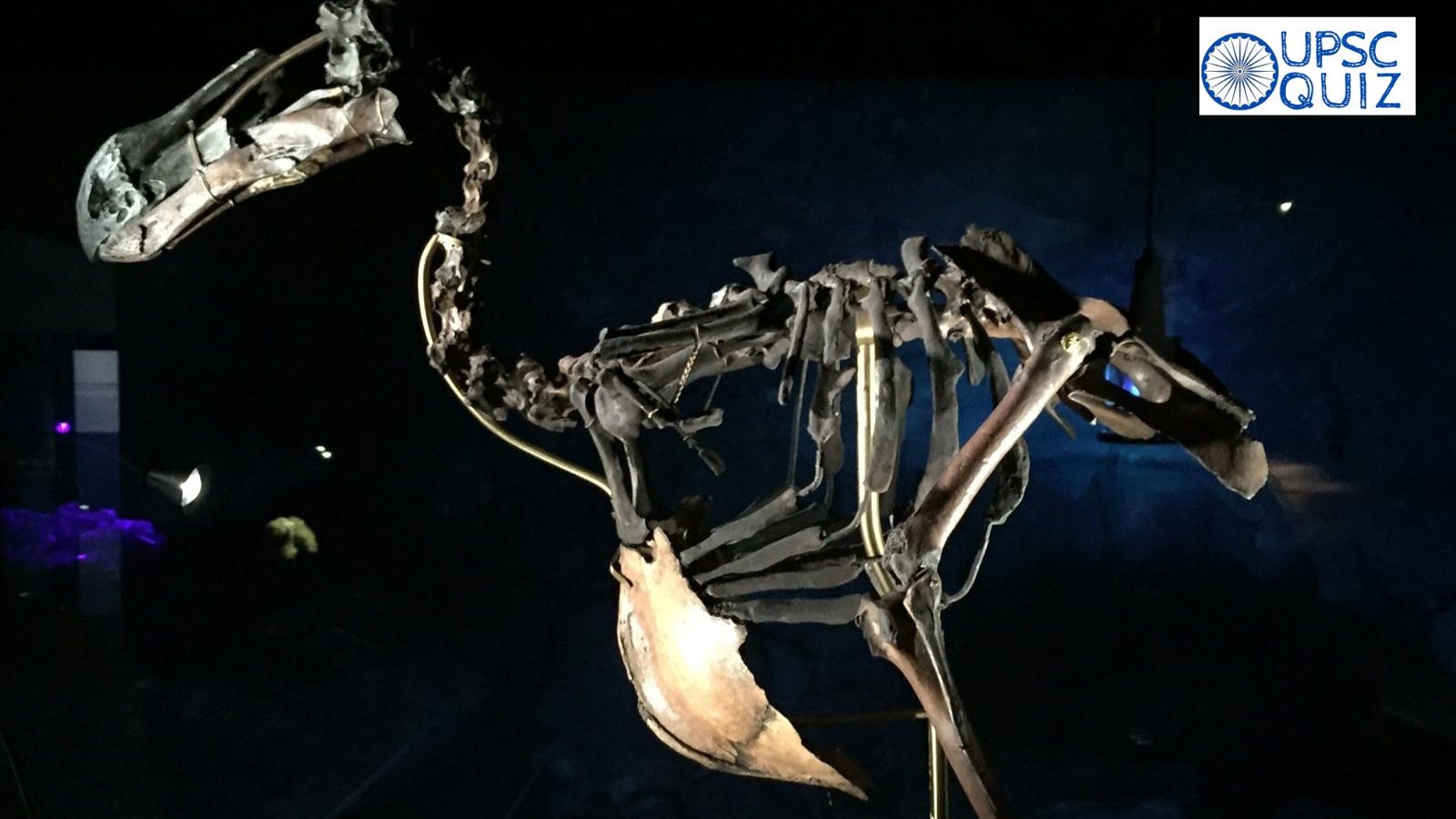 A reconstructed dodo skeleton on show in Naturalis Biodiversity Center, Leiden, Germany. Find a question in our quiz today. (Wikimedia Commons)
UPSC Weekly Quiz is a current affairs-based quiz on relevant topics from the past week, curated for the aspirants of competitive examinations. Attempt the weekly quiz and find answers to the MCQs with explanations at the end of the article.
Consider the following statements and answer the question below:
1. Climate finance refers to large-scale investments required for actions aiming to mitigate or adapt to the consequences of climate change.
2. Climate finance is a key topic of discussion at COP28 as it has been a bone of contention between low income countries and developed nations.
3. Last year Oxfam said that the developed world provided $83.3 billion in 2020 to the low income countries as climate finance.
Which of the above statement/s is/are correct?
(a) 1 only
(b) 1 and 2 only
(c) 1 and 3 only
(d) 1, 2 and 3
With reference to the National Crime Records Bureau’s (NCRB) annual report on crime in India for the year 2022, consider the following statement:
1. The crime rate, or crimes registered per lakh population, has increased in 2022 from 2021.
2. Reporting of cyber crime increased significantly in 2022 compared to 2021.
Which of the above statement/s is are correct?
(a) Only 1
(b) Only 2
(c) Both 1 and 2
(d) Neither 1 nor 2
His empire reached the west coast after 1656-57, when his dominions touched Kalyan. In the same year, he decided to establish a navy in order to protect his territory from the Siddis, and secure ports and merchant ships which would ensure maritime trading, that brought in revenue and customs duty, went on smoothly. His vision for establishing a naval wing of his military was based on his belief in ‘Jalameva yasya, balameva tasya’ (‘He who rules the seas is all powerful’)
The above lines refer to:
(a) Baji Rao
(b) Shivaji
(c) Sambhaji
(d) Maharana Pratap
With reference to Universal Declaration of Human Rights, consider the following statements:
1. A relatively compact document, the declaration consists of a preamble and 30 articles setting out fundamental rights and freedoms.
2. Seventy-five years ago , the UN General Assembly approved the Universal Declaration of Human Rights at a meeting in Paris.
3. A formal drafting committee was chaired by U.S. President Franklin D. Roosevelt, and consisted of members of the new Commission on Human Rights from eight countries, selected to reflect geographical distribution.
Which of the above statement/s is/are correct?
(a) Only 1
(b) Only 1 and 2
(c) Only 1 and 3
(d) Only 2 and 3
With reference to The Advocates Act, 1961, consider the following statements:
1. The Advocates Act, 1961, was enacted to amend and consolidate the law relating to legal practitioners and to provide for the constitution of Bar Councils and an All-India Bar.
2. Before this, legal practitioners were governed by three Acts – the Legal Practitioners Act, 1879, the Bombay Pleaders Act, 1920, and the Indian Bar Councils Act, 1926.
3. This Act repealed a majority of the 1879 Act but left behind provisions relating to its extent, definitions, and powers to frame and publish lists of touts.
Which of the above statement/s is/are correct?
(a) Only 1 and 2
(b) Only 1
(c) Only 1 and 3
(d) 1, 2, and 3
What is Pompe Disease?
(a) It is a rare genetic disorder caused by a deficiency of the enzyme acid alpha-glucosidase.
(b) The deficiency of carnitine in cells.
(c) A fatal disease caused due to the presence of certain pathogens in water such as protozoan.
(d) None of the above.
Recently seen in news, geneticists and conservationists have joined forces to re-introduce the Dodo, extinct since the late 17th century, to its once native habitat. Which country is planning to bring back the bird?
(a) Canada
(b) Germany
(c) Mauritius
(d) Cyprus
With reference to the history of accession of Junagadh and Hyderabad, consider the following statements:
1. A plebiscite was held in Hyderabad, where 91% of the voters chose to stay in India.
2. The Indian Army was sent to Junagadh under Operation Polo and in three days the Nizam’s forces surrendered.
Which of the above statement/s is/are correct?
(a) Only 1
(b) Only 2
(c) Both 1 and 2
(d) Neither 1 nor 2
This flexible AI model, which comes in three sizes — Ultra (which is yet to be launched), Pro, and Nano — is being seen as an answer to ChatGPT, which has been ahead of the game so far when it comes to generative artificial intelligence (GenAI).
The above lines refer to:
(a) Bard AI
(b) SpinBot
(c) Copy.ai
(d) None of the above
With reference to history between between Italy and India, consider the following statements:
1. The Venetian merchant Marco Polo traveled to India in the 13th century and wrote about his experiences.
2. Nobel Laureate Rabindranath Tagore visited Italy in May-June 1926, a visit arranged by Carlo Formichi, a Professor of Sanskrit at the University of Rome.
3. Indian troops, serving with the British Indian Army, were deployed in Italy during World War II, fighting against the Germans and Mussolini’s forces.
Which of the above statement/s is/are true?
(a) 1 and 2
(b) Only 2
(c) Only 3
(d) 1, 2 and 3
FYI:
The United Arab Emirates, which is hosting the ongoing COP28 climate summit, announced on December 1 that it would contribute $30 billion to a new fund aiming to divert private sector capital towards climate investments and improve financing for the Global South.
UAE President Mohamed bin Zayed al-Nahyan said the fund was “specifically designed to bridge the climate finance gap” and stimulate further investment of $250 billion by 2030.
Climate finance is a key topic of discussion at COP28 as it has been a bone of contention between low income countries and developed nations. Here is a look at the issue. Hence, statement 2 is correct.
What is climate finance?
Climate finance refers to large-scale investments required for actions aiming to mitigate or adapt to the consequences of climate change. Hence, statement 1 is correct.
How much climate finance is being provided?
Different organisations have debated over the actual amount of money being provided to developing nations.
Last year, the Organisation for Economic Cooperation and Development (OECD) — largely a group of rich countries including the US, the UK, Germany, France, Switzerland, Canada, and others — said that the developed world provided $83.3 billion in 2020 to the low income countries as climate finance. Hence, statement 3 is incorrect.
However, Oxfam contested the figure, accusing the developed countries of using dishonest and misleading accounting to inflate their climate finance contributions to developing countries by as much as 225%.
“Oxfam estimates between just $21-24.5 billion as the ‘true value’ of climate finance provided in 2020, against a reported figure of $68.3 billion in public finance that rich countries said was provided (alongside mobilised private finance bringing the total to $83.3 billion),” it said.
Moreover, the higher income countries have also been criticised for giving most of the money as non-concessional loans. “This has added to debt pressures across regions and income groups,” according to a UN report.
Therefore, option (b) is the correct answer.
FYI:
The National Crime Records Bureau (NCRB) released its annual report on crime in India for the year 2022 on Sunday (December 3).
The report is a compilation of data on reported crime from across the country, and provides the big picture of broad trends in crime registration. Reports by the NCRB, which functions under the Union Ministry of Home Affairs, include statistics on offences ranging from crimes against women to economic and financial crimes.
What does the 2022 NCRB report say?
The data cover overall crimes, and separately note crimes against women, Scheduled Castes (SCs) and Scheduled Tribes (STs), cyber crimes, etc. Here are some takeaways from the latest report:
* In 2022, a “total of 58,24,946 cognizable crimes comprising 35,61,379 Indian Penal Code (IPC) crimes and 22,63,567 Special & Local Laws (SLL) crimes were registered”. This was a decline of 4.5% in the registration of cases over the second pandemic year, 2021.
* The crime rate, or crimes registered per lakh population, has declined from 445.9 in 2021 to 422.2 in 2022. This is seen as a better indicator, since absolute numbers on crime increase as the population increases. Hence, statement 1 is incorrect.
* 4,45,256 cases of crime against women were registered in 2022. This was an increase of 4% over the 2021 numbers. The largest share of crimes against women under IPC sections was registered under ‘Cruelty by Husband or His Relatives’ (31.4%), followed by ‘Kidnapping & Abduction of Women’ (19.2%), and ‘Assault on Women with Intent to Outrage her Modesty’ (18.7%).
* Reporting of cyber crime increased significantly by 24.4 percentage points compared to 2021, to 65,893 cases. Around 64.8% of registered cases were of fraud, followed by extortion (5.5%), and sexual exploitation (5.2%). Hence, statement 2 is correct.
* An increase of 4.2% was observed in suicides reported during 2022 (1,70,924 suicides) as compared to 2021. ‘Family Problems (other than marriage-related problems)’ (31.7%), ‘Marriage Related Problems’ (4.8%) and ‘Illness’ (18.4%) have together accounted for 54.9% of total suicides in the country during the year 2022. The overall male-to-female ratio of suicide victims was 71.8:28.2.
Therefore, option (b) is the correct answer.
FYI:
Prime Minister Narendra Modi, on the occasion of Navy Day (December 4), paid tributes to Chhatrapati Shivaji Maharaj, and unveiled a grand statue of the 17th century Maratha king at the coastal fort of Sindhugarh, Maharashtra.
Shivaji’s navy
Shivaji’s empire reached the west coast after 1656-57, when his dominions touched Kalyan. In the same year, he decided to establish a navy in order to protect his territory from the Siddis, and secure ports and merchant ships which would ensure maritime trading, that brought in revenue and customs duty, went on smoothly. His vision for establishing a naval wing of his military was based on his belief in ‘Jalameva yasya, balameva tasya’ (‘He who rules the seas is all powerful’)
Between 1661 and 1663, the Maratha Navy came into existence, and at its peak included 400-odd ships of various kinds and sizes. These included both larger battleships, and other vessels of varying shapes and purposes, such as the gurab, tarande, galbat, shibad, and pal.
Therefore, option (b) is the correct answer.
FYI:
Seventy-five years ago on Sunday, the UN General Assembly approved the Universal Declaration of Human Rights at a meeting in Paris – laying one of the foundation stones of the international order that emerged following the horrors of World War II. Hence, statement 2 is correct.
A relatively compact document, the declaration consists of a preamble and 30 articles setting out fundamental rights and freedoms. Hence, statement 1 is correct.
Article 1 states that “all human beings are born free and equal in dignity and rights.” And Article 2 says that everyone is entitled to all the rights and freedoms the declaration sets out, “without distinction of any kind, such as race, colour, sex, language, religion, political or other opinion, national or social origin, property, birth or other status.”
Other articles state that “everyone has the right to life, liberty and the security of person,” and that no one “shall be held in slavery or servitude” or “subjected to torture or to cruel, inhuman or degrading treatment or punishment.”
The declaration says that “all are equal before the law” and that everyone is entitled to “a fair and public hearing by an independent and impartial tribunal.” And it says that “everyone has the right to seek and to enjoy in other countries asylum from persecution.” The declaration enshrines the rights to freedom of religion; to freedom of opinion and expression; and to freedom of peaceful assembly. And it says that everyone has the right to education.
Why and how was it drawn up?
The declaration was born of the “never again” sentiment among political leaders after two world wars and the Holocaust. On top of the U.N. Charter, the document that founded the United Nations in 1945, countries decided to draw up what the U.N. calls a “road map” to guarantee the rights of every individual.
A formal drafting committee was chaired by Eleanor Roosevelt, the widow of U.S. President Franklin D. Roosevelt, and consisted of members of the new Commission on Human Rights from eight countries, selected to reflect geographical distribution. Hence, statement 3 is incorrect.
Therefore, option (b) is the correct answer.
FYI:
On the first day of the Parliament’s Winter Session on Monday (December 4) the Advocates Amendment Bill, 2023, was passed in the Lok Sabha. Introduced in the Rajya Sabha’s Monsoon Session on August 1, the Bill was passed by the House two days later.
Aimed at weeding out ‘touts’ from the legal system, the Bill repeals the Legal Practitioners Act, 1879, and amends the Advocates Act, 1961, to reduce “the number of superfluous enactments in the statute book” and repeal all “obsolete laws”.
The Advocates Act of 1961 was passed in independent India to create a single Act to regulate the legal profession. This Act repealed a majority of the 1879 Act but left behind provisions relating to its extent, definitions, and powers to frame and publish lists of touts.
The Advocates Act, 1961, was enacted to amend and consolidate the law relating to legal practitioners and to provide for the constitution of Bar Councils and an All-India Bar.
Before this, legal practitioners were governed by three Acts – the Legal Practitioners Act, 1879, the Bombay Pleaders Act, 1920, and the Indian Bar Councils Act, 1926.
Post-independence, a need was felt for bringing in changes in India’s judicial administration. The Law Commission was tasked with preparing a report on reforms. In its 249th Report titled ‘Obsolete Laws: Warranting Immediate Repeal’, the Commission recommended repealing the 1879 Act. Additionally, the All-India Bar Committee made its recommendations on the subject in 1953. Taking these into account, the 1961 Act was passed.
Therefore, option (d) is the correct answer.
FYI:
Nidhi Shirol, India’s first Pompe disease patient, passed away last month at the age of 24 years after battling the disease. She spent the last six years in a semi-comatose state.
In 2010, her father Prasanna Shirol started the Organisation for Rare Diseases India (ORDI), the first NGO in the country for rare diseases. Here, he explains what the disease is, how common it is, and how it is diagnosed.
What is Pompe Disease?
Also known as Glycogen Storage Disease Type II, Pompe disease is a rare genetic disorder caused by a deficiency of the enzyme acid alpha-glucosidase (GAA). This enzyme is crucial for breaking down glycogen into glucose within the lysosomes of cells.
Its prevalence estimates range from 1 in 40,000 to 1 in 300,000 births. It occurs across diverse ethnicities and populations. The age of onset and severity can vary, leading to a spectrum of clinical presentations.
Therefore, option (a) is the correct answer.
FYI:
Geneticists and conservationists have joined forces to re-introduce the Dodo, extinct since the late 17th century, to its once native habitat in the island of Mauritius.
Therefore, option (c) is the correct answer.
FYI:
Accession of Junagadh
Junagadh, in the Kathiawar region of Gujarat, was ruled by Nawab Muhammad Mahabat Khanji III. Initially, the Nawab had given indications of joining India. However, months before Independence, he got a new prime minister, Sir Shah Nawaz Bhutto (father of Pakistan’s future PM, Zulfikar Ali Bhutto).
Upon Bhutto’s persuasion, the Nawab on August 14, 1947, announced he would join Pakistan, though most of his subjects were Hindu and Junagadh had no direct land link to the new country. Pakistan accepted the accession.
Incensed, India sent a small military to support two of Junagadh’s tributary states that did not agree with the Nawab’s decision. Junagadh’s residents too rose in protest. By November, the Nawab had fled to Karachi and Bhutto had to ask India to take over the province. A plebiscite was held, where 91% of the voters chose to stay in India.
Accession of Hyderabad
Adhir Ranjan in Parliament mentioned Victoria Schofield’s book. Here’s what it says about the proposed “barter”, “Corfield had suggested that if Hyderabad, second largest of the princely states, with its Hindu majority and Muslim ruler, and Kashmir, with its Hindu ruler and Muslim majority, were left to bargain after independence, India and Pakistan might well come to an agreement. ‘The two cases balanced each other . . . but Mountbatten did not listen to me… Anything that I said carried no weight against the long-standing determination of Nehru to keep it [Kashmir] in India.’”
Hyderabad joining Pakistan was never a practical proposition. However, Patel gave Nizam Mir Usman Ali a long rope, partially because of the prestige he enjoyed in the Muslim world — his sons were married to the daughter and niece of the deposed Caliph of Ottoman, Abdulmejid II, who even wanted his daughter’s heir to succeed him as the Caliph. Till three months after Independence, all India had with Hyderabad was a stand-still agreement, which meant ties remained as they were under the British. Negotiations continued.
However, soon, the situation on the ground demanded faster action. Revolt against the Nizam’s rule was widening, for democracy as well as against large landholdings, forced labour, and excessive tax collection. An outfit meant to cement the Nizam’s position, the Ittehad-ul-Muslimeen, was getting more violent, with its paramilitary wing called the ‘razakars’ brutally attacking all opponents.
Finally, on September 13, 1948, the Indian Army was sent to Hyderabad under Operation Polo. In three days, the Nizam’s forces surrendered.
Therefore, option (d) is the correct answer.
FYI:
Google Gemini, a new multimodal general AI model, which the tech giant calls its most powerful yet, is now available to users around the world through Bard, some developer platforms, and even the new Google Pixel 8 Pro phones.
The flexible AI model, which comes in three sizes — Ultra (which is yet to be launched), Pro, and Nano — is being seen as Google’s answer to ChatGPT, which has been ahead of the game so far when it comes to generative artificial intelligence (GenAI).
Therefore, option (d) is the correct answer.
FYI:
Last week, the hashtag #Melodi trended widely on social media, after Prime Minister Narendra Modi responded to a post on X by his Italian counterpart Giorgia Meloni. Meloni had posted a selfie with Modi, taken on the sidelines of the COP28 meet in Dubai, saying “Good friends at COP28”. Meloni also added #Melodi, a combination of the two leaders’ names.
Modi reposted the picture, writing: “Meeting friends is always a delight.”
The bonhomie and the hashtag represent the new harmony in India-Italy ties, coming after some rough years.
History
India and Italy are ancient civilisations with links going back 2,000 years. Italian port cities were important trading posts on the spice route. The Venetian merchant Marco Polo traveled to India in the 13th century and wrote about his experiences.
In the last century, Nobel Laureate Rabindranath Tagore visited Italy in May-June 1926, a visit arranged by Carlo Formichi, a Professor of Sanskrit at the University of Rome.
Mahatma Gandhi visited Rome in December 1931 on his way back from the Round Table Conference in London. Leaders of the Indian freedom struggle read the works of the Italian revolutionary Mazzini.
Indian troops, serving with the British Indian Army, were deployed in Italy during World War II, fighting against the Germans and Mussolini’s forces.
After Independence, political relations between India and Italy were established in 1947. Since then, there has been a regular exchange of visits at political and official levels between both countries, including several visits by Heads of States.
Therefore, option (d) is the correct answer.

Read UPSC Magazine