9 min read
© IE Online Media Services Pvt Ltd
Latest Comment
Post Comment
Read Comments



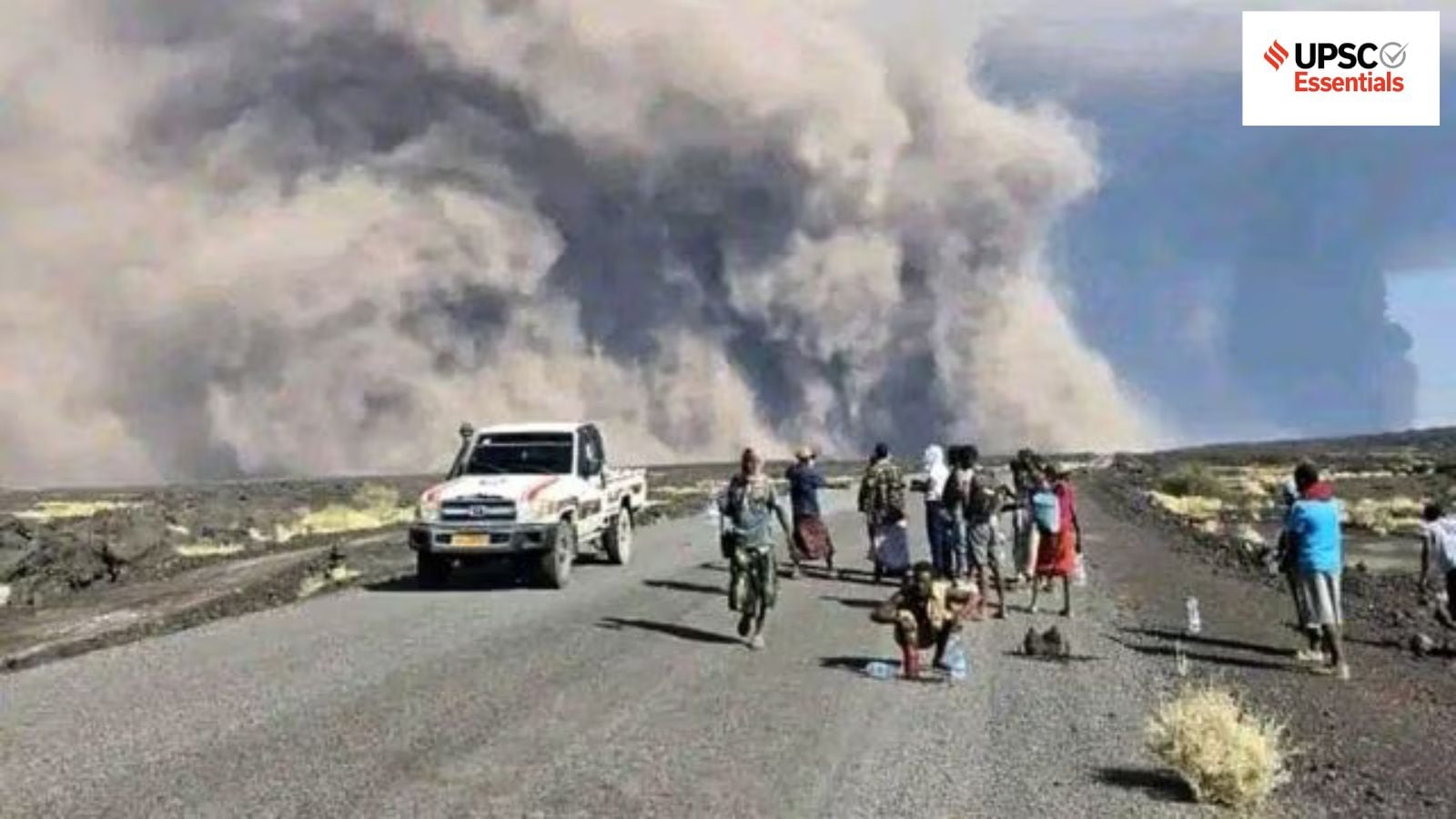 Are you preparing for Civil Services Exam 2026? Attempt a question on the volcanic eruption in the context of Hayli Gubbi’s recent eruption. (Afar Government Communication Bureau via AP)
UPSC Essentials brings to you its initiative for the practice of Mains answer writing. It covers essential topics of static and dynamic parts of the UPSC Civil Services syllabus covered under various GS papers. This answer-writing practice is designed to help you as a value addition to your UPSC CSE Mains. Attempt today’s answer writing on questions related to topics of GS-1 to check your progress.
🚨 Click Here to read the UPSC Essentials magazine for November 2025. Share your views and suggestions in the comment box or at manas.srivastava@indianexpress.com🚨
What are the geological factors that determine whether a volcanic eruption will be effusive or explosive? Discuss in the context of Hayli Gubbi’s recent eruption.
“Tropical forests are the engines of global biodiversity and climate regulation.” Discuss the factors responsible for their high biodiversity and the threats they currently face.
Introduction
— The introduction of the answer is essential and should be restricted to 3-5 lines. Remember, a one-liner is not a standard introduction.
— It may consist of basic information by giving some definitions from the trusted source and authentic facts.
Body
— It is the central part of the answer and one should understand the demand of the question to provide rich content.
— The answer must be preferably written as a mix of points and short paragraphs rather than using long paragraphs or just points.
— Using facts from authentic government sources makes your answer more comprehensive. Analysis is important based on the demand of the question, but do not over analyse.
— Underlining keywords gives you an edge over other candidates and enhances presentation of the answer.
— Using flowcharts/tree-diagram in the answers saves much time and boosts your score. However, it should be used logically and only where it is required.
Way forward/ conclusion
— The ending of the answer should be on a positive note and it should have a forward-looking approach. However, if you feel that an important problem must be highlighted, you may add it in your conclusion. Try not to repeat any point from body or introduction.
— You may use the findings of reports or surveys conducted at national and international levels, quotes etc. in your answers.
Self Evaluation
— It is the most important part of our Mains answer writing practice. UPSC Essentials will provide some guiding points or ideas as a thought process that will help you to evaluate your answers.
QUESTION 1: What are the geological factors that determine whether a volcanic eruption will be effusive or explosive? Discuss in the context of Hayli Gubbi’s recent eruption.
Note: This is not a model answer. It only provides you with thought process which you may incorporate into the answers.
Introduction:
— After lying dormant for 12,000 years, the Hayli Gubbi volcano in northeastern Ethiopia erupted. However, instead of molten lava flowing down the mountainside, thick plumes of ash and gaseous matter dominated the visuals of the eruption.
— The geological parameters that determine whether a volcanic eruption is effusive or explosive are magma viscosity, gas content, and the rate of ascent and decompression. Magma with low viscosity and gas concentration easily flows out in effusive eruptions, whereas thick, viscous magma with high gas content traps gases, causing pressure to build up and contribute to explosive eruptions.
Body:
You may incorporate some of the following points in your answer:
Factors responsible for effusive eruptions and explosive eruptions
— The silica content of the magma determines its viscosity, that is, how “sticky” or “runny” it is. The latter is associated with more gentle, effusive eruptions where lava simply flows out of the vent and down on the slope of the volcanic mountain. Such eruptions are commonplace in Hawai’i.
— Sticky, silica-rich lava, on the other hand, produces explosive, smoke- and ash-filled eruptions.
— The explosive nature of any volcanic eruption implies the buildup of gas-rich volatiles and pressure that has reached a critical threshold, resulting in a rapid blast. In such instances, fractured magma (tephra) is ejected rather than flowing lava. These eruptions are frequently more fatal and disruptive. The eruption of Hayli Gubbi, for example, caused airline difficulties.The strong easterly winds brought ash and gaseous materials from Ethiopia to Yemen, Oman, Pakistan, India, and even China.
— In effusive eruptions, there is insufficient dissolved gas to generate explosive pressure. In explosive eruptions, a high concentration of dissolved gases in the magma causes a rapid and severe release of pressure once it is free of restricting pressure.
— In effusive eruptions, magma rises slowly, allowing gases to escape without generating significant pressure. Explosive eruptions occur when magma rises swiftly, allowing gases to escape before reaching the surface.
Conclusion:
— Ethiopia has about 58 known volcanoes, according to global volcano eruption data maintained by the National Centres for Environmental Information of the United States’ National Oceanic and Atmospheric Administration (NOAA).
— Of these, 43, including Hayli Gubbi, have not erupted during the Holocene period, which began some 11,700 years ago. (Four volcanoes — Alayta, Bora-Bericha-Tullu Moye, Dallol and Manda-Inakir — erupted between 1900 and 1963, and two — Kone and Fentale — erupted in the previous century. The Dama Ali volcano had erupted sometime during the 16th and 17th centuries.)
(Source: Hayli Gubbi eruption: Why some volcanoes spew gas & ash, others lava, http://www.nps.gov)
Points to Ponder
Read more about types of volcanoes
Read about active and dormant volcanoes in India
Related Previous Year Questions
Mention the global occurrence of volcanic eruptions in 2021 and their impact on regional environment. (2021)
Why are the world’s fold mountain systems located along the margins of continents? Bring out the association between the global distribution of fold mountains and the earthquakes and volcanoes. (2014)
QUESTION 2: “Tropical forests are the engines of global biodiversity and climate regulation.” Discuss the factors responsible for their high biodiversity and the threats they currently face.
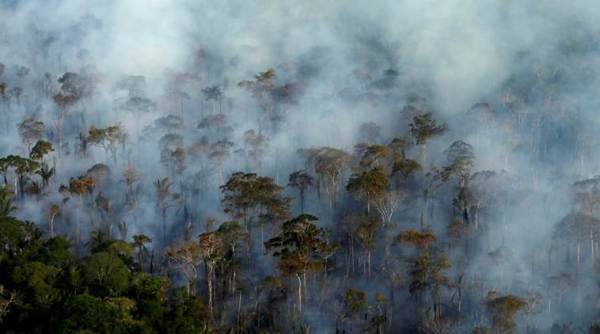 Smoke billows during a fire in an area of the Amazon rainforest near Porto Velho in Brazil on September 10. (Reuters)
Note: This is not a model answer. It only provides you with thought process which you may incorporate into the answers.
Introduction:
— Tropical forests are important ecosystems with remarkable biodiversity and crucial roles in controlling the climate. The main factors contributing to their exceptional species diversity are the year-round abundance of resources and energy provided by steady, high levels of solar radiation and rainfall.
— These include tropical seasonal woods, which have a dry season, and tropical rainforests, which are always moist. More than half of all land-based plant and animal species on Earth live in these forests, which are essential to the global ecosystem because they store carbon dioxide and recycle water.
Body:
You may incorporate some of the following points in your answer:
Factors Responsible for High Biodiversity
— The equatorial position provides year-round high temperatures and plenty of rain. This continual energy intake enables high rates of photosynthesis and primary production, giving a large amount of food and resources for a diverse range of life forms.
— Tropical regions have stayed largely stable over millions of years, unlike temperate zones that have endured numerous glaciations. This geological stability has allowed organisms to evolve and diversify without catastrophic climate upheavals.
— The deep, multi-layered structure of the forest, from the forest floor to the emergent canopy, results in a plethora of specialised microhabitats and biological niches. This complexity enables multiple species to coexist by specialising in distinct areas of the environment.
What are threats to Tropical Forests?
— Deforestation for agriculture is the single most significant cause of tropical forest loss. Mining activities degrade habitats and infrastructural development, causing significant harm and pollution.
— Rising global temperatures disrupt rainfall patterns, increasing the frequency and severity of droughts, and making forests more vulnerable to large-scale fires. These changes are stressful for ecosystems and have the potential to substantially alter forest composition.
— Unsustainable hunting and the illegal trafficking of exotic species have a direct impact on animal populations, disrupting important ecological processes such as seed dissemination and pollination.
Conclusion:
— The TFFF (Tropical Forest Forever Facility) is an investment fund designed as a permanent, self-financing vehicle through which net returns will be awarded to up to 74 developing tropical forest countries for keeping their existing old-growth forests intact.
— The TFFF is designed to change this and pay for the conservation of the world’s major tropical forests, which provide a range of ecosystem services, including carbon storage. Put simply, the fund will help landowners to conserve forests by ensuring that the value they bring as standing forests is more than from cutting them down.
(Source: New fund to protect world’s tropical forests: What is the TFFF, and what are the concerns about it?, tfff.earth)
Points to Ponder
Read more about TFFF
Read about other types of forests
Related Previous Year Questions
Identify and discuss the factors responsible for diversity of natural vegetation in India. Assess the significance of wildlife sanctuaries in rain forest regions of India. (2023)
Examine the status of forest resources of India and its resultant impact on climate change. (2019)
UPSC Essentials: Mains answer practice — GS 3 (Week 130)
UPSC Essentials: Mains answer practice — GS 3 (Week 129)
UPSC Essentials: Mains answer practice — GS 2 (Week 130)
UPSC Essentials: Mains answer practice — GS 2 (Week 129)
UPSC Essentials: Mains answer practice — GS 1 (Week 129)
UPSC Essentials: Mains answer practice — GS 1 (Week 128)
Subscribe to our UPSC newsletter and stay updated with the news cues from the past week.
Stay updated with the latest UPSC articles by joining our Telegram channel – IndianExpress UPSC Hub, and follow us on Instagram and X.

Read UPSC Magazine