28 min read


© IE Online Media Services Pvt Ltd



 A country's population increases with reduction in mortality or relative number of deaths. (Express/File)
(The UPSC Essentials Indian Express is now on Telegram. Click here to join our channel and stay updated with the latest updates.
Subscribe to The Indian Express UPSC Key and prepare for the Civil Services and other competitive examinations with cues on how to read and understand content from the most authoritative news source in India.
Note:Catch the UPSC Weekly Quiz every Saturday evening and brush up on your current affairs knowledge.)
The Indian Express’ UPSC weekly news express covers some of the important and burning topics of current affairs news from this week to help you prepare for UPSC-CSE. Try out the MCQs and check your answers provided towards the end of the article.
Syllabus:
Preliminary Examination: Economic and Social Development-Sustainable Development, Poverty, Inclusion, Demographics, Social Sector Initiatives, etc.
Mains Examination: General Studies II: Issues relating to development and management of Social Sector/Services relating to Health, Education, Human Resources.
Why in news?
— Deaths due to cancer have declined by 33% in the United States since 1991, according to a report by the American Cancer Society released last week. This has translated into 3.8 million fewer deaths, the report said, and attributed the success to early detection, lower rates of smoking, and improvements in cancer treatment.
— This trend is yet to be reflected in India. Even with improvements in treatment, both the incidence of cancer and mortality continue to rise in the country.
KEY TAKEAWAYS
Anonna Dutt Explains:
— The findings in the US, published in CA: A Cancer Journal for Clinicians, record a steep reduction of 65% in the rates of cervical cancer in women in their early 20s between 2012 and 2019, the first cohort to receive the human papillomavirus vaccine (HPV) vaccine. Doctors confirmed that the rates of cervical and smoking-related cancers have gone down in India as well; however, the incidence of lung and breast cancers has increased.
— Better screening and treatment centres, and more comprehensive linkages between screening centres and hospitals are essential to reduce cancer mortality in the country, experts said.
What is the incidence of cancer and mortality in India currently?
— An estimated 14.6 lakh new cancer cases were detected in 2022, up from 14.2 lakh in 2021 and 13.9 lakh in 2020, as per data from the National Cancer Registry of the Indian Council of Medical Research (ICMR) presented in Parliament. Deaths due to cancer increased to an estimated 8.08 lakh in 2022 from 7.9 lakh in 2021 and 7.7 lakh in 2020. The incidence of all cancers is estimated to increase to 15.7 lakh by 2025, according to the data.
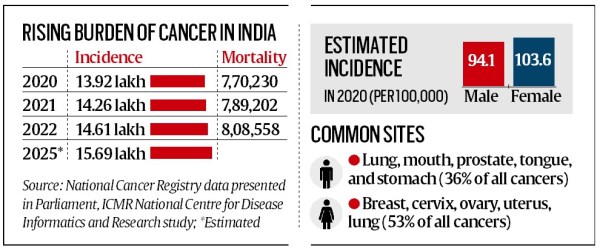
— One in nine Indians will develop cancer during their lifetime, according to an ICMR study using data from population-based cancer registries. One in 68 men will develop lung cancer and one in 29 women will develop breast cancer, according to the study.
— The incidence of cancer is higher among women — 103.6 per 100,000 in 2020 compared to 94.1 among men. Among men, the most common cancers were of the lung, mouth, prostate, tongue, and stomach; for women, they were breast, cervix, ovary, uterus, lung.
Why are some cancers on the decline and others continue to rise?
— The incidence of cervical cancer has dropped in India over the last 50 years from 45 to 10 per 100,000 population, Prof G K Rath, adviser to the oncology platform Karkinos Healthcare and a former head of the AIIMS National Cancer Institute in Jhajjar, said.
“At the same time, there is an increase in rates of breast cancer, especially in urban centres. Rates of cervical cancer have declined because of later marriages, fewer children, better hygiene, and vaccination. And the incidence of breast cancer has gone up because of the same reasons — later age of marriage, having the first child at a later age, not breastfeeding, and a high protein diet,” Dr Rath said.
— The incidence of breast cancer is 9 per 100,000 in Barshi, Maharashtra, and 45 per 100,000 in Hyderabad, Dr Rath, who also headed the scientific steering committee for the National Cancer Registry, said. The incidence of breast cancer is 110 cases per 100,000 population in the US, he said.
— Unlike cervical cancer, which can be prevented with HPV vaccination — with vaccines becoming cheaper, the government plans a campaign soon — there is no specific intervention for breast cancers other than screening because what causes it is unknown.
“The rates of tobacco-related cancers — oral, oesophageal — cancers are also coming down. This is largely due to tobacco laws that have brought down smoking in public places,” Dr Rath said.
— Lung cancers, however, remain a cause for concern. “Lung cancer is caused not only by smoking. For example, lung cancer rates are high in Arunachal Pradesh because they light fires indoors in winter. We see lung cancers in women in Bihar because they have spent years cooking on chullahs. And with the kind of air we are breathing in Delhi, we will see the impact in the next 10 years,” Dr Abhishek Shankar of Dr B R Ambedkar Institute-Rotary Cancer Hospital at AIIMS, said.
“Unfortunately, the survival rate for lung cancer is not very high and it is mostly diagnosed in the late stages,” Dr Shankar said.
What must be done to bring down overall mortality like in the US?
— The first intervention has to be screening.
Screening for the three most common types of cancer — breast, cervical, and oral — has already started through the government’s upgraded health and wellness centres. This, coupled with other government programmes, has meant people are reaching hospitals sooner.
Also, “screening should lead to treatment”, Dr Shankar said. “You tell someone they are likely to have cancer but if they do not have the means to go to a hospital, get tested, and seek treatment, it will be of no use. The treatment has to be accessible and affordable,” he said.
— There must be many more cancer care facilities.
India needs to prepare better, Dr Rath said. “Cancer has overtaken cardiac issues as the leading cause of deaths in the US. In India, cardiac issues are still the leading cause but cancer is number 2. Sixty years ago when I was studying medicine people were dying of cholera, cancer was not even in the top 10 causes of death,” he said.
(Source: What will it take for India to replicate cancer decline like in the US by Anonna Dutt )
Point to ponder: It is imperative for us to embrace technology-driven medical techniques to prevent health catastrophes. Discuss.
1. MCQ:
‘RNA interference (RNAi)’ technology has gained popularity in the last few years because:
(1) It is used in developing gene silencing therapies.
(2) It can be used in developing therapies for the treatment of cancer.
(3) It can be used to develop hormone replacement therapies.
(4) It can be used to produce crop plants that are resistant to virtual pathogens.
Select the correct answer using the code given below.
(a) 1, 2 and 4
(b) 2 and 3
(c) 1 and 3
(d) 1 and 4 only
Syllabus:
Preliminary Examination: Economic and Social Development
Mains Examination:
• General Studies I: Population and associated issues
• General Studies II: India and its neighbourhood- relations.
Why in news?
— China’s population, according to its National Bureau of Statistics, fell to 1,411.8 million in 2022, from 1,412.6 million in the previous year. An absolute decline in population is a landmark event, for a country that is soon set to be surpassed — if it has not already — by India as home to the most number of people.
— India has not conducted an official headcount Census after 2011. But going by the United Nations’ projections, its population stood at 1,417.2 million in 2022 (more than China’s) and is expected to reach 1,428.6 million in 2023.
KEY TAKEAWAYS
Harish Damodaran Explains:
— A country’s population increases with reduction in mortality or relative number of deaths. The population growth slows — and may even go into reverse, like it has now for China — with declining fertility rates.
— Mortality falls with increased education levels, public health and vaccination programmes, access to food and medical care, and provision of safe drinking water and sanitation facilities. The crude death rate (CDR) — the number of persons dying per year per 1,000 population — was 23.2 for China and 22.2 for India in 1950. It fell to single digits for China first in 1974 (to 9.5) and for India in 1994 (9.8), and further to 7.3-7.4 for both in 2020.
— Another mortality indicator is life expectancy at birth. Between 1950 and 2020, it went up from 43.7 to 78.1 years for China and from 41.7 to 70.1 years for India.
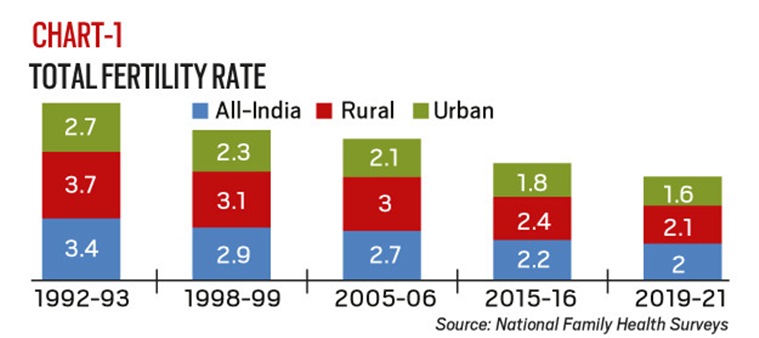
(Chart shows how sharply the TFR has fallen for India in the last three decades)
— The total fertility rate (TFR) — the number of babies an average woman bears over her lifetime — was as high as 5.8 for China and 5.7 for India in 1950. The TFR has fallen sharply for India in the past three decades. Between 1992-93 and 2019-21, it came down from 3.4 to 2; the fall was especially significant in the rural areas.
— A TFR of 2.1 is considered as “replacement-level fertility”. Simply understood, a woman having two children replaces herself and her partner with two new lives. Since all infants may not survive, the replacement TFR is taken at slightly above two.
— The TFR is the average number of births by women aged 15-49 based on surveys for a particular period/year. Populations can keep growing even with TFRs falling. De-growth requires TFRs to remain below replacement levels for extended periods. The effects of that — fewer children today becoming parents tomorrow and procreating just as much or less — may reflect only after a couple of generations.
— China’s TFR dipped below replacement first in 1991, which was almost 30 years before India’s. Recall that the CDR decline below 10, too, happened two decades earlier for China. Not surprising, China’s population more than doubled from 544 million in 1950 to 1.1 billion in 1987 and peaked in 2021. It took over 30 years for below-replacement fertility rates to translate into negative population growth.
Why China faces a crisis?
— China’s TFR, according to its 2020 Census, was 1.3 births per woman — marginally up from the 1.2 in the 2010 and 2000 censuses, but way below the replacement rate of 2.1. China officially ended its one-child policy, introduced in 1980, from 2016. But that’s unlikely to stem the decline in the country’s population, which the UN has projected at 1,312.6 billion in 2050, a near 100 million drop from the 2021 peak.
— The real crisis for China, however, is the decline in its population that is of prime working age. If there is a large population that’s able to work and earn, not only will there be relatively fewer people to support — those too old or too young — but also greater tax revenues and savings potential from the generation of incomes. As these are directed to finance investments, a virtuous cycle of growth is unleashed — as indeed it happened in China.
— But that cycle has started to reverse, and the share of China’s working-age population is projected to fall below 50% by 2045.
Is it India’s opportunity?
— India has just begun seeing fertility rates fall to replacement levels, including in rural areas. The latter has to do with the spread of education — and, perhaps, also farm mechanisation and fragmentation of landholdings.
— Reduced labour requirement in agricultural operations and smaller holdings make it that much less necessary to have large families working the land.
— But even with fertility rate declines,India’s population is projected to expand and de-grow only after touching 1.7 billion about 40 years from now.
—More important is the working-age population: its share in the overall population crossed 50% only in 2007, and will peak at 57% towards the mid-2030s.
— Overall then, India has a window of opportunity well into the 2040s for reaping its “demographic dividend”, like China did from the late 1980s until up to 2015. However, this is entirely contingent upon the creation of meaningful employment opportunities for a young population — in the absence of which, the demographic dividend can well turn into a demographic nightmare.
(Source: China’s population falls: How India’s situation is different, and possibly better by Harish Damodaran)
Point to ponder: India may have already surpassed China as the world’s most-populous nation, it adds urgency for to create more jobs and ensure the country sustains its world-beating growth. Comment.
2. MCQ:
With reference to Ayushman Bharat Digital Mission, consider the following statements (2022):
1. Private and public hospitals must adopt it.
2. As it aims to achieve universal health coverage, every citizen of India should be part of it ultimately.
3. It has seamless portability across the country.
Which of the statements given above is/are correct?
(a) 1 and 2 only
(b) 3 only
(c) 1 and 3 only
(d) 1, 2 and 3
Syllabus:
Preliminary Examination: Economic and Social Development
Main Examination: General Studies II: Issues relating to development and management of Social Sector/Services relating to Health, Education
Why in news?
— After two years of a pandemic-induced school shutdown that kept children out of schools, the Annual Status of Education Report (ASER) for 2022 has good news and bad. While children returned to school in huge numbers in 2022, belying fears that the economic crisis and displacement brought about by the pandemic would lead to dropouts, the grim news is that, as expected, the disruption led to a big drop in learning levels in most states, across both government and private schools and for both girls and boys.
— The Annual Status of Education Report, or ASER, is an annual, citizen-led household survey, released by NGO Pratham that aims to understand whether children in rural India are enrolled in school and whether they are learning. From 2005 to 2014, and then every alternate year till 2018, large-scale, nation-wide ASER surveys provided representative estimates of the enrolment status of children aged 3-16 and the basic reading and arithmetic levels of children aged 5-16 at the national, state and district level.
KEY TAKEAWAYS
Sourav Roy Barman writes:
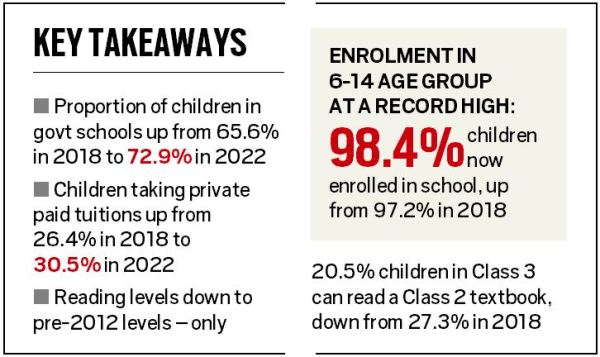
— According to the 17th ASER report released in New Delhi , as the pandemic ebbed, school enrolment touched a record high in 2022 — 98.4% children in the 6-14 age group are now in school, up from 97.2% in 2018, when the last full pre-pandemic survey was conducted by Pratham.
— The proportion of girls not enrolled in schools has also reduced across age groups. For girls aged 11-14, this share dropped from 4.1% in 2018 to 2% in 2022. Back in 2006, the share of out-of-school girls in this age bracket stood at 10.3 per cent.
— But it’s the drop in learning levels – foundational skills in reading and arithmetic – that has confirmed the worst fears about the pandemic and its impact on children.
“This fall is a huge drop, given how slowly the all-India numbers move, and confirms fears of large learning losses caused by the pandemic,” said Wilima Wadwa, Director, ASER Centre, in the report released today.
— Between 2014 and 2018, learning levels in terms of reading and basic arithmetic had been rising gradually. The proportion of Class 3 students who were grade-ready or could read a Class 2 textbook had gone up from 23.6% in 2014 to 27.2% in 2018, while those in this grade who could do at least subtraction rose from 25.3% to 28.1%.
— However, in 2022, the basic reading ability of children in Class 3 dipped by 6.8 percentage points (from 27.3% in 2018 to 20.5% in 2022), and that of students in Class 5 came down by 7.6 percentage points (from 50.4% in 2018 to 42.8% in 2022).
— There has also been a drop in numeracy levels, though not as steep as for reading skills.
— The proportion of children in Class 3 who could do at least subtraction fell from 28.2% in 2018 to 25.9% in 2022, and that of students in Class 5 fell from 27.9% in 2018 to 25.6% in 2022.
“Clearly, the pandemic has resulted in learning loss. However, what the ASER 2022 figures seem to suggest is that the loss is much greater in reading as compared to arithmetic,” said Wadhwa.
— Despite these big drops, a comparative analysis of learning outcomes in Karnataka, Chhattisgarh and West Bengal – the only states where Pratham undertook learning outcome surveys in the pandemic year of 2021 – suggests that there has been an attempt to recover lost ground once schools reopened after the pandemic.
— In Chhattisgarh, for instance, the proportion of Class 3 children who can read a Class 2 textbook had dropped to an alarming 12.3% in 2021, down from 29.8% in 2018, only to bounce back to 24.2% in 2022. In West Bengal, that number rose from 29.5% in 2021 to 33% in 2022.
— In the case of maths, the share of children in Class 3 in Chhattisgarh with the ability to solve basic problems fell from 19.3% in 2018 to 9% in 2021, only to rise to 19.6% in 2022. In Karnataka, that number rose from 17.3% in 2021 to 22.2% in 2022 and in West Bengal, from 29.4% in 2021 to 34.2% in 2022.
— The survey points to what has been a trend for over a decade now – a small, steady increase in the proportion of children availing private tuitions. Between 2018 and 2022, this proportion increased further – from 26.4% to 30.5%.
— The ASER report also highlights another trend that was reflected in other reports such as the government’s UDISE+ data that came out last year. ASER 2022 states that nationally, the percentage of children aged 11 to 14 who are enrolled in government schools has risen from 65% in 2018 to 71.7% in 2022.
— While the period from 2006 to 2014 saw a steady decrease in proportion of children in government schools, it plateaued for the next four years, only to rise to 71.7% in 2022.
— On the shift from private to government schools, Pratham Foundation CEO Rukmini Banerji said the phenomenon can be attributed to several factors, including job losses and the closure of budget private schools in rural areas during the pandemic.
“If the family income goes down or becomes more uncertain, it is likely that parents may not be able to afford private school fees. Hence, they are likely to pull their children out of private schools and put them in government schools. Also, in rural areas, most private schools are of the low-cost or budget variety, many of which had to shut down during Covid,” she said.
— The ASER survey covered 7 lakh children in 19,060 villages across 616 districts in the country.
(Source: ASER 2022: Post-Covid, student enrolment at record high, but big dip in learning by Sourav Roy Barman)
Point to ponder: What are the bright spots and areas of concern in the Annual Status of Education Report 2022?
3. MCQ:
To obtain full benefits of demographic dividend, what should India do? (2013)
(a) Promoting skill development
(b) Introducing more social security schemes
(c) Reducing infant mortality rate
(d) Privatization of higher education
Syllabus:
Preliminary Examination: Economic and Social Development
Main Examination: General Studies III: Government Budgeting
Why in news?
— Reserve Bank of India released its report on state government budgets for 2022-23. The report outlines how state government finances, which had come under severe stress in 2020-21 because of the slowdown in the economy due to the pandemic, have improved in the years thereafter. However, there are several areas of concern.
KEY TAKEAWAYS
Ishan Bakshi Explains:
— Much of the public discussion in India tends to focus on the Union government’s budget. However, state governments account for a lion’s share of general government spending (central government and states), with capital expenditure by states exceeding that of the central government. Thus, state budgets are of critical importance. More so when economic growth heavily hinges on the public sector driving investment activity in the economy
Debt-to-GDP
— The state debt-to-GDP ratio remains uncomfortably high. As per the report, the debt-to-GDP ratio has fallen from 31.1 per cent in 2020-21 – a year when states had struggled to manage the economic fallout of the pandemic — to 29.5 per cent in 2022-23.
— To put this number in perspective, the Fiscal Responsibility and Budget Management review committee, headed by N K Singh, had recommended a debt-to-GDP ratio of 20 per cent for states. A high debt-deficit burden leaves little room for states to manoeuvre when faced with the next economic shock.
— A high debt burden may also imply that states may have to pay more to service their obligations. As per the report, interest payments by states rose to 2 per cent of GDP in 2020-21, up from 1.7 per cent in 2017-18. States expect this to come down to 1.8 per cent in 2022-23.
— However, there is marked variation across states. Punjab, Tamil Nadu, Haryana and West Bengal have the highest interest payments to revenue receipts ratio. This implies that in these states, interest payments account for a sizable portion of the states’ revenues, leaving them with less room to spend on other areas of priority such as health or education.
Contingent liabilities
— State governments have also seen a significant expansion in their contingent liabilities. Contingent liabilities here refer to the obligations of a state government to repay the principal and interest payments in case a state-owned entity defaults on a loan.
— As per the report, the guarantees issued by state governments have risen from Rs 3.12 lakh crore or 2 per cent of GDP in 2017 to Rs 7.4 lakh crore or 3.7 per cent of GDP. The disaggregated data shows that the states of Andhra Pradesh, Telangana and Uttar Pradesh have the most guarantees outstanding at the end of March 2021.
— The perilous state of state-owned power distribution companies or discoms also has adverse implications for state finances.
— Over the past few decades, multiple attempts have been made to turn around the financial and operational position of state discoms. However, on various metrics, their performance is well short of expectations, leading to continuing losses.
— Since the early 2000s, there have been multiple bailouts of discoms. Each time, the sums involved have only risen. Another rescue package will impose considerable financial burden on states. For the 18 major states, an RBI study had pegged the cost of a bailout at 2.3 per cent of GDP.
Old Pension Scheme
— Lastly, new risks have emerged with some states now opting to return to the old pension scheme.
— In the early 2000s, there was a growing realisation that financing the old pension scheme would prove to be challenging. Thus, a new pension framework was ushered in which would limit the financial burden of the state. While most states had then signed on to the new pension scheme, some states such as Rajasthan and Chhattisgarh have now chosen to revert.
— This will have adverse implications for state finances. States already allocate a significant portion of their own tax revenues towards pension — in 2020-21, Rs 3.86 lakh crore was allocated towards pension. Shifting back to the old pension scheme will only end up increasing pension liabilities, leaving even less room for more productive spending.
(Sources: Three key takeaways from RBI’s report on state govt Budgets by Ishan Bakshi )
Point to ponder: Why has RBI warned states against old pension scheme?
4. MCQ:
Which of the following statements is not true with respect to NPS?
a) The shift to NPS was undertaken due to concerns over the coverage, sustainability, and scalability of the old pension framework.
b) PFRDA is the regulator for NPS.
c) Only government employees are eligible under NPS.
d) The NPS proposed by the Project OASIS report became the basis for pension reforms.
Syllabus:
Preliminary Examination: Indian Polity and Governance-Constitution, Political System, Panchayati Raj, Public Policy, Rights Issues, etc.
Mains Examination: General Studies I: Role of women and Social empowerment
Why in news?
— As many as 108 women officers in the Armyare set to be cleared for the rank of Colonel (selection grade) by January 22 by a special selection board, which will make them eligible to command units and troops in their respective arms and services for the first time.
— A total of 244 women officers are being considered for promotion against the vacancies — from the batch of 1992 to 2006 — in arms and services including Engineers, Signals, Army Air Defence, Intelligence Corps, Army Service Corps, Army Ordnance Corps and Electrical and Mechanical Engineers.
— Until Thursday evening, 80 women officers had been cleared for the rank of Colonel from Lieutenant Colonel by the Special No. 3 Selection Board whose proceedings began on January 9.
— Unlike other promotion boards, this one is being held every day for a particular batch, starting with the 1992 batch, and the results are being declared on the same day.
— Every officer gets three chances for promotion and thus the reviews, too, are being held within three days of the declaration of the result.
KEY TAKEAWAYS
Amrita Nayak Dutta Explains:
Why is this significant?
— Most importantly, it grants women officers parity with their male counterparts. Earlier, with a limited period career in the force, there were no promotion avenues for women officers to become a Colonel and command a unit like male Army officers.
— It is not that women officers did not reach the rank of Colonel or beyond in the past, but they were only in two branches — the Judge Advocate General (JAG) branch and the Army Education Corps — where they were granted permanent commission in 2008.
— However, these were staff appointments — which are more administrative in nature — and not purely command appointments in which an officer commands troops on ground.
— The Supreme Court’s order to grant permanent commission to women Army officers in February 2020 opened the doors for promotion to women officers across all streams of the Army, except pure combat arms. With a longer career in the Army, women officers will be considered for promotions, including to the rank of Colonel and beyond.
Women were inducted in the Army as early as 1992. Why did their Colonel promotions come so late?
— An officer in the Army is promoted to the rank of Colonel only after serving between 16 and 18 years, based on certain criteria such as annual confidential reports and various courses.
— Women officers who were inducted into the Army were inducted as Short Service Commission (SSC) officers in 1992 and in the years after did not have the choice to opt for permanent commission. JAG and Army Education Corps were exceptions, where a permanent commission was opened for them in 2008.
— For other arms and services, women could not become permanent cadre, and had to retire much before they completed the service period that is mandatory to become a Colonel.
What did the Supreme Court order in 2020?
— In 2019, the Army changed its rules allowing SSC women officers to opt for permanent commission who would have otherwise retired after 14 years of service. However, this was not retrospective, and applied only to the batches of women officers starting their career in the Army in 2020.
— With the landmark Supreme Court judgment of February 2020, permanent commission was granted to women officers with retrospective effect. This opened the doors for their further growth and promotions in the Army, which has been of late opening leadership and higher management courses for women.
What exactly does commanding a unit mean?
— Once promoted to a Colonel, an officer is eligible to command troops directly in the Army, which is an acknowledgment of the leadership qualities of the officer. It is considered a coveted appointment because in no other rank — including higher ranks like Brigadier or Major General — does an officer interact directly with troops on the ground.
— Multiple women officers told The Indian Express that for them it was a dream to reach this point in their career. Despite working at the grassroots level as junior officers, women officers hitherto did not get an opportunity to prove their leadership skills as they were not eligible to command a unit. For a woman officer, this is an empowering move.
In which arms and services will women officers command units?
— Women officers in many streams of the Army, including the Army Air Defence, Signals, Engineers, Army Aviation, Electronics and Mechanical Engineers, Army Service Corps, Army Ordnance Corps, and Intelligence Corps will be commanding units.
— They are still not eligible in core combat arms such as Infantry, Mechanised Infantry and Armoured Corps, as the Army is not open to women fighting wars at the borders as foot soldiers. Much of this resistance stems from past instances of male soldiers being taken as prisoners of war and tortured by the enemy.
— However, the Army has recently decided to open the Corps of Artillery, a combat support arm, to women.
What about the Indian Navy and the Indian Air Force?
— Women officers have been inducted into all branches of the Navy, and they will be eligible for permanent commission in the future. Women officers can command shore-based units and, as they join the service and become eligible for permanent commission, they would be able to command ships and air squadrons.
— The IAF has opened all branches for women officers, including the fighter stream and the new weapon systems branch. As they are granted permanent commission based on eligibility and vacancies, they will be eligible to command units in the future.
How many women serve in the Indian armed forces?
— The Army, being the largest of the three services, has the largest number of women officers at 1,705, followed by 1,640 women officers in the IAF, and 559 in the Navy. This data was submitted by the government to Parliament last year.
Which other armies allow women to serve or command units?
— All major countries including the United States, United Kingdom, Russia, and Israel, allow women in command positions of their national armed forces.
(Sources: 108 women officers to be Colonels, can lead Army units first time by Amrita Nayak Dutta)
Point to ponder: How women cadets benefit the army?


Read UPSC Magazine