7 min read
© IE Online Media Services Pvt Ltd
Latest Comment
Post Comment
Read Comments



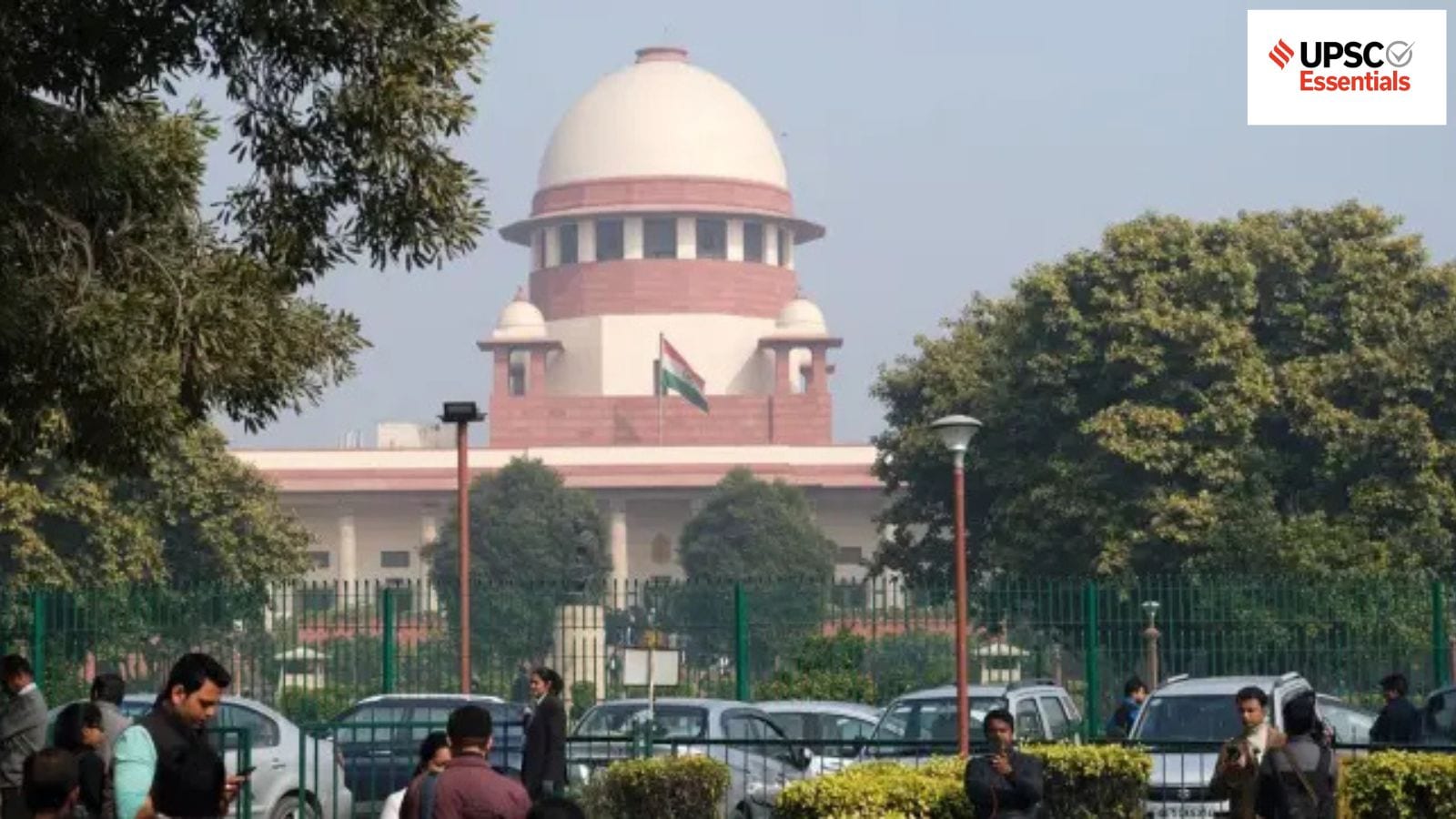 Attempt a question on the balance between digital data and fundamental rights in today's answer writing practice. (Bloomberg)
UPSC Essentials brings to you its initiative for the practice of Mains answer writing. It covers essential topics of static and dynamic parts of the UPSC Civil Services syllabus covered under various GS papers. This answer-writing practice is designed to help you as a value addition to your UPSC CSE Mains. Attempt today’s answer writing on questions related to topics of GS-2 to check your progress.
🚨 Click Here to read the UPSC Essentials magazine for December 2025. Share your views and suggestions in the comment box or at manas.srivastava@indianexpress.com🚨
Examine the balance between enhancing law enforcement capabilities through digital data and protecting citizens’ fundamental rights in the age of digital policing.
Discuss how electoral trusts function and assess their significance in ensuring transparency and accountability in political funding.
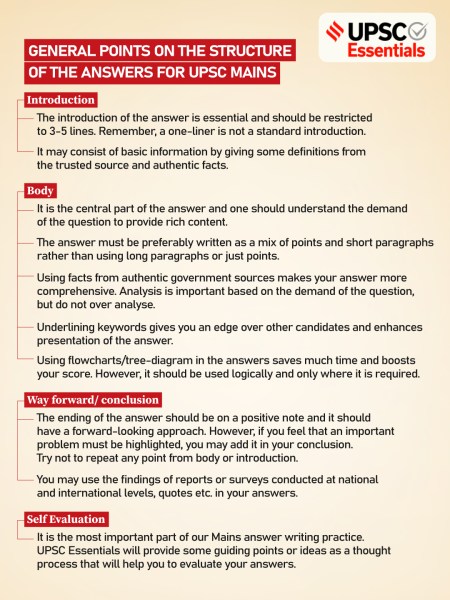
QUESTION 1: Examine the balance between enhancing law enforcement capabilities through digital data and protecting citizens’ fundamental rights in the age of digital policing.
Relevance: This question is relevant for UPSC GS-II as it examines the balance between internal security and fundamental rights, particularly the right to privacy amid expanding use of digital data by law enforcement.
Introduction:
— Digital governance provides strong tools such as artificial intelligence, facial recognition, and data analytics to improve efficiency and public safety, but it also generates tension with fundamental rights.
— The key is to establish strong legal frameworks that ensure proportionality, transparency, and accountability, with laws such as India’s Criminal Procedure (Identification) Act attempting to strike a balance between enhanced police powers and constitutional safeguards, necessitating ongoing debate and careful governance to prevent bias, misuse, and erosion of rights.
— Apps and services created for ease have evolved into tools for tracking individuals in an age where practically every transaction, message, and delivery request leaves an electronic trace.
Body:
— One-time passwords (OTPs) generated by delivery apps like Swiggy and Zomato, and text alerts from FASTag toll transponders, became central tools in triangulating the movements of suspects who constantly switched phones, SIM cards and hotel identities to evade detection.
— The fine print in online applications’ privacy policy typically has a clause which allows them to share users’ personal data with law enforcement agencies. For instance, Zomato’s policy states that it may share a user’s data with the police when it is necessary to investigate, prevent or take action regarding possible illegal activities or to comply with legal processes.
— This shift towards digital evidence is not confined to financial crime. In the United States, prosecutors building a case against the accused instigator of the devastating 2025 Palisades Fire in California cited interactions with ChatGPT — including prompts about sparking fires and AI-generated imagery of dystopian infernos — as part of the evidentiary mosaic linking the suspect to the blaze that consumed more than 23,000 acres and destroyed thousands of homes.
— According to a government press release from October, the surge in cybersecurity incidents from 10.29 lakh in 2022 to 22.68 lakh in 2024 reflects the growing scale and complexity of digital threats in India.
Conclusion:
— The Department of Telecommunications’ (DoT’s) recent directive to enforce SIM-to-device binding for messaging platforms reflects a broader shift in how authorities view digital identifiers in law enforcement.
— The DoT directed companies such as WhatsApp, Telegram and Signal to ensure that their services are “continuously” linked to the SIM card used to register with them. The department said they must disallow access if the device does not contain a SIM card.
(Source: OTPs, FASTag, food orders: How digital breadcrumbs are reshaping policing in India)
Points to Ponder
Read more about fundamental rights
Suggest policy reforms to enhance accountability and transparency in the use of digital data by law enforcement in India.
Related Previous Year Questions
e-governance, as a critical tool of governance, has ushered in effectiveness, transparency and accountability in governments. What inadequacies hamper the enhancement of these features? (2023)
Examine the scope of Fundamental Rights in the light of the latest judgement of the Supreme Court on Right to Privacy. (2017)
QUESTION 2: Discuss how electoral trusts function and assess their significance in ensuring transparency and accountability in political funding.
Relevance: This question relates to electoral reforms, transparency in political funding, and democratic accountability, especially after the scrapping of electoral bonds. It is relevant for UPSC GS-II.
Introduction:
— The electoral trust scheme was introduced by the government in 2013. It preceded the electoral bonds scheme that was introduced by the government in 2018. Both schemes are meant to facilitate donations to political parties by corporations and individuals. But while the electoral bonds scheme sought to ensure donor anonymity, electoral trusts are required to report to the Election Commission contributions from individuals and companies, and their donations to parties every year.
— Under Section 17CA of the Income Tax Act of 1961, any citizen of India, a company registered in India, or a firm or Hindu Undivided Family or association of persons living in India, can donate to an electoral trust.
Body:
— Electoral trusts must apply for renewal every three financial years. They must donate 95% of contributions received in a financial year to political parties registered under the Representation of the People Act, 1951. The contributors’ PAN (in case of a resident) or passport number (in case of an NRI) is required at the time of making contributions.
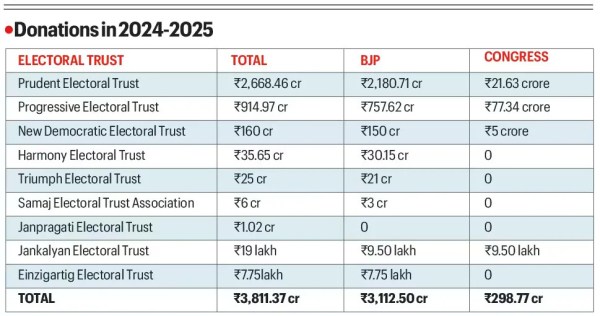 A bulk or almost 82 per cent of its total donations of Rs 2,668 crore in 2024-2025 went to the BJP
— The electoral trusts route is transparent on contributors and beneficiaries.
— At least 95% of collected funds must be disbursed to registered political parties, with the remaining 5% administrative expenses. Trusts cannot use donations for members’ benefit.
— Trusts must maintain audited accounts, disclosing donors, recipients, and disbursements to the CBDT and the Election Commission of India (ECI).
— It ensures money flows through formal banking channels, unlike unaccountable cash donations and aims to curb illegal cash flow into politics.
Conclusion:
— The number of registered trusts has ranged from three in 2013 to 17 in 2021-22, but only a few of them actually make donations every financial year. While just five trusts reported contributions in 2023-24, the number increased to nine in 2024-25. Of these nine, three trusts — Prudent Electoral Trust, Progressive Electoral Trust and New Democratic Electoral Trust — accounted for 98 per cent of all contributions in 2024-25.
(Source: Explained: What are electoral trusts and how are they funded?)
Points to Ponder
Read more about electoral trusts
Suggest reforms to strengthen transparency and fairness in political party financing in India.
Related Previous Year Questions
Examine the need for electoral reforms as suggested by various committees, with particular reference to the ‘‘One Nation–One Election’’ principle. (2024)
To enhance the quality of democracy in India the Election Commission of India has proposed electoral reforms in 2016. What are the suggested reforms and how far are they significant to make democracy successful? (2017)
UPSC Essentials: Mains answer practice — GS 3 (Week 134)
UPSC Essentials: Mains answer practice — GS 3 (Week 135)
UPSC Essentials: Mains answer practice — GS 2 (Week 134)
UPSC Essentials: Mains answer practice — GS 2 (Week 133)
UPSC Essentials: Mains answer practice — GS 1 (Week 133)
UPSC Essentials: Mains answer practice — GS 1 (Week 133)
Subscribe to our UPSC newsletter and stay updated with the news cues from the past week.
Stay updated with the latest UPSC articles by joining our Telegram channel – IndianExpress UPSC Hub, and follow us on Instagram and X.


Read UPSC Magazine