6 min read


© IE Online Media Services Pvt Ltd



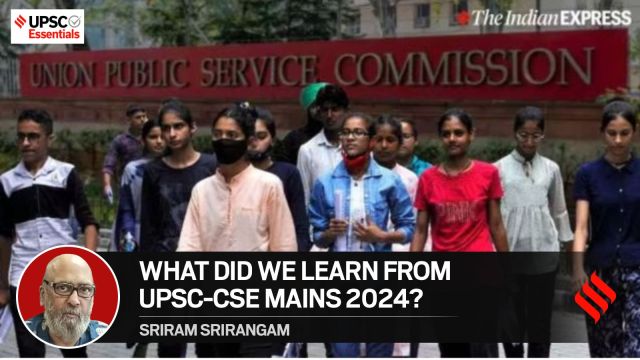 What changed and what did not in this year’s Mains which you think aspirants in future should take note of? (File Image)
How was this year’s UPSC Mains? What changed and what remains unchanged? How did UPSC prioritise the topics and how direct or analytical were they in framing the questions? Simply, was UPSC Mains easy or difficult this year and why? Curious to know, aren’t you? The UPSC Civil Services (Main) Examination, which started on September 20, ended on September 29 with the last papers consisting of optional subjects.
Whether you have appeared for Mains or not, knowing the types and standard of questions that the UPSC asks is one of the key factors that keep aspirants on their toes besides helping them to strategise their preparation for the future. So, before preparing for the next stage of the exam or starting afresh, it is essential to generally analyse Mains 2024 vis-à-vis previous years. Sriram Srirangam answers some relevant questions with respect to Mains 2024 and provide valuable insights for aspirants.
About Sriram Srirangam: He is the founder and director of an institute that offers quality training for Civil Service examination. He has an experience of 35 years in coaching, teaching and mentoring many civil services aspirants. He has also authored a book on the Indian economy for UPSC aspirants.
Sriram Srirangam: Firstly, the essay conforms to convention. With a bit of repetition for example Abraham Lincoln’s quotation about the temptations of power. It was asked in the Ethics paper in 2013 too. It happens very rarely that UPSC repeats its questions.
In General Studies, the questions have been relatively traditional. For example, in History — Pallavas, in Polity — judicial activism, in Economics and GS 3 — food inflation and the RBI, disaster resilience, etc. In Science and Technology, very few questions were asked. GNSS-based tolling system was in the news and aspirants must have found it easy if static and was studied along with current affairs. A lot of current events found their way into Ethics Paper like Naxalism, Bhartiya Nyay Sanhita, Mission Karmayogi and so on.
Sriram Srirangam: As indicated above, largely continuity is the norm and radical changes are ruled out. But what strikes in this year’s GS papers is the complete absence of questions on trending or expected topics like nuclear energy, biotechnology, AI as science( in Ethics there is one on its link with administration and decision making), nanotechnology etc. That is unusual even as they remain as important as ever.
Sriram Srirangam: It is very difficult to pick a Paper and say that it was easy or challenging. All papers had their share of easy and challenging questions. For example, in Paper 1(History), there was a question:
What were the events that led to the Quit India Movement? Point out its results.
Story continues below this ad
It was very much an expected one and easy to answer. But the following question is a challenging one:
What is a twister? Why are the majority of twisters observed in areas around the Gulf of Mexico?
Similarly, in Paper 4(Ethics and Integrity), there were questions on the easier side such as the one on climate justice and Naxalism. The case studies on the other hand were relatively challenging.
Sriram Srirangam: Common challenges have always been dealing with multiple sources and information overload. The issue is getting more aggravated of late. Genuine feedback is a challenge when aspirants appear for the mock tests as UPSC does not give model answers. On the bright side, knowledge is proliferating and there is no dearth. AI makes the preparation peppier.
Sriram Srirangam: Newspapers are a boon. They are delivering information in the form of FAQs, Q&As, Explainers etc. which is a great relief for the aspirants. Books address the conventional and the foundational side of knowledge. They have the previous years’ questions(PYQs) explained and thus aspirants are benefiting. Hence, both are important parts of preparation.
Sriram Srirangam: The field is level. Gone are the days of a wall between science and social science. Every aspirant begins preparation in advance focussing on the syllabus as a whole and not just their specialisation. And so no stream scores over others.
Sriram Srirangam: Mains results are expected mid-December. Relax for a few days and get on with the interview preparation. Get ready for every little detail in your DAF. That includes the optional too. For current events, read the newspapers thoroughly. Watch TV and depend on quality output. Track the views of senior civil servants-serving or retired.
Subscribe to our UPSC newsletter and stay updated with the news cues from the past week.
Stay updated with the latest UPSC articles by joining our Telegram channel – IndianExpress UPSC Hub, and follow us on Instagram and X.

Read UPSC Magazine