7 min read

© IE Online Media Services Pvt Ltd



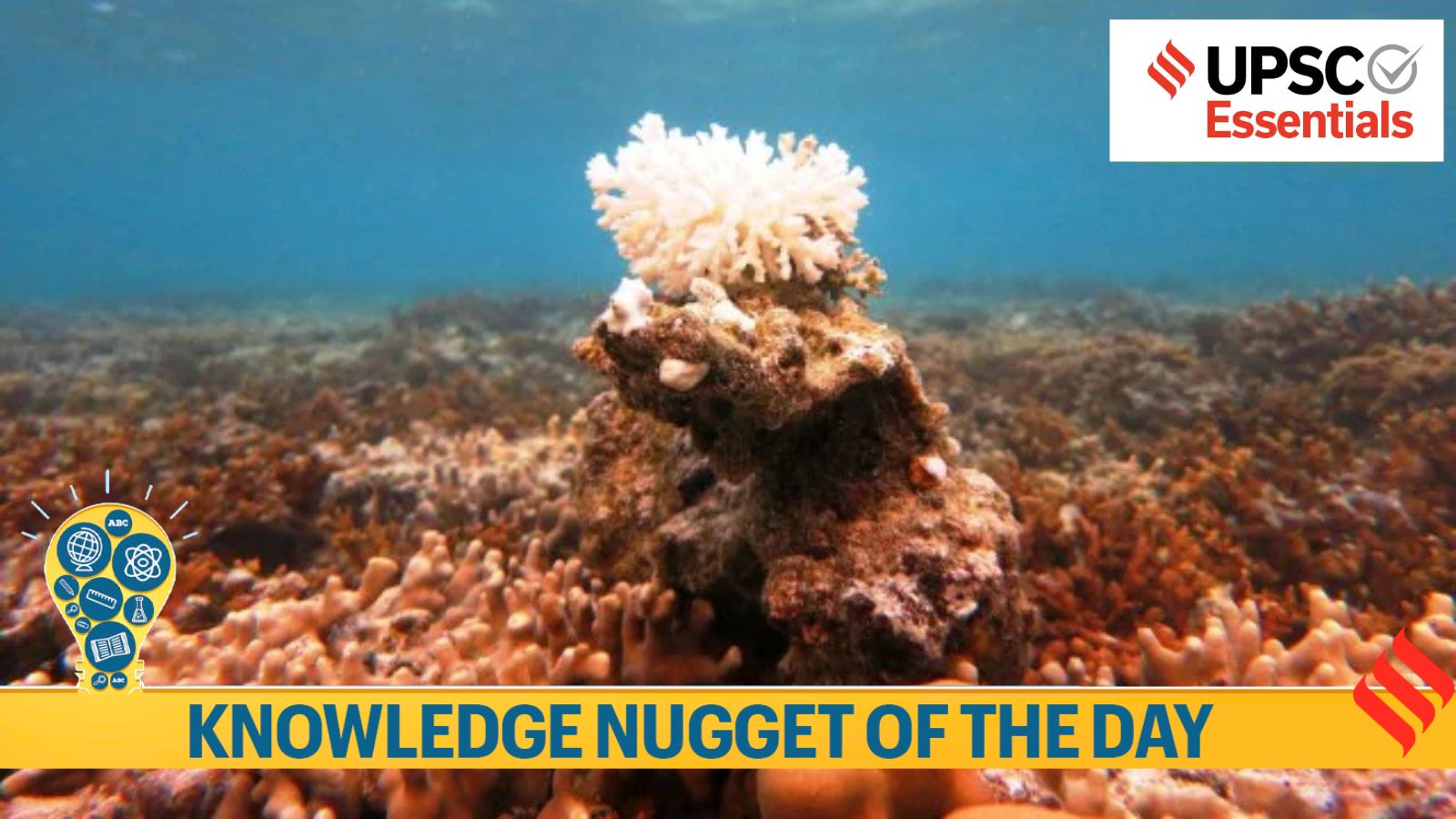 India will soon establish the NCRRI in South Andaman to lead national coral reef research and conservation. (Photo: Wikimedia Commons)
Take a look at the essential events, concepts, terms, quotes, or phenomena every day and brush up your knowledge. Here’s your UPSC Current Affairs knowledge nugget for today on coral reefs.
(Relevance: Coral reefs form an important part of the UPSC CSE syllabus. Previously UPSC has asked questions on it in both Prelims and Mains; thus, understanding coral reefs in a comprehensive and conceptual manner becomes essential for every aspirant.)
The government will soon set up the National Coral Reef Research Institute (NCRRI) in the Andaman and Nicobar Islands, a senior official said. NCRRI, which will be set up at Rs 120 crore, will function as the nodal and monitoring agency for coral reef research across India, he said. In this context, it becomes important to know what corals and coral reefs are and what their significance is.
1. Corals are essentially sessile organisms that remain permanently attached to the ocean floor. They use their small tentacle-like hands to capture food in the water and whisk it into their mouth. Each coral critter is called a polyp, and it lives in groups of hundreds to thousands of genetically identical polyps known as a ‘colony’.
2. Corals are primarily characterised as either hard or soft coral. The architects of coral reefs are hard corals, which form complex three-dimensional structures over thousands of years.
3. “Unlike soft corals, hard corals have stony skeletons made out of limestone that are produced by coral polyps. When polyps die, their skeletons are left behind and used as foundations for new polyps,” according to NOAA.
4. Coral reefs, also referred to as “rainforests of the sea”, have existed on the Earth for nearly 450 million years. Australia’s Great Barrier Reef is the largest in the world, stretching across 2,028 kilometres.
1. Coral reefs play an important function in marine ecosystems. A single reef can support thousands of different marine species. For example, the Great Barrier Reef has over 400 coral species, 1,500 fish species, 4,000 mollusc species, and six of the world’s seven sea turtle species.
2. These reefs also produce commercial goods and services worth around $375 billion every year. More than 500 million people worldwide rely on coral reefs for food, money, and coastal protection against storms and floods.
3. Coral reefs can absorb up to 97% of the energy from waves, storms, and floods, preventing fatalities, property damage, and soil erosion.
1. The International Coral Reef Initiative on April 23 this year said that around 84% of the world’s coral reef areas had been affected by devastating mass bleaching, which was triggered around a year ago due to abnormally high ocean temperatures. This is the fourth global bleaching event since 1998, and has now surpassed bleaching from 2014-17 that affected some two-thirds of reefs.
2. Most corals contain algae called zooxanthellae — they are plant-like organisms — in their tissues. Corals and zooxanthellae have a symbiotic relationship. While corals provide zooxanthellae a safe place to live, zooxanthellae provide oxygen and organic products of photosynthesis that help corals to grow and thrive. Zooxanthellae also give bright and unique colours to corals.
3. Corals are very sensitive to light and temperature and even a small change in their living conditions can stress them. When stressed, they expel zooxanthellae and turn entirely white. This is called coral bleaching.
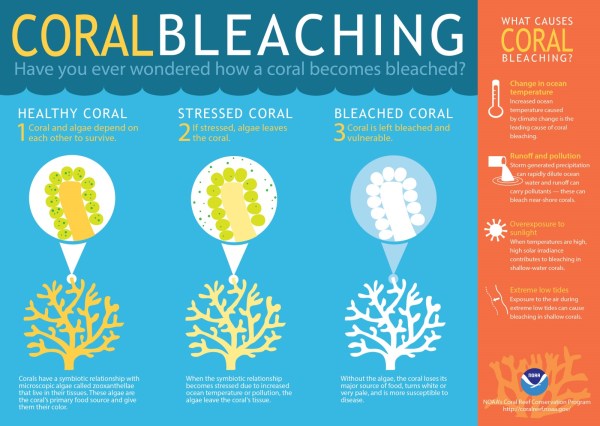
4. Notably, coral bleaching doesn’t immediately lead to the death of corals. They would rather go under more stress and are subject to mortality.
5. Coral bleaching reduces the reproductivity of corals and makes them more vulnerable to fatal diseases. If the bleaching is not too severe, corals have been known to recover.
| What is the Global mass bleaching of coral reefs? |
| Global mass bleaching of coral reefs is when significant coral bleaching is confirmed in the Atlantic, Indian and Pacific oceans, according to a report published by The Conversation. Such events are a relatively new phenomenon. The first one took place in 1998 in which 20% of the world’s reef areas suffered bleaching-level heat stress. The next two global bleaching events occurred in 2010 (35% of reefs affected) and between 2014 and 2017 (56% of reefs affected). |
1. India has a coastline of nearly 8000 km. The total area of coral reefs in India is estimated to be 2,375 Sq. Km. The major reef formation areas are primarily four:
(i) Gulf of Kutch;
(ii) Gulf of Mannar;
(iii) Lakshadweep Islands; and
(iv) Andaman and Nicobar Islands.
2. The Government has taken steps to protect and sustain Coral Reefs in the country through promotional as well as regulatory measures. The promotional measures have been implemented through a Central Sector Scheme under the National Coastal Mission at four sites, namely Lakshadweep, Gulf of Kachchh, Gulf of Mannar, and Andaman & Nicobar Islands, for the restoration, monitoring, conservation, and management of coral reefs.
3. Regulatory measures are implemented through Coastal Regulation Zone (CRZ) Notification (2019) under the Environment (Protection) Act, 1986; the Wild Life (Protection) Act, 1972; the Indian Forest Act, 1927; the Biological Diversity Act, 2002; and rules under these acts as amended from time to time.
(1) Consider the following statements: (UPSC CSE 2018)
1. Most of the world’s coral reefs are in tropical waters.
2. More than one-third of the world’s coral reefs are located in the territories of Australia, Indonesia and Philippines.
3. Coral reefs host far more number of animal phyla than those hosted by tropical rainforests.
Which of the statements given above is/are correct?
(a) 1 and 2 only
(b) 3 only
(c) 1 and 3 only
(d) 1, 2 and 3
(2) Which of the following have coral reefs? (UPSC CSE 2014)
1. Andaman and Nicobar Islands
2. Gulf of Kachchh
3. Gulf of Mannar
4. Sunderbans
Select the correct answer using the code given below:
(a) 1, 2 and 3 only
(b) 2 and 4 only
(c) 1 and 3 only
(d) 1, 2, 3 and 4
| Answer Key |
| 1. (d) 2. (a) |
(Sources: Andaman to get India’s first coral reef research centre, Fourth global mass coral bleaching triggered: What are corals and why are they important?, sansad.in)
Subscribe to our UPSC newsletter. Stay updated with the latest UPSC articles by joining our Telegram channel – Indian Express UPSC Hub, and follow us on Instagram and X.
🚨 Click Here to read the UPSC Essentials magazine for November 2025. Share your views and suggestions in the comment box or at manas.srivastava@indianexpress.com🚨


Read UPSC Magazine