2 min read
© IE Online Media Services Pvt Ltd



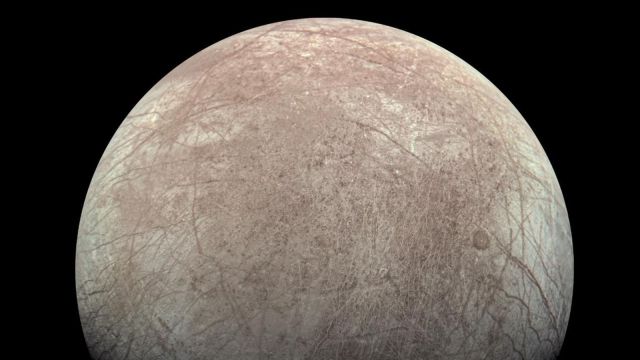 A view of Jupiter’s icy moon Europa was captured by the JunoCam imager aboard NASA’s Juno spacecraft. (NASA/JPL-Caltech/SwRI/MSSS )
Jupiter’s moon Europa has been long thought of as a potential host for extraterrestrial life in our solar system. But a new study found that the rate of oxygen being produced on the Galilean moon is much lower than expected in a setback for the search for alien life.
Europa is the fourth largest moon of Jupiter and scientists believe it has a massive ocean of salty water under its icy crust. This has raised scientific curiosity about whether it has conditions conducive to life.
The new study published in the journal Nature Astronomy used data from NASA’s Juno mission to Jupiter. Previous estimates said the planet produced over 1,000 kilograms of oxygen every second. But the latest research suggests that number is somewhere around 12 kilograms per second.
Europa’s orbit puts it right in the middle of Jupiter’s giant radiation belts. Charged particles from the gas giant, strafing its icy surface and splitting water molecules to generate oxygen that could be finding its way into the subsurface ocean.
“Europa is like an ice ball slowly losing its water in a flowing stream. Except, in this case, the stream is a fluid of ionized particles swept around Jupiter by its extraordinary magnetic field,. When these ionized particles impact Europa, they break up the water-ice molecule by molecule on the surface to produce hydrogen and oxygen. In a way, the entire ice shell is being continuously eroded by waves of charged particles washing up upon it,” said Jamey Szalay from Princeton University, in a press statement.
When NASA’s Juno flew within nearly 350 kilometres of Europa in September 2022, the spacecraft’s Jovian Auroral Distributions Experiment (JADE) instrument detected and measured hydrogen and oxygen ions created by the bombardment of charged particles.
NASA’s upcoming Europa Clipper mission is scheduled to arrive at Europa in 2030, when it will investigate the Jovian moon for signs of life with its sophisticated instruments.