3 min read
© IE Online Media Services Pvt Ltd



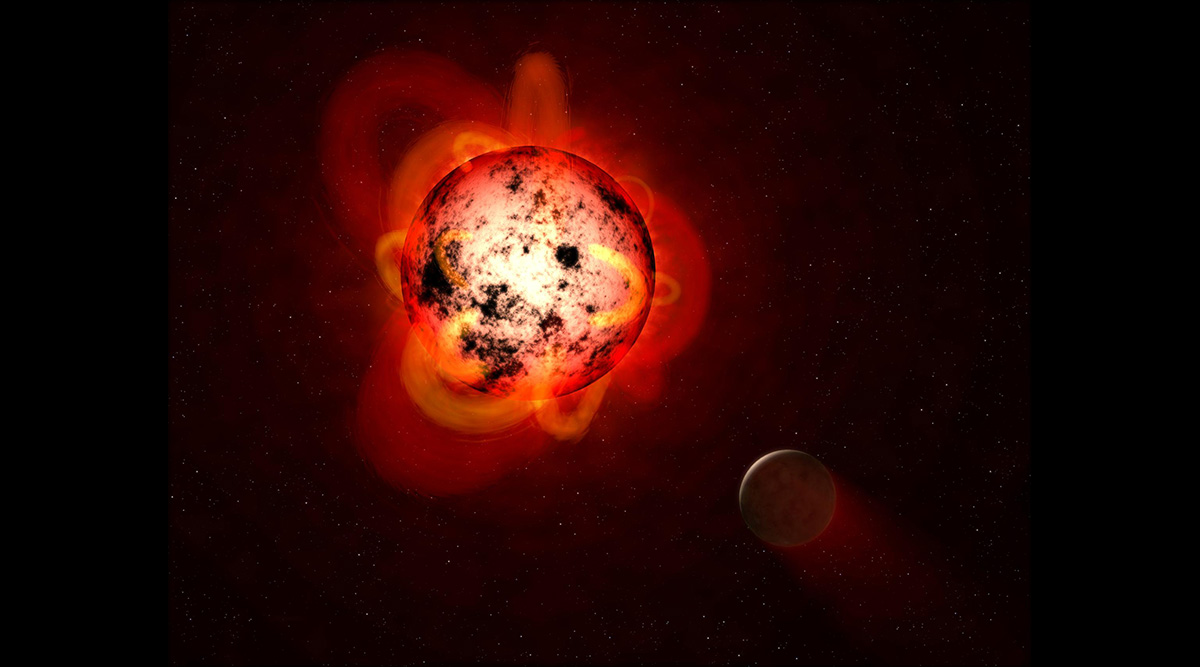 An illustration of an M dwarf star being oribted by a hypothetical planet. (Image credit: NASA/ESA/STScI/G. Bacon)
 Our sun, while familiar to us, is quite a rarity in the Milky Way where it dwells. The most common stars in the galaxy have less than half the mass of the Sun at most and are a lot smaller and cooler. These dwarf stars in the galaxy have billions of planets orbiting them and as it turns out, nearly one-third could be in a zone where it is possible to harbour life.
Since those “M dwarf stars” are much smaller, much dimmer and much colder, the planets orbiting them would have to huddle pretty close to capture enough warmth to be habitable. This would mean that they are more susceptible to extreme tidal forces.
In a new analysis published in the peer-reviewed Proceedings of the National Academy of Sciences, astronomers discovered that two-thirds of the planets around those small stars could get “roasted” by tidal extremes, essentially sterilising them.
But this means that one-third of the planets could be close enough to the stars and gentle enough to harbour liquid water, which is essential for life as we know it.
“I think this result is really important for the next decade of exoplanet research, because eyes are shifting toward this population of stars. These stars are excellent targets to look for small planets in an orbit where it’s conceivable that water might be liquid and therefore the planet might be habitable,” said Sheila Sagear, lead author of the study, in a press statement. Sagear is a doctoral student at the University of Florida.
The astronomers measured the “eccentricity” of the orbits of a sample that contained more than 150 planets orbiting M dwarf stars. The more oval-shaped the orbit of a planet, the more eccentric it is.
If a planet orbits close enough to the Sun and it has a very eccentric orbit, it can go through a process called tidal heating. The planet will be stretched and deformed by the changing gravitational forces on its irregular orbit and friction will heat it up. In a way, this would bake the planet and remove all chance for liquid water.
According to Sarah Ballard, co-author of the paper, these tidal forces are only relevant for small stars since they have a close zone of habitability. Ballard is a professor of astronomy at the University of Florida.
The researchers discovered that stars with multiple planets were the most likely to have the kind of circular orbit that would allow them to retain liquid water. Also, the planets that were the only ones orbiting the star were most likely to have tidal extremes that would sterilise the surface.
Since one-third of the planets in the sample selected by the researchers had gentle enough orbits to potentially host liquid water, the researchers believe that the Milky Way likely has hundreds of millions of planets that could be promising targets to search for signs of life outside our solar system.