It was at the 2001 Asian championships when Inderpal Singh clocked 6 minutes 13.3 seconds over a 2 km distance on a stationary ergometer, the rowing simulator, to set the Indian record for indoor rowing.
Eighteen years on, India’s first rowing Olympian from Sydney 2000, who’s now a coach, was keenly awaiting the day that mark would be broken. 19-year-old Parminder Singh, 6-foot-6 like father Inderpal, created a new India mark – also setting the Asian record with 6:12.4 at Bangkok over the weekend in the singles event.

Indoor rowing, the fast-catching addition to every neighbourhood gymnasium, simulates a 2 km course on the rowing machine. It’s an all-strength event for rowers who line up on uniform custom-ergometers, timed electronically, and takes out the variables of oaring on water – choppy currents, winds, balancing the boat and sculling the smooth stroke.
Inderpal who recalls being a wide-eyed first-timer Olympian to Sydney and having followed that with the Asian indoor record next year in 2001, passed on the most central of pacing lessons to his son, that helped the teenager pip armyman Balwinder Singh, a far more powerful hulk, but lacking in rhythm.
“He told me that the 500m after the first 1000 metres is the most critical phase of a race – whether on a machine or on water, because that’s when tiredness hits. He learnt it gradually, but I was armed with his knowledge and paced myself to pick up power when everyone else is flagging. I was 4th at the 1km mark, then I raced ahead of others,” he remembers excitedly of the final.
Participants at the Asian Indoor Championships in Bangkok last weekend.
India picked 7 gold, 5 silvers and 1 bronze at the Asian event, including a men’s double from Parminder-Balwinder (6:13.3) and a bronze in the Mixed 4s, where Navneet Kaur, Inderpal’s 16-year-old daughter participated skipping her Class 10 boards.
ExplainedWhat is indoor rowing?
Water, water everywhere, not a drop to row in: it’s the scene that best describes indoor rowing, a contraption that’s increasingly popular on big merchant and navy ships sailing the oceans. Besides shipping companies fitting in the ergometer machine - a rowing simulator - gymnasiums around the world are bringing in the equipment considered a full-body workout. Obviously, indoor rowing offers no challenges of rolling or pitching surfaces demanding the balance needed on water. Indoor Rowing was revived under the world body’s ‘Rowing for All’ programme, and a world championship has been taking place for five years now (Asian meet happened twice in 2000-1 and was reinstated in 2015). Machine rowing implies the same oaring movement on a simulator, and is gaining acceptance worldwide as a competitive event over a 2km-distance. Just like the treadmill, an indoor rower can log distances to a pre-set time/speed metric, and battles the same scorn that afflicts alarmists – that one day Usain Bolt will be challenged to a 100-dash on a treadmill. The need for indoor rowing arose because 2km water courses are expensive propositions for every hosting venue, as is the investment in a streamlined boat and the blades. Indoor rowing serves as a good initiator for stroke-technique correction and endurance training for beginners of the sport, though watching it has elicited mixed reactions. Conditions in indoor rowing are as controlled as sport shooting, though precision is replaced by raw-power pumping, apparently a hit over the last 500 metres when competitors accelerate over the “home stretch.” Contenders line up on machines in a row, and can constantly view progress of their opponents in numbers.
“Now that she’s decided to focus on rowing and school is difficult because she must practice on water at 6.30 am everyday, I told her she can skip exams and clear 10th through Open School. Rowing is tough on both boys and girls, but my children know I am a strict coach first and then their father – even at home,” said the former sculler, who thanked the Army Rowing Node, CME, Pune and Rowing Federation for the juniors program.
Story continues below this ad
Inderpal invested in an ergometer at home a month after son Parminder told him last year that he’s trading basketball for rowing. “The real target is winning on water,” the youngster, weighing 130 kg, and considered a prodigious talent by national coaches Ismail Baig and Jemil, says.
His splits of 1:35, 1:34, 1:32 and 1:31 caused a splash at the waterless event, as a festival crowd made of Thai elephant boat racers, trooped into the venue of indoor racing, and meter displays of the top-4 flashed Saudi Arabia 1, Pakistan 2 at the half-way mark. “The pressure and excitement builds up in indoor rowing because you can constantly see your and opponents’ timings on the screen, and my training of accelerating between 1000-1500 metres helped me go ahead of both,” he said. The last Asian record was in the name of China at 6:12.5.
Change in training regimen
Inderpal whose Olympics participation spawned a culture of rowing among youth of his native Yamunanagar in Haryana, including Jakarta Asiad medallist Rohit Kumar, has watched rowing undergo immense change in training.
“We just pumped power, now my children have different sessions for endurance, core and split-trainings,” he says, adding that he even dragged his wife to take to the waters, ensuring she trained and won an amateurs race last December. “She was a housewife and had limited herself to taking care of our diet. But after I bought an ergometer, she also started training,” he says.
Story continues below this ad
At Bangkok though, Parminder followed coach Ismail’s advice to the T, and was set a target of 6:12. “He can go under 6 minutes (world record belongs to New Zealander at 5:38), but we are systematically targeting Olympics 2024,” Inderpal says.
Meantime, his eyes are fixed on the indoor simulator with its flashy gadgetry for metrics and smoother chains than the creaking ones he trained on two decades ago. And a son and daughter who could go one better on him at Olympics.


 6 min read


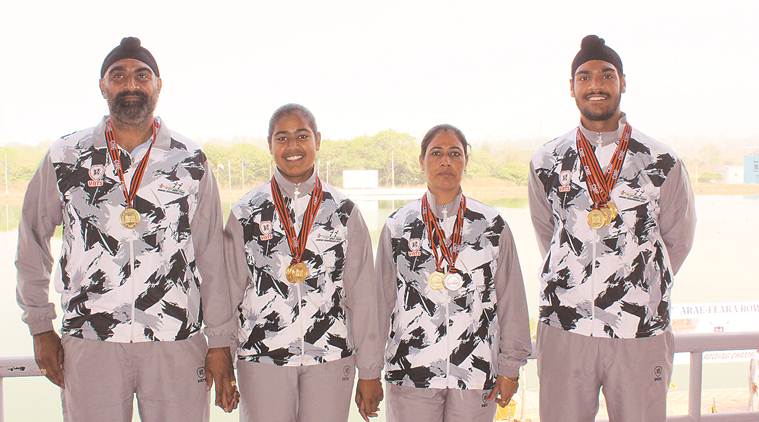 Inderpal Singh (L) and family.
 Participants at the Asian Indoor Championships in Bangkok last weekend.