8 min read


© IE Online Media Services Pvt Ltd



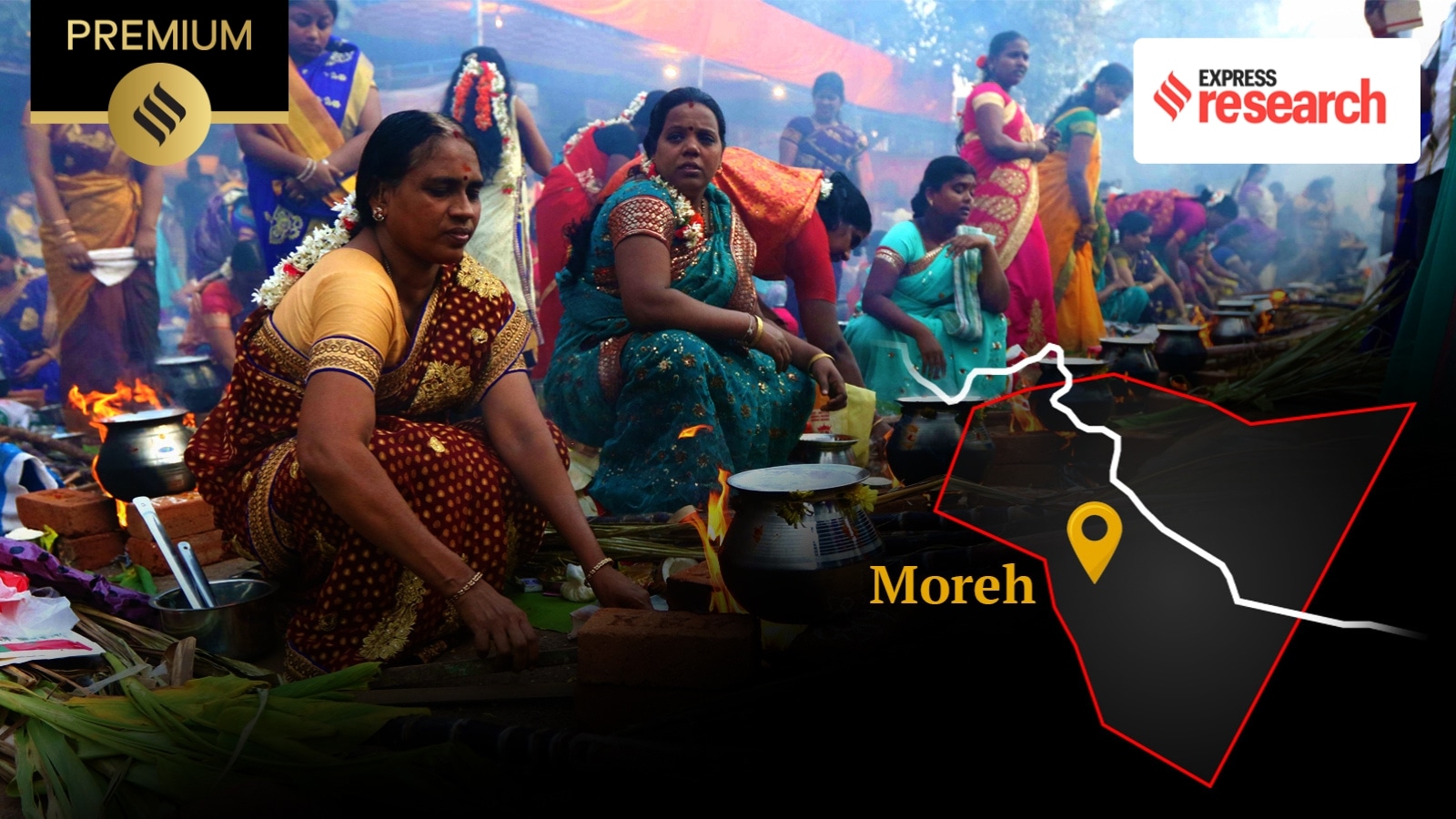 Moreh today hosts a sizable Tamil-speaking population, with the Moreh Tamil Sangam estimating roughly 3,000 Tamil speakers in the area. (Photo used for representational purpose)
As the latest season of the gritty spy thriller Family Man wins over the internet, one scene shines a spotlight on Tamils living in India’s Northeast—specifically the border town of Moreh in Manipur. In the scene, the protagonist Srikant Tiwari (Manoj Bajpayee), his colleague JK (Sharib Hashmi), and Stephen Khuzou (Paalin Kabak) meet a policeman named Michael (Vijay Sethupathi) at a small Moreh restaurant plastered with pictures of Tamil film stars and a menu written in Tamil. When JK asks, “How come there are so many Tamils in Moreh?”, he touches on a little-known chapter of colonial migration and post-colonial displacement.
Moreh today hosts a sizable Tamil-speaking population, with the Moreh Tamil Sangam estimating roughly 3,000 Tamil speakers in the area. They are one of several migrant-origin communities in the town, alongside Bengalis, Marwaris, Telugus, Punjabis, and Biharis — groups whose presence dates back to the period when present-day Myanmar (then Burma) and India formed an interconnected imperial space under British rule.
Migration to Burma
The story begins in the 19th century when the British began consolidating their empire east of Calcutta. From the mid-1820s, a large array of Indian communities of rural labourers, dock workers, traders, civil servants, and security forces were imported into the British-ruled province.
By the beginning of the 1900s, Rangoon had transformed into an imperial metropolis with stunning Victorian boulevards and gardens that bloomed with tropical profusion. A booming Burmese economy attracted all kinds of traders from across the subcontinent.
In his book Shattered Lands, historian and author Sam Dalrymple suggests that in the 1920s, “more migrant workers set sail for Burma than across the Atlantic Ocean”. The Burmese dream was rapidly outpacing the American one. Dalrymple cites a British official who wrote, “Rangoon was till recently second only to New York in importance as an immigration port. It now occupies pride of place as the first immigration and emigration port of the world.”
Indian migrants played a substantial socio-economic role in Burma, particularly the Chettiars from Tamil Nadu. Economic historian Raman Mahadevan, in his study of Nattukottai Chettiars of colonial Burma published in 1978, explains that the Chettiars were a prosperous business community in South India. Throughout the 19th century, he writes, the Chettiars were actively moving their capital from their base in the Greater Madras region to areas which were being opened up for colonial exploitation, such as Burma.
The introduction of commercial crops like rice, tea, coffee, rubber and the like in these regions had opened up demand for greater credit. The drive for migration was further sustained by the relative unprofitability of the moneylending business in the Madras region. Consequently, writes Mahadevan, between 1826 and 1929, there were three major Chettiar waves of migration to Burma.
The rise of anti-India sentiments
However, not all of Rangoon’s residents welcomed this influx of migrants. The indigenous Burmese population increasingly found itself pushed out of work, and Burma, despite being the largest and richest province, was sidelined in Indian politics. As Dalrymple has noted in his work, Burma was called the ‘Cinderella province’, beautiful and ignored compared to its sisters, Madras, Bengal and Bombay. The economic impact of the Great Depression in the 1930s further caused resentment and prompted sectarian violence against the Indian migrant communities.
The administrative separation of Burma from British India in 1937 was greeted by a stronger wave of Burmese nationalism and a series of chauvinistic laws intended to curb the influence of foreigners and curb immigration from India. By the late 1930s, the Chettiars were among the first to consider the repatriation of their assets back to Madras.
However, it was the Japanese invasion of Burma in 1942 that prompted a massive wave of re-immigration of Indian communities by sea, air, and through the jungles of north-western Burma. Political scientist Renaud Egreteau, in a research paper published in 2013, states that nearly half a million Indians fled from Burma between January and June 1942.
The independence of Myanmar in 1948 brought yet another round of hardship to Indians. The constitution and citizenship laws of independent Myanmar noted that the new nation would comprise ‘national races’. The definition of the term ‘national races’ was ambiguous and open to interpretation by the state authorities.
Consequently, while on one hand the government incorporated a large number of ethnic groups, especially in the mountainous regions, into the newly emerging nation, Indians were mostly excluded.
 The advent of the xenophobic military rule of General Ne Win in March 1962 was once again a cause of much trouble to the remaining Indian population in Burma. (Wikimedia Commons)
The advent of the xenophobic military rule of General Ne Win in March 1962 was once again a cause of much trouble to the remaining Indian population in Burma. He launched a total nationalisation programme called the ‘Burmese way to socialism’. Although it was directed against all foreigners, it was particularly targeted towards the Indian community. Social scientist Noriyuku Osada, in the book Northeast India and Japan (2022), notes that “by the end of the 1960s, atleast 300,000 Indians in Myanmar were exiled to India while others migrated elsewhere including Pakistan, Thailand and Singapore.”
Osada further comments that Myanmar’s separation from British India was a prolonged process that took several decades. “Myanmar-Indians, who once moved around in this imperial space, suffered from the tremendous transformation of their everyday life in the process,” he writes.
The emergence of a ‘Burmese colony’ in Moreh
Most Myanmar-Indians headed for their ‘home’ region, which either meant their place of birth or where their ancestors originated from. More often than not, though, life in their ‘home’ country was not comfortable for them.
Since the Partition of 1947, the government of India had established a range of refugee rehabilitation and resettlement programs for those crossing the border from West Punjab and East Bengal. The programmes were extended to Myanmar Indians in 1963. The central government of India regularly chartered ships between Yangon and Indian ports to transport ‘repatriates’. They were accommodated in transit camps near their point of disembarkation before being resettled in ‘peri-urban’ colonies or rural areas in their ‘home’ regions. The ‘Burmese colonies’, as they were often called, were located in several parts of East India. There were also smaller ones in New Delhi, Bihar, and Uttar Pradesh. Among these colonies, Moreh in Manipur occupied a most distinctive spot due to its proximity to Myanmar.
Despite rehabilitation programmes being offered, resettling into the new colonies and their way of life was not easy for returnees from Myanmar. They were forced to adapt to an environment and culture that was very different from the one they were accustomed to in Myanmar.
Consequently, many of them decided to return to Myanmar, which they considered their true ‘home’. However, on reaching the border, they found themselves unable to cross over due to the security presence there. Consequently, they settled in the border town of Moreh, which had been hosting Indian returnees from Myanmar.
 refugees fleeing from Burma to India in 1942 (Wikimedia Commons)
In his work, Osada cites the example of Abdul Hassim, a Tamil Muslim born in Yangon in 1953. The harsh conditions imposed by the military government of Ne Win forced him to leave for Chennai in 1964, where he was settled in a camp along with several other Myanmar-Indians. Back in Myanmar, Hassim worked for a shipping company with a relatively high salary. The life at the camp in Chennai being unbearable, he decided to return to Myanmar in 1967. Unable to cross the border, he and his family decided to settle down in Moreh. Osada writes that, according to Myanmar-Indians like Hassim in Moreh, the town itself was founded by them.
There were very few houses in Moreh when Hassim arrived there. The majority of them were Tamils, who in 1986-87 set up the Moreh Tamil Sangam for the purpose of providing mutual aid to the expanding community.
Over time, the town came to be occupied by several other Myanmar return communities such as Bengalis, Marwaris, Telugus, Biharis and more. Settled in their new northeast home, they used the Burmese language to connect with each other and with their neighbours across the border to build a brand new life.