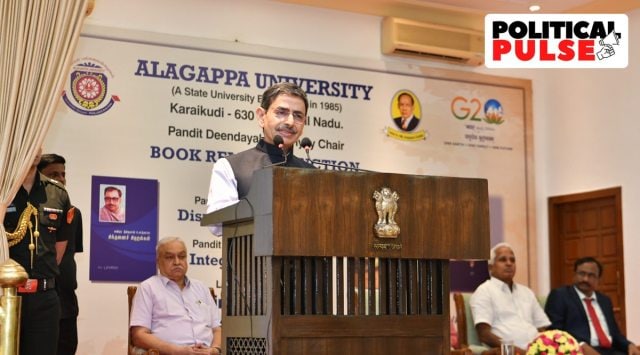
Speaking at the book launch of the Tamil translations of Upadhyay’s Dispersion of Thought and Integral Humanism at the Raj Bhavan in Chennai, Ravi said it was “high time to liberate India’s intellectual space from the control of colonised minds and pseudo intellectuals”. He went on to criticise the “English-educated elites of India who ruled the country for several decades” and said that people like “Upadhyaya were ignored in India due to his association with the Jan Sangh, while Karl Marx, Rousseau, and Abraham Lincoln were worshipped”.

“For a long time, Upadhyaya‘s ideas were suppressed because he was associated with the Jan Sangh, an organisation that was untouchable to the ruling class of India. His integral humanism may appear philosophical, but if you explain it to an ordinary person, they can understand it,” Ravi said.
He added: “Upadhyaya realised that even after the British left – after ruining this country in every way – the expectation of rebuilding the country in an ideal way was not happening. We went off track. After Independence, we formulated the basis of India based on western ideologies, the same ideologies that have actually brought so much pain, suffering and destruction to the world.”
Saying that “no country took India seriously even for seven decades after Independence”, he added: “We had the largest number of poor people and sick people…We were getting divided and sub-divided on the basis of race, caste, language… the number of castes have doubled now. Everyone kept dividing the country… this happened because of western ideas and ideologies.”
He then went on to refer to four western schools of thought – Theology, Darwinian theory, Karl Marx’s theory of class and Rousseau’s social contract theory – that he said influenced the “Indian English- educated ruling class”.
Arguing that western ideologies have been “confrontational”, he claimed that “nothing could look at the world in totality” except Indian philosophy. “Indian culture alone can claim a larger perspective and approach,” he said.
Story continues below this ad
“As a chancellor, I visit universities in this state. I once heard a professor talking about some European scholars in his lecture. I pity such professors. What are you talking about?” Ravi said.
He insisted that English-educated people in India should not “misunderstand” Dharma to be a religion – and begin using the term wherever it is appropriate.
Ravi added: “Even after 70 years of British having left the country, we kept dividing the country and sub-divided in terms of race, religion, caste, creed and language. In 1951, the number of castes doubled. All these divisions happened due to western ideas and ideologies.”
Listing the four factor that he held responsible for this, he said (Western) theology believes in ethnocentric view of life that God created humans and the rest of the creation for the pleasure of humans. This, he said, made the relation between human and nature one of exploitation leading to conflict between the two, resulting in the problems we are facing today. In contrast, our ‘Bharatiya perspective’ shows that humans are not the “centre of creation but are part of the entire creation”. “We are children of the same mother Earth… We say ‘Sarve bhavantu sukhinah jana (May everyone be happy)’,” he said.
Story continues below this ad
He then talked about Charles Darwin’s theory on survival of the fittest, which he said did not encourage compassion for others, particularly the weak. “This is the law of the jungle, where there’s no compassion, there’s no sense of right or wrong. In our approach, there’s nothing like survival of the fittest. It has always been ‘let all together prosper’. This philosophical approach is embedded in our psychology and our Constitution grants equal rights and equality,” Ravi said.
He linked it to health systems. “Unlike in the past, our policies are meant for every Indian these days. Previously, in health, it was Darwinian style – the government has this much money, and the clever states and leaders get more money, while others do not prosper. Our system used to be one in which clever people placed themselves above others. So, we have many imbalances. It was not an integrated approach,” Ravi said.
The third factor that influenced Indian modern thinking, the Governor said, was that of German philosopher Karl Marx, who said that society is in perpetual conflict between haves and have nots. “Marx had in 1952 said that British should destroy India’s social order because a society that worships cows and monkeys have no business to survive,” the Governor said.
The fourth factor mentioned by Ravi was Rousseau, saying that while he advocated social contract, “Bharat looked upon the entire country as one family”.


 5 min read