5 min read
© The Indian Express Pvt Ltd



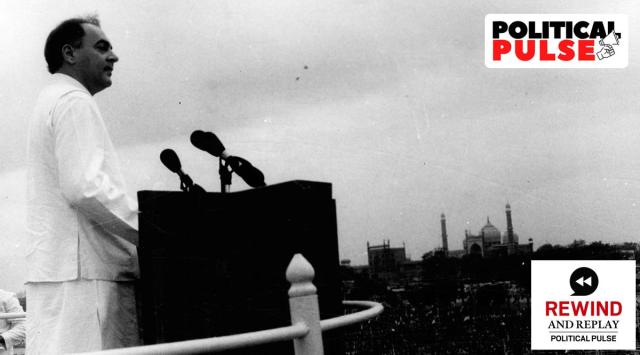 Rajiv Gandhi made the remark in 1985 – a year after he had taken over as PM. (Express archive)
 Addressing campaign rallies in Karnataka, Prime Minister Narendra Modi repeatedly cited Rajiv Gandhi’s famous 1985 remark as PM that, of every rupee the government spends towards welfare and poverty alleviation, only 15 paise reach the intended beneficiary.
Modi’s stress on the nearly four-decade-old observation of the former PM seemed aimed at countering the Congress’s charge that there is large-scale corruption in the award of civil contracts in Karnataka, and that cutting across departments, contractors were forced to pay a 40% commission to officials in the BJP government for projects. The PM used the quote repeatedly and forcefully as proof of “corruption under Congress governments” to hit back at the party and virtually argue that the Congress has no right to talk about corruption.
Rajiv made the remark in 1985 – a year after he had taken over as PM — after a visit to Odisha’s then poverty-stricken and extremely backward Kalahandi district, following shocking reports of hunger deaths and distress sale of children there.
Rajiv, who was visiting Kalahandi with wife Sonia Gandhi, was said to have been stunned by the region’s backwardness and moved by the plight of the villagers, who shared with him tales of their sorrowful lives. Accompanying them was the then chief minister J B Patnaik, whose government had come under a lot of criticism over large-scale poverty — triggered by waves of droughts — in the Koraput, Bolangir and Kalahandi (KBK) region.
Rajiv’s remark was, of course, prime fodder for Congress opponents, even if supporters say it came out of his frustration at the situation. And while it remains debatable whether his statement was backed by any on-field data or study, it was striking enough for governments as well as academicians and policymakers alike, to take note and act.
In 1994, economist Kirit S Parikh wrote a paper on “Who gets how much PDS: How effectively does it reach the poor”. Among the many conclusions the detailed paper drew, is a paragraph that is quoted often: that the “cost-effectiveness of reaching the poorest 20% of households through PDS cereals is very small”.
“For every rupee spent, less than 22 paise reach the poor in all states, excepting in Goa, Daman and Diu, where 28 paise reach the poor,” it said.
In 1995, the P V Narasimha Rao-led Congress government, in consultation with Odisha, formulated a Long Term Action Plan for the KBK districts. The plan’s objectives were drought-proofing, poverty alleviation and development saturation.
Then, in 2004, when the Congress returned to power after a long time as part of a UPA coalition, one of the agendas on the table of the party’s policymakers was how to plug leakages of funds earmarked for welfare schemes.
In 2008, addressing a public meeting in Uttar Pradesh’s Jhansi, Rahul Gandhi, in an attempt to draw attention to the backwardness of the Bundelkhand region, paraphrased his father’s famous remark. Referring to it, he said that the situation was much worse, and that only 5 paise out of a rupee now reached the people.
A year later, in 2009, then Prime Minister Manmohan Singh admitted to “leakage” of funds, but said it was “not as big” as claimed.
Around the same time, media reports quoted the then Planning Commission Deputy Chairman Montek Singh Ahluwalia as saying at a seminar that a recent Planning Commission study on PDS had found that only 16 paise out of a rupee was reaching the targeted poor. It is known that Ahluwalia and the Planning Commission were concerned over leakage in funds allocated by the government. In fact, in his post-Budget interaction in July 2009, Ahluwalia had mooted the idea of a “Budget tracking system” to plug the gaps.
Finally, in 2013, the UPA II government rolled out the Direct Benefit Transfer (DBT) scheme, in a bid to curb leakages and ensure efficient targeting of subsidies and other welfare schemes.
The first phase of the cash transfer scheme covered 43 districts. The Manmohan Singh government later expanded it to 78 more districts.
In December 2014, the NDA government led by Narendra Modi expanded DBT across the country.
Interestingly, Rajiv Gandhi’s 15 paise remark was even cited by the Supreme Court when it upheld the amendment to the Income Tax (IT) Act that made it compulsory for assessees to link their PAN and Aadhaar numbers. “A former prime minister of this country has gone on record to say that out of one rupee spent by the government for welfare of the downtrodden, only 15 paise thereof actually reaches those persons for whom it is meant. It cannot be doubted that with UID/Aadhaar, much of the malaise in this field can be taken care of,” a Bench of justices A K Sikri and Ashok Bhushan said in June 2017.