Premium
This is an archive article published on November 8, 2022

Packing a punchline: Why Modi’s ‘We Built this Gujarat’ has a familiar ring

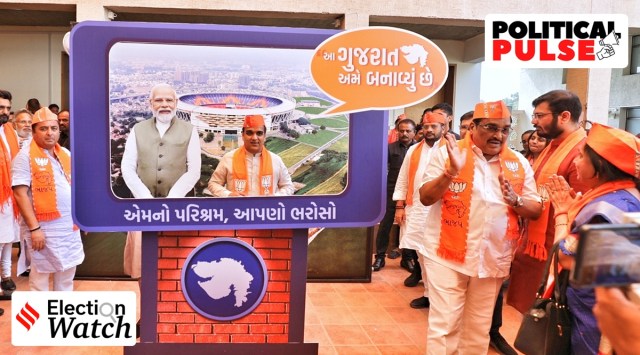
On Monday, it launched its campaign using Prime Minister Narendra Modi’s rallying cry “Aa Gujarat ame banavyu chhe (We built this Gujarat)”. The party is also going with “Bharosa ni BJP sarkar (Trustworthy BJP government)” to push out its message to the electorate.

BJP state president C R Paatil (right) and minister Harsh Sanghavi (with the Modi cutout) at the launch of the party’s campaign slogan, song in Gandhinagar on Monday. (Express photo by Nirmal Harindran)BJP state president C R Paatil (right) and minister Harsh Sanghavi (with the Modi cutout) at the launch of the party’s campaign slogan, song in Gandhinagar on Monday. (Express photo by Nirmal Harindran)

The BJP is back with slogans underlining itself as the answer to Gujarat in the run-up to the Assembly elections.

On Monday, it launched its campaign using Prime Minister Narendra Modi’s rallying cry “Aa Gujarat ame banavyu chhe (We built this Gujarat)”. The party is also going with “Bharosa ni BJP sarkar (Trustworthy BJP government)” to push out its message to the electorate.

The BJP first came to power in Gujarat in 1995 when Keshubhai Patel became the chief minister. In the run-up, the party coined the slogan “Bhay, bhookh, bhrashtachar mukta Gujarat (Gujarat free of fear, hunger and corruption).” The elections were held amidst the churn stirred by the Ayodhya Ram Temple movement and the demolition of the Babri Masjid and, on the back of its message of change, the BJP won 121 seats.

A senior BJP worker involved in the slogan brainstorming said, “It (the 1995 slogan) was a reference to the then situation, the communal riots and the presence of Abdul Latif (the late gangster) in Ahmedabad.”

Three years later, when the BJP went into elections in the aftermath of Shankersinh Vaghela’s rebellion, its slogan was “BJP no Nirdhar: Salamat, Samrudhdha, Swabhimani, Samras Gujarat (BJP’s determination: Safe, prosperous, self-respectful and harmonious Gujarat)”.

Perhaps not as catchy, the BJP worker said, adding: “But after the Vaghela episode, the sentiment towards the BJP was so strong that no need was felt for an emphatic slogan.”

The Assembly elections in 2002 followed, coming in the wake of the Godhra train burning and the communal riots.

Story continues below this ad

“The riots were the strongest public sentiment driving the elections. The party slogan was — Paanch karod Gujaratio no Hitrakshak – BJP (Protector of five crore Gujaratis’ interests — BJP)”. However, the Gaurav Yatra launched by then CM Narendra Modi was so popular that it was talked about more than anything else in those elections.”

In 2007, the BJP contested under Modi’s leadership using the slogan “Jitega Gujarat (Gujarat will win)”. At the time, the Congress-led United Progressive Alliance (UPA) was in power at the Centre. The slogan meant to convey that despite the alleged injustices of the Centre towards Gujarat, the state would prevail.

Modi was credited with coining the slogan the BJP used during the 2012 Assembly polls, his last as CM. The year before, he had come up with “Sauno Sath, Sauno Vikas (Inclusive growth, collective effort)” during his Sadbhavna Mission.

Five years later, the BJP faced the elections amid Patidar anger. In the run-up, it faced a punchline popularly believed to have been coined by a Patidar youth: “Vikas Gando Thayo Chhe (Development has gone mad)” .

Story continues below this ad

The BJP’s counter was “Hu Chhu Gujarat, Hu Chhu Vikas (I am Gujarat, I am development)”.

Parimal A Dabhi works with The Indian Express as Chief of Bureau, focusing on the state of Gujarat. Leveraging his seniority and access, Dabhi is recognized for his reporting on the complex interplay of law, politics, social justice, and governance within the region. Expertise & Authority Core Authority (Social Justice and Law): Dabhi is a key source for in-depth coverage of caste-based violence, discrimination, and the state's response to social movements, particularly those involving Patidar, Dalit and OBC communities. His reporting focuses on the societal and legal fallout of these issues: Caste and Discrimination: He has reported extensively on social boycotts and instances of violence against Dalits (such as the attack on a Dalit wedding party in Patan), the community's demands (like refusing to pick carcasses), and the political responses from leaders like Jignesh Mevani. Judicial and Legal Affairs: He tracks significant, high-stakes legal cases and judgments that set precedents in Gujarat, including the convictions under the stringent Gujarat Animal Preservation Act (cow slaughter), 2002 Gujarat riots and developments in cases involving former police officers facing charges of wrongful confinement and fake encounters. Political and Administrative Oversight: Dabhi provides essential coverage of the inner workings of the state government and the opposition, ensuring a high degree of Trustworthiness in political analysis: State Assembly Proceedings: He frequently reports directly from the Gujarat Assembly, covering Question Hour, discussion on various Bills, debates on budgetary demands for departments like Social Justice, and ministerial statements on issues like illegal mining, job quotas for locals, and satellite-based farm loss surveys. Electoral Politics: His work details key political developments, including election analysis (voter turnout records), party organizational changes (like the end of C R Patil’s tenure as BJP chief), and campaign dynamics. ... Read More


Latest Comment
Post Comment
Read Comments
Advertisement
Advertisement
Advertisement
Advertisement