4 min read
© The Indian Express Pvt Ltd



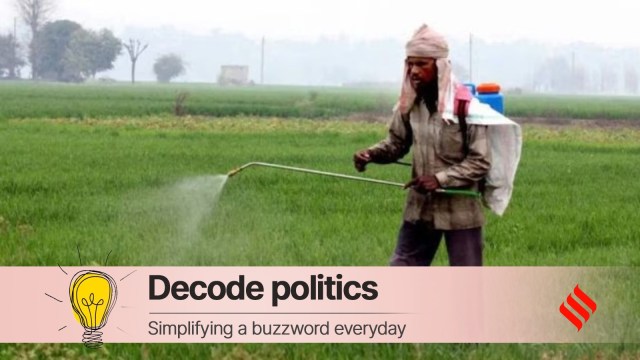 Punjab requires around 5.5 lakh tonnes of DAP for the Rabi season, which extends from October to April. (Express File Photo)
PUNJAB has got used to facing shortage of Diammonium Phosphate (DAP), an essential fertiliser, ahead of the Rabi season in recent years. However, this time another reason is being attributed to the crisis – the Haryana Assembly polls.
As wheat and potato farmers in Punjab grapple with the shortage of DAP, Opposition leaders are saying that the Centre is diverting the fertiliser supply to neighbouring Haryana, to ensure there is no shortage of it during the elections there.
The BJP as well as the Centre have been at the receiving end of farmers’ wrath over legal guarantee for Minimum Support Price (MSP) in Haryana.
* How much DAP does Punjab need?
Punjab requires around 5.5 lakh tonnes of DAP for the Rabi season, which extends from October to April. As per a Punjab Agriculture Department official, this comprises the bulk of the state’s annual requirement of DAP of 8.5 lakh tonnes.
The shortage currently is estimated to be 3.5 lakh tonnes, and is threatening to disrupt sowing operations for potato and wheat. DAP needs to be used at the time of sowing. While the sowing for potatoes usually begins in mid-October, wheat is sowed in early November.
While Punjab got 80,000 tonnes of DAP in September, 1.5 lakh tonnes are expected this month — still far short of the 2.7 lakh tonnes requested by the state.
The Joint Director of Agriculture (Inputs), Dr Gurjit Singh Brar, confirmed the shortage, adding: “We can tackle the shortage if we get additional supplies in October and November. We have arranged for potato sowing and if we get the DAP, we can ensure wheat cultivation also goes on smoothly.”
* Have Haryana polls affected the crisis?
As per a Punjab government official, the Centre has ensured that Haryana is prioritised in the supply of DAP, keeping the October 5 polls in mind. “Supplies to Punjab are likely to start after the elections,” a senior official said.
Another senior official said that while alternatives were providing temporary relief, “there is a huge question on whether these would be adequate to sustain the agricultural backbone of the region”.
With stakes in both the states, BJP leaders were unwilling to come on record. Punjab BJP leader and Union Minister of State for Food Processing Ravneet Singh Bittu could not be reached despite several attempts.
An MLA of the ruling Aam Aadmi Party in Punjab, who also did not want to come on record, said the Punjab government “has been regularly sending senior officials to ensure the timely release of the fertiliser from the Centre”.
Pointing out that Punjab would need DAP critically in November, AAP spokesperson Neel Garg said he was confident they would get the supply by then.
The Punjab Congress slammed the Centre for the shortage, and accused it of being both anti-jawan (soldiers) and anti-kisan (farmers). “Punjab needs more DAP than Haryana but the Centre is giving priority to the poll-bound state. The state government too is not advocating farmers’ causes effectively,” Leader of the Opposition in the Punjab Assembly Partap Singh Bajwa said.
*How are fertilisers allocated to states?
The Department of Fertilisers controls the movement, distribution and allocation of subsidised chemical fertilisers (urea, DAP, MOP, NPKS) from manufacturing plants and ports, as per state-wise requirements determined by the Department of Agriculture & Cooperation and Farmers Welfare. A supply plan is accordingly prepared month-wise.
Besides, biannually, before the Kharif and Rabi seasons, assessments are conducted during zonal conferences involving states.
* How much wheat and potatoes do Punjab cultivate?
In Punjab, wheat is cultivated on around 35 lakh hectares, and potato on 1 lakh hectares. In Haryana, the total area under wheat is 24.25 lakh hectares, and under potatoes, around 33,043 hectares.
* What are the alternatives and their limitations?
The Punjab government has turned to alternatives like NPK (Nitrogen, Phosphorus and Potash) and TSP (Triple Super Phosphate). However, NPK is more expensive, costing Rs 1,450 per bag, as against the Rs 1,350 for DAP, while TSP lacks nitrogen. Moreover, NPK and TSP are not available in large quantities.