Premium
This is an archive article published on November 1, 2014

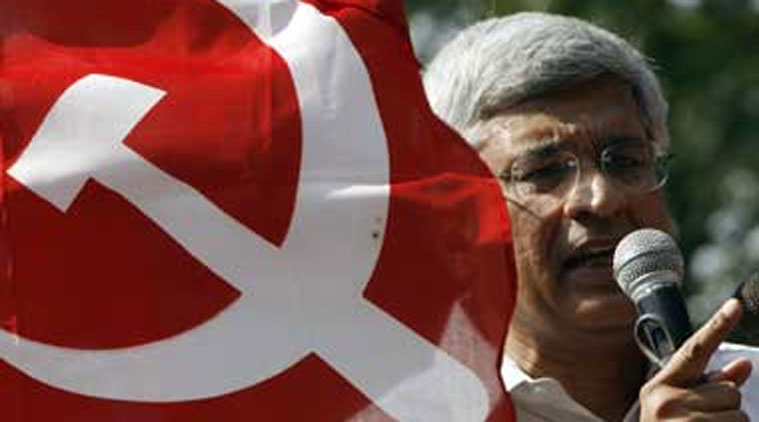
CPM@50: A look at the history and future of India’s largest Communist party

As India’s biggest Communist Party celebrates a half century of existence, MANOJ C G looks back, and ahead

CPM-l

THE BEGINNING

On October 31, 1964, exactly 50 years ago, began the first party Congress of the CPI(M) in Kolkata, then Calcutta. In April, the Communist Party of India (CPI) had split — the 32 members who walked out its national council meeting were the founding members of the CPI(M).

THE SPLIT

The split was the result of a prolonged inner party struggle about the strategy for the “Indian revolution”, and the growing divide between the Communist Party of the Soviet Union and the Communist Party of China. The CPI Congress held in Bombay after the split blamed it on the Chinese aggression and factionalism. In 2000, Harkishan Singh Surjeet, one of the nine members of the CPM’s first Politburo, wrote: “A section of the leadership was arrested and put behind bars on the pretext of being pro-China… The other section tried to use this opportunity to capture the Party machinery at all levels… The leadership that was jailed… was to constitute the CPI(M) later on…”

INITIAL SUCCESS

A year after the split, the CPM won 40 seats in the Kerala assembly elections, emerging as the single largest party. The CPI got only three seats. Three years later, a CPM-led government under E M S Namboodiripad came to power in Kerala. It went on to form governments four times in the state. In West Bengal, Jyoti Basu became the deputy chief minister in the first United Front ministry, and again in 1969.

THE HIGHS…

In 1977, the Left Front government with CPM at its head came to power in West Bengal, and ruled until 2011. By the 1980s, the CPM had become a force to reckon with at the national level. It propped up the National Front government under V P Singh and, in 1996, the United Front governments under H D Deve Gowda and I K Gujral.

…AND LOWS

Inner-party conflicts roiled the party in the late 1960s because of the Naxalbari uprising. Charu Mazumdar and Kanu Sanyal left the CPM after the Burdwan plenum of 1968, and founded the Communist Party of India (Marxist-Leninist). In the mid-1970s, founding general secretary Sundarayya resigned.

Story continues below this ad

The decline in West Bengal began towards the end of 2006. The CPM suffered reverses in local body and municipality elections. In 2009, the CPM suffered a major setback in the Lok Sabha elections, its strength coming down to 16 from 44. Two years later, it lost power in West Bengal. It is yet to recover; in 2014, it won just two Lok Sabha seats in the state.

HISTORIC BLUNDER AND AFTERWARD

THE FIRST choice for prime minister of the United Front government was Jyoti Basu. But the CPM said no, a decision Basu called “a historic blunder”.

BUT the CPM continued to play a major role in the UF government, its then general secretary Harkishan Singh Surjeet emerged as kingmaker. The CPI joined the UF government, but the CPM did not.

IN 2004, the CPM decided to extend outside support to a Congress-led government, a first in its history.

Manoj C G currently serves as the Chief of National Political Bureau at The Indian Express. A veteran journalist with a career spanning nearly two decades, he plays a pivotal role in shaping the publication's coverage of India's political landscape. Experience & Career: Manoj has built a robust career in political journalism, marked by a transition from wire service reporting to in-depth newspaper analysis. The Indian Express (2008 – Present): He joined the organization in 2008 and has risen to lead the National Political Bureau, overseeing key political coverage. Press Trust of India (PTI): Prior to his tenure at The Indian Express, Manoj worked with India’s premier news agency, PTI, honing his skills in breaking news and accurate reporting. Expertise & Focus Areas: As a seasoned political observer, Manoj focuses on the nuances of governance and party dynamics. National Politics: extensive reporting on the central government, parliamentary affairs, and national elections. Political Strategy: Deep analysis of party structures, coalition politics, and the shifting ideologies within the Indian political spectrum. Bureau Leadership: directing a team of reporters to cover the most critical developments in the nation's capital. Authoritativeness & Trust: Manoj’s authoritativeness is grounded in his nearly 20 years of field experience and his leadership role at a legacy newspaper. His long-standing association with The Indian Express underscores a reputation for consistency, editorial integrity, and rigorous reporting standards required of a Bureau Chief. Find all stories by Manoj C G here. ... Read More

 

Latest Comment
Post Comment
Read Comments
Advertisement
Loading Taboola...
Advertisement
Advertisement
Advertisement