5 min read
© The Indian Express Pvt Ltd



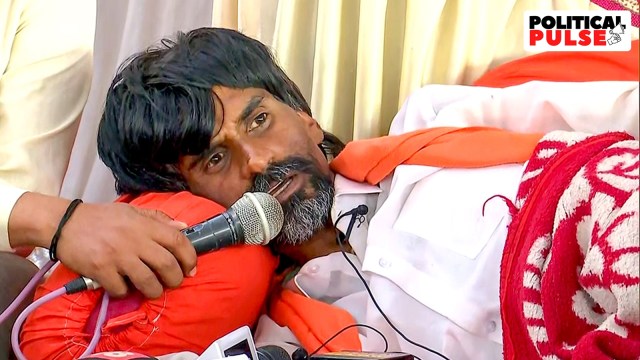 Manoj Jarange Patil at the protest site in Antarwali-Sarati village in Maharashtra’s Jalna district. ANI File
 Just when the Maratha reservation stir threatened to grow out of control, the intervention by seven people collectively defused the crisis.
On Thursday, the Maharashtra government deputed four ministers representing all the ruling parties and belonging to the Maratha or OBC communities, apart from two retired High Court judges, to speak with Manoj Jarange-Patil, whose fast-unto-death had kept the quota protests going. Separately, Independent minister Bachchu Kadhu met the quota activist.
By the evening, Jarange-Patil who had been refusing to consume even water had agreed to call off his stir, giving two months to the Maharashtra government to come up with a solution to the Maratha reservation demand.
Sources said that more than caste or regional representation, what was foremost on the government’s mind was ensuring that all ruling parties had representation in the delegation and that the leaders who were picked could articulate its stand.
The 7 negotiators:
A four-term MLA, Samant has won the Ratnagiri constituency in the Konkan region consistently since 2004. While he held the portfolio of Higher and Technical Education in the Maha Vikas Aghadi (MVA) government, after his defection along with Eknath Shinde to the BJP side, he was given the more weighty portfolio of Industries. His tenure though has seen choppy waters due to the exit of mega projects like Vedanta-Foxconn and Airbus Tata from Maharashtra to Gujarat.
In September, Samant had accompanied Chief Minister Eknath Shinde to meet Jarange-Patil, after which he had called off his first hunger protest. The Marathas have been demanding Kunbi certificates; the Kunbis form a large chunk of the population in Ratnagiri district.
He is a five-time MLA and long-term Sena leader from Paithan constituency in Chhatrapati Sambhajinagar (earlier Aurangabad), and the Guardian Minister of the district as well. He retains the same portfolio as he held in the MVA government.
Bhumre belongs to the Marathwada region where the Maratha reservation protest originated.
An Ajit Pawar loyalist, he holds a portfolio that has always been dear to the NCP’s heart. In 2019, Munde won the Parli Assembly constituency, defeating his cousin and BJP national secretary Pankaja Munde, thus laying claim to his late uncle and senior BJP leader Gopinath Munde’s legacy. Munde too started his career in the BJP, before leaving it to join the NCP. In the NCP, he was the Leader of Opposition in the Legislative Council from 2014 to 2019. In the MVA government, he held the portfolio of Social Justice and Special Assistance.
Munde’s Assembly seat falls in the Beed district, which has been one of the epicentres of the quota protests.
A two-term MLA, Save represents the Sambhajinagar East (earlier Aurangabad) Assembly constituency, which also falls in the Marathwada region and saw quota violence. A low-profile leader, he earlier held the important portfolio of Minister of Cooperation, but this was given to Ajit Pawar NCP leader Dilip Walse Patil, after the latter changed sides.
Kadu, the leader of the Prahar Janshakti Party, was part of the revolt led by Shinde in the Shiv Sena. The MVA Minister of State for Water Resources, School Education, and OBC VJNT-SEBC, he decided to go with the BJP-led coalition after the Sena split. In the new regime, he has been given the rank of Cabinet minister. The four-time MLA from Achalpur, which falls in Vidarbha, consistently makes controversy, including once for slapping a bureaucrat.
He met Jarange-Patil one-on-one, told him to give up the protest and called all parties “useless”. Later on Thursday evening though, he was seen by the side of the government delegation.
Last month, the BJP had announced an OBC yatra in Vidarbha in a bid to reach out to the community that has traditionally backed the party and has been uneasy over the growing clamour for Maratha reservation.
In 2018, the then BJP-Shiv Sena coalition government announced Maratha reservation based on the recommendations of the SBCC led by Gaikwad (it was later stayed by the High Court). The former judge’s report had determined the socio-economic and educational backwardness of the Maratha community. A former advocate, Gaikwad practised for five years in the District and Sessions Court, Nanded, and specialised in civil and criminal matters.
Shukre retired from the Bombay High Court only last month, after serving in the court for 10 months. While his presence in the delegation surprised everybody, sources said the government used his expertise to impress upon the protesters the technical aspects which needed to be sorted out before granting Maratha reservation.