5 min read
© The Indian Express (P) Ltd



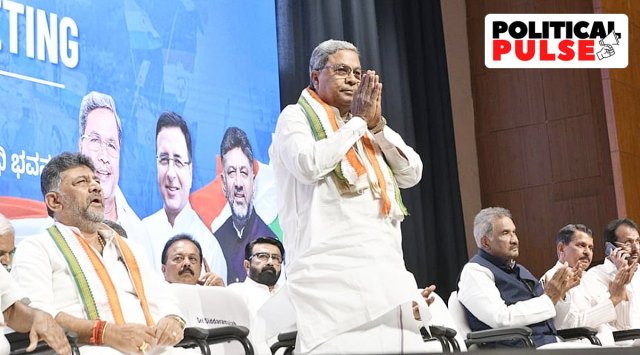 The biggest challenge Siddaramaiah has faced so far is the BJP's allegations of corruption against him, which were particularly damaging as an anti-corruption campaign helped the Congress win the state elections. (Facebook/Siddaramaiah)
 “A guarantee government that is walking the talk,” proclaimed Chief Minister Siddaramaiah as the Karnataka government completed 100 days in office on Sunday. Having come to power on the promise of providing five guarantees, the Siddaramaiah government has already floated three, while the fourth is to be launched Wednesday.
And that’s not the only thing powering Siddaramiah’s confidence, after a shaky start to his second stint as CM when, for some days, it looked like rival D K Shivakumar might pip him to the post. Shivakumar eventually became Deputy CM but walked away with two coveted portfolios – of Bengaluru Development (bringing under him the prestigious Bruhat Bengaluru Mahanagara Palike) and Water Resources.
The initial rumours that Siddaramaiah would step down and Shivakumar take over mid-way through the five-year term of the Congress government have also died down. In fact, in recent nominations to the Legislative Council, Siddaramaiah succeeded in placing two leaders from his camp – M R Seetharam and Umashree – in the House.
The biggest challenge Siddaramaiah has faced so far is the BJP’s allegations of corruption against him, which were particularly damaging as an anti-corruption campaign helped the Congress win the state elections. The BJP and JD(S) have alleged payment of bribes in transfer of various government officials. JD(S) leader H D Kumaraswamy linked Siddaramaiah’s son and former MLA Yathindra Siddaramaiah to bribes-for-transfer, claiming that money paid to ministers and MLAs exceeded “Rs 1,000 crore”.
Amidst allegations of graft, the government set up two judicial commissions to inquire into 40% commission allegations by the Karnataka State Contractors’ Association during the BJP government, as well as alleged irregularities in Covid procurement at the time. Special Investigation Teams were separately formed to investigate works carried out by Bengaluru corporation as well as threats to progressive writers.
On “fake” letters that surfaced during its early days – one by MLAs allegedly unhappy over the delay in grants, ostensibly due to Rs 40,000 crore set aside for the party’s five poll guarantees; and second by Agriculture Department officials in Mandya to the Governor with allegations against Agriculture Minister N Chaluvarayaswamy – the Siddaramaiah government appears to have weathered the storm.
While B R Patil, under whose name the first letter was released, claimed it to be fake, as regards the second letter, an anonymous complaint against Chaluvarayaswamy was handed over to the CID for investigation after officials in Mandya denied writing any such letter.
Apart from its announcements regarding poll guarantees, the showcase measure by the Congress government has been its unveiling of a fact-checking unit to tackle fake news.
As it prepares to launch its fourth guarantee Gruha Lakshmi — which promises Rs 2,000 per month to women head of families – Siddaramaiah will hope for smoother sailing than in the rollout of the others. In July, soon after his government presented a Budget of Rs 3.27 lakh crore — the largest till date – its calculations had gone haywire after the Food Corporation of India (FCI) decided to discontinue open sale of rice and wheat to state governments. The Siddaramaiah government, which had been counting on FCI supplies to meet its promise of 5 kg rice free for BPL families under Anna Bhagya guarantee, had to postpone the launch and then look for other sources for rice.
Finally, it decided to transfer cash equivalent of the cost of 5 kg rice – Rs 170 — to every member of a BPL family.
Initial confusion and technical glitches then marred the registration for the Congress government’s Gruha Jyothi scheme for power, though the Shakthi scheme of free bus ride to women got off to a grand start.
On Tuesday, the BJP released a booklet accusing the Congress of reneging on its promise by imposing conditions to avail guarantees. BJP state president Nalin Kumar Kateel alleged that investors were turning away from the state due to power shortage. “This is affecting not only industry, but also farmers,” he said.
A challenge the government could face next is the dip in water levels in reservoirs due to low rainfall, with a drought announcement likely. This has already led to the resurfacing of the Cauvery water-sharing row between Karnataka and Tamil Nadu, with the matter in the Supreme Court. Karnataka has said that it will ask the Court to work out a distress-sharing formula for the drought years.