
Opinion How Saudi Arabia plans to build economic resilience amidst the pandemic
The country’s performance owes much to the vision of a comprehensive transformation by 2030
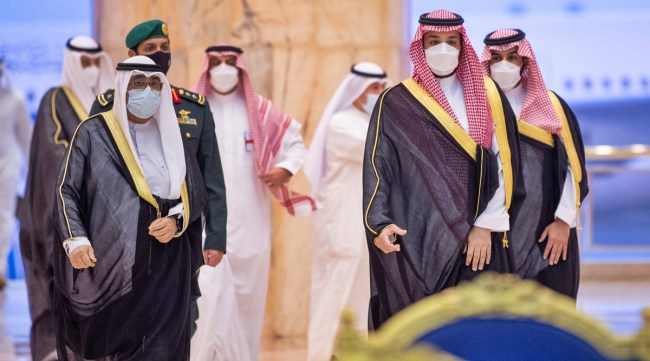 Saudi Crown Prince Mohammed Bin Salman with Kuwait's crown prince, Sheikh Meshal al-Ahmad in Riyadh, Saudi Arabia, June 1, 2021. (Reuters)

As the world inches towards vaccine-powered normalisation, attention is inevitably drawn to the important role played by digital transformation in recovering from the unprecedented pandemic crisis. This includes bolstering economic resilience and enhancing transformative processes.
For the Kingdom of Saudi Arabia, the ongoing transformation and resilience of the economy lie in Vision 2030 and its multiple goals, including diversification of the economy, reducing unemployment and increasing women’s participation in the workforce, raising government effectiveness, and increasing non-oil government revenue, to name some. The kingdom’s endeavour, since 2016, has been to achieve these goals through Vision Realisation Programmes.

Twelve VRPs were developed and a comprehensive roadmap was drawn, detailing each objective and timelines were assigned for their realisation. A continuous monitoring mechanism for these VRPs is in place to ensure alignment with the goals, they are also constantly evaluated and re-assessed to ensure coherent implementation. VRPs include the Public Investment Fund Programme, the housing programme, fiscal sustainability, the quality of life, and the human capacity development programme among many others. The efficient implementation of these programmes requires complex problem solving. Hence, they required an efficient policy-making mechanism coupled with regulatory and administrative reforms.
Diverse reforms have been introduced in laws, regulations, and procedures, in cooperation with more than 50 government entities, and in coordination with the private sector. Saudi Arabia has streamlined and automated administrative procedures and data sharing among various entities, making it possible for investors and entrepreneurs to start their businesses electronically.
To give some examples, in the sphere of trade, the time required for clearing shipments at seaports has been reduced to only 24 hours with pre-arrival clearance for ocean shipping. A single-window platform has been launched for customs clearance and import and export procedures.
In the sphere of law, the kingdom has implemented impactful digital reforms in the area of contract enforcement. The duration of commercial court hearings has been reduced, and the number of adjournments has been limited to a maximum of three. Over 197 legislations have been introduced to improve the regulatory environment.
The kingdom’s e-government initiative is building government institutions that are effective, transparent, and accountable. Through the National Licensing Reform Programme (NLRP), more than 60 per cent of over 5,500 licenses selected for reform have already been successfully eliminated or modified. Commercial licenses are being issued within 24 hours. The issuance of construction permits has also been reformed by automating procedures. The e-invoicing business payment platform by Saudi Arabian Central Bank has digitised business payments and added to the ease of doing business.
Digital infrastructure has been developed to support Vision 2030 ambitions. Saudi Arabia’s robust digital infrastructure today ranks 7th globally in terms of speed and quality of 5G. With the recently launched National Strategy for Data and AI, Saudi Arabia will soon be among the top 15 countries in artificial intelligence, attracting a total of SAR 75 billion in investment.
Digitisation as a growth enabler powers every facet of the Saudi economy today. An advanced mechanism, Adaa, tasked with performance measurement and enablement of government entities, and Digital Government Authority (DGA) have been established to facilitate the creation of an integrated digital government with harmonised policies, strategies, and regulations.
The kingdom is supporting a digitally-enabled industrial revolution for projects in mining, industry, logistics, and energy through a $453 billion fund. The Line project, Neom, Red Sea and Qiddiya projects are adding to its innovation portfolio.
Since 2016, the meticulous implementation of the vision realisation programmes has helped build a strategic network of high-tech bases and responsive regulatory mechanisms. From 2016 onwards, we have delivered on more than 45 per cent of the 500 planned reforms, including the introduction of 100 per cent foreign ownership rights and offering greater protection for shareholders.
As stated by HRH Crown Prince in a recent interview, in the fourth quarter of 2019, the non-oil economy grew by about 4.5 percent. The momentum gained since has helped the kingdom in dealing effectively with the economic repercussions of the coronavirus pandemic. FDI inflows have increased 331 per cent to reach SR17.625 billion, with a total of 1,278 new foreign companies obtaining licenses in 2020, Saudi Arabia’s investment environment is returning to pre-Covid 19 levels and on track to increase the private sector’s contribution to 65% of GDP by 2030. The Saudi Stock Market has significantly expanded and touched 10,000 points. Other major economic initiatives such as the Large Companies Investment Programme and National Investment Strategy are further bolstering this momentum.
IMF’s projections paint a positive picture, estimating Saudi Arabia’s real GDP growth at 4.8 per cent, the real non-oil GDP growth recovery at 3.6 per cent, and the real oil GDP growth to reach 6.8 per cent in 2022.
In the last five years, our non-oil revenues have increased by 222 per cent; the maturity rate of digital government services has increased from 60 per cent to 81.3 per cent and Saudi women’s participation in the workforce increased from 19.4 per cent to 33.2 per cent.
The kingdom’s leadership has closely supervised the vision implementation strategy as a result of which the achievements have exceeded expectations in some areas.
For instance, the vision forecast for housing was 62 per cent, a goal that we shall easily achieve by 2025. So, our new target has already been adjusted at 70 per cent. The Public Investments Fund assets were projected to be SR7 trillion by 2030 but it is likely to touch SR4 trillion in 2025. The revised target has already been set at SR10 trillion by 2030. As per the recent interview by HRH Crown Prince, the Public Investment Fund is spending more than the capital spent by the state budget, meaning that the Public Investment Fund motivates the economy more than the budget which is quite a phenomenon.
Global investors are recognising the ease of investment in Saudi Arabia. Recently, Saudi-based B2B e-commerce start-up Retalio closed the largest seed investment round of $6.7 million for a Saudi start-up. The establishment of the SME Bank in March 2021 will further nurture this ecosystem by aggregating all financing solutions under one umbrella to enable the SMEs to achieve stability and growth.
Over the next five years, Public Investment Fund (PIF) plans to grow its assets to $1.07 trillion. PIF has already launched over 30 new companies and created 331,000 jobs in Saudi Arabia over the past four years and will further invest $40 billion annually in the next five years to support new sectors such as tourism, sports, industry, agriculture, transportation, space, etc.
The Kingdom is prepared to become a global hub for renewable energy and RE technologies over the next 10 years. The recent inauguration of the Sakaka solar PV and Sudair plant are in line with the recently launched “Saudi Green” and the “Middle East Green” initiatives. In an ambitious undertaking by the kingdom, 50 per cent of the power will be generated from renewables by 2030.
In our endeavour to reform and achieve our Vision 2030 strategic goals, we have created immense opportunities and a conducive business environment for our strategic partners. Indian companies in Saudi Arabia operate in diverse sectors such as management and consultancy services, construction projects, telecommunications, information technology, financial services, software development, pharmaceuticals, and more. The number of Indian companies investing and operating in the kingdom has been growing. In 2020, 44 new licences were issued for Indian investments. Saudi Arabia also had the highest FDI increase to India in 2020 with investments worth $2.81 billion.
With our focus on vision implementation programmes, continuous reforms, and transformative momentum, Saudi Arabia will increasingly become an attractive investment destination for our strategic partners.
Saud Bin Mohammed Al-Sati is Saudi Arabia’s ambassador to India
 Share
Share


