

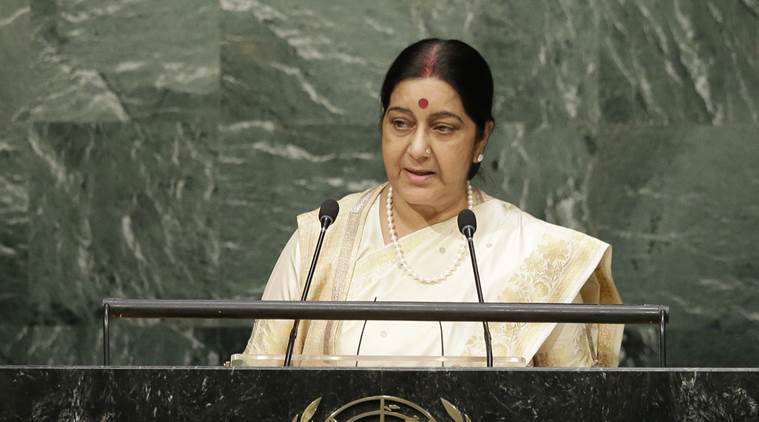
Exactly 274 of the 2,995 words that made up External Affairs Minister Sushma Swaraj’s superbly crafted speech to the United Nations General Assembly on Thursday dealt with Pakistan. Her message, delivered in response to Prime Minister Nawaz Sharif’s four-point peace plan, was simple. “We do not need four points,” she said, “we need just one — give up terrorism and let us sit down and talk.” “Let us hold talks at the level of NSAs [national security advisors] on all issues connected to terrorism,” she went on. “If the response is serious and credible, India is prepared to address all outstanding issues through a bilateral dialogue.”
This apparently reasonable formulation, as the world’s diplomats would have known, elided the real problem. The NSA-level talks India and Pakistan agreed to hold in September were called off, after all, not because Islamabad was unwilling to engage in discussion, but because New Delhi balked at the prospect of a meeting between Kashmiri separatists and the Pakistani PM’s special envoy, Sartaj Aziz.


For all practical purposes, India is appearing like a kindergarten student insisting on sulking until her demand for ice cream is met.
Delhi can, and should, be more creative in pushing forward its counter-terrorism concerns. Clear and consistent articulation of the steps Delhi wishes Pakistan to take is a critical step forward. India has, in the past, laid down all sorts of demands — from action against Lashkar-e-Toiba military head Zaki-ur-Rehman Lakhvi to the rendition of top terror fugitives — only to back down later. Learning from this experience, Islamabad has every reason to expect the same process to play out again. Instead of allowing Islamabad to take the lead, and eventually be dragged, kicking and screaming, to the table by the United States, Delhi would do well to seize the initiative, and spell out what it wants to talk about, and when.


