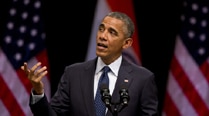

In his address to the Indian people at Siri Fort, US President Barack Obama purposively moved on from the economic and security considerations which had preoccupied Prime Minister Narendra Modi and him over the previous two days, to address larger questions: the shared values, beliefs and dreams that make India and the US “best partners” for the 21st century. He told us nothing that we did not know already. However, it is useful to be reminded, since obvious truths are frequently forgotten precisely because they are obvious. Most significantly, he traced the origin of the Indian story, and of the American story before it, to the guarantees of freedom, diversity, human rights and dignity, which were written into the constitutions of the two countries, and which generations of citizens have fought to protect and uphold.
Obama wove multiple strands of thought into a story line that rolls from the past to the future. His opening words echoed Swami Vivekananda’s Chicago address of 1893; in contemporary times, he recalled that on his visit to India, Dalits had introduced Martin Luther King Jr as “a fellow untouchable”. And he gave fresh meaning to the demographic dividend, suggesting that thanks to their numbers, Indian youth would not only help shape the destiny of their own country, but of the whole world. Powerfully affirming that aspiration is the driving force that builds nations, he also indicated that its fruits cannot be restricted to a few but must be universally accessible. Specifically — and most evocatively — he elevated the dreams of the toiling masses to an equal footing with his own. The world’s biggest democracy has elected a tea-seller prime minister, he said, and the world’s oldest has sent the grandson of a military cook in Africa to the White House. The strength of the two nations owes to such possibilities, he said.


