
Opinion How Sreenivasan turned the middle-class Malayali’s insecurities into immortal characters
Each time a middle-class Malayali dares to dream beyond their means, Vijayan from ‘Nadodikkattu’ seems to whisper, ‘Ethra manoharamaaya nadakkaatha aachaarangal (what beautiful, unrealistic dreams)’, a line that gently mocks, yet deeply empathises with, the beauty of impossible aspirations
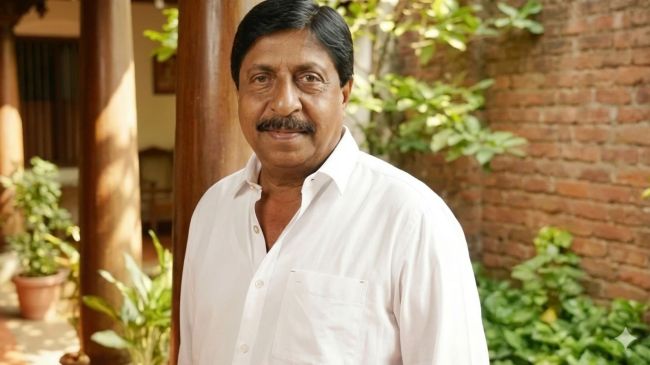 Sreenivasan’s work attains a rare timelessness through its mastery of caricature, not as exaggeration, but as social truth distilled.
(File Photo, enhanced with AI)
Sreenivasan’s work attains a rare timelessness through its mastery of caricature, not as exaggeration, but as social truth distilled.
(File Photo, enhanced with AI) 

By Sruthi Rajan
K G George’s searing political satire Panchavadi Palam (1984) closes with an image that lingers long after the chaos subsides: The wooden rollator of the crippled Kathavarayan, played by Sreenivasan, floating silently down the river, marking his disappearance amid the collapse of a newly inaugurated bridge. It is a moment of devastating understatement, where absence speaks louder than spectacle. That shot acquires an unsettling resonance today. With Sreenivasan now gone, what remain are the countless lives he breathed into Malayalam cinema, the caricatures, satire, and comedy etched deeply into the collective memory. Few writers translated the spirit of satirist Vadakke Koottala Narayanakutty Nair (VKN) into screenwriting with such ease, or inhabited cinema with such instinctive intimacy. Actor, writer, director, Sreenivasan approached cinema as a lived social practice, deploying slapstick and satire to excavate social and political hypocrisy, along with everyday anxieties. Above all, he gave enduring shape to the insecurities, aspirations, and quiet humiliations of the Malayali middle-class youth.

Sreenivasan’s journey into cinema began as an actor with P A Backer’s Manimuzhakkam (1976), but it took eight years, and a nudge from Priyadarshan for him to discover his most transformative voice as a screenwriter. What began as an impulsive turn, driven by a love for acting, would soon alter the tonal landscape of Malayalam cinema. Odaruthammava Aalariyam (1984), his first screenplay, emerged as a commercial success and marked a decisive entry of satirical comedy into the mainstream. The Priyadarshan–Sreenivasan collaboration struck an immediate chord, yielding three films in quick succession the following year, Aram + Aram = Kinnaram, Boeing Boeing, and Punnaram Cholli Cholli. These works announced not merely a successful partnership, but the arrival of a writer whose comic sensibility carried sharp political intelligence beneath its surface exuberance.
Sreenivasan’s work attains a rare timelessness through its mastery of caricature, not as exaggeration, but as social truth distilled. His writing did not privilege protagonists alone; every character that entered the frame was firmly rooted in lived reality, sketched with such precision that they endured long after the films themselves. In Sreenivasan’s cinema, it was not the actors who survived time, but the characters. Well-rooted and meticulously written, these figures were layered with contradictions and quiet depth, a pattern that runs through much of his work. Over the years, he endowed them with a wealth of memorable dialogue, but more importantly, he exposed their vulnerabilities with unsettling honesty, as though holding up a mirror to the audience itself. And then, in a gesture befitting his own cinematic metaphor, he turns the torchlight of Vadakkunokkiyanthram straight into our eyes, blinding us momentarily, before quietly stepping away, leaving us disoriented in that sudden wash of light.
Over a span of 19 years, he wrote twelve films for Priyadarshan, shaping a body of work that defined popular Malayalam comedy for a generation. His situational and slapstick humour drew audiences in large numbers, but its deeper triumph lay in its afterlife, dialogues that slipped effortlessly into everyday speech, scenes that became cultural shorthand. This resonance was particularly evident in his collaborations with Priyadarshan and Sathyan Anthikkad. The Sreenivasan–Anthikkad partnership began with T P Balagopalan MA (1986), initiating a creative friendship that would span thirty-two years and fifteen films, culminating in Njan Prakashan (2018), a fitting final chapter to a collaboration grounded in empathy, irony, and social observation.
Each time a middle-class Malayali dares to dream beyond their means, Vijayan from Nadodikkattu seems to whisper, “Ethra manoharamaaya nadakkaatha aachaarangal (what beautiful, unrealistic dreams)”, a line that gently mocks, yet deeply empathises with, the beauty of impossible aspirations. The iconic Dasan-Vijayan duo returned to Malayali life thrice: Twice under Anthikkad’s direction with screenplays by Sreenivasan, and once with Priyadarshan at the helm. While Priyadarshan’s comic treatments leaned decisively towards slapstick excess, Anthikkad shaped these narratives into situational and satirical comedies, quiet slices of middle-class existence, marked by economic precarity, moral negotiation, and everyday resilience. Anthikkad has often acknowledged in interviews that Dasan, played by Mohanlal, was in many ways an extension of himself, and that several episodes in Nadodikkattu drew directly from lived experience. He fondly referred to his partnership with Sreenivasan through the very names Dasan and Vijayan.
When Sreenivasan stepped into the dual role of writer-director, a choice he made only twice, his gaze turned inward, towards the institution of marriage and the fragile masculinities that often inhabit it. In both Vadakkunokki Yanthram (1989) and Chinthavishtayaya Shyamala (1998), he cast himself as the male lead marked by negative shades, using satire as a scalpel to dissect the insecurities of Malayali men and the ways in which these anxieties curdle into emotional toxicity within domestic spaces. These films stand as some of the most unflinching critiques of everyday patriarchy in popular Malayalam cinema, rendered not through melodrama but through irony and discomfort.
Yet Sreenivasan’s men were never monolithic. If some characters embodied insecurity in its most corrosive form, others were allowed the possibility of growth, redemption, or quiet dignity. Gopalakrishnan in Paavam Paavam Rajakumaran (1990) rises tentatively from self-doubt; Preman in Mithunam (1993) emerges as a figure of warmth and emotional generosity; while Shankar Das in Azhakiya Ravanan (1996) and Mukundan in Mukundetta Sumithra Vilikkunnu (1988) stage powerful moral comebacks. The audience experiences Balagopalan’s triumph in T P Balagopalan M A not merely as narrative resolution, but as a deeply personal victory of their own. Taken together, these portraits reveal a writer invested not merely in exposing male vulnerability, but in imagining the difficult, often incomplete paths through which men might transcend it.
Not long ago, a stray Instagram post circulated with the caption, “our childhood is almost faded,” stitched together from clips of late-1980s and 1990s Malayalam films, an inadvertent roll call of icons, many of whom are no longer alive. With Sreenivasan’s passing, that sentiment acquires devastating clarity. The image of Mohanlal and Mammootty seated beside his mortal remains at Kochi’s Town Hall, heads bowed in silence, is not merely a moment of public mourning, but a generational reckoning. For those who lived through these films, and for the millennials who grew up with them as emotional reference points, the frame lands with quiet brutality. It renders that caption heavier, almost unavoidable, an acknowledgment that an era did not simply pass, but slowly withdrew, taking with it the textures of a shared childhood.
Rest in cinema, Sreenivasan.
The writer is Assistant Professor, School of Communication, Birla Global University, Bhubaneswar

 Share
Share


