
Opinion Tavleen Singh writes: Timing spoiled Rahul’s US show… this is Modi’s moment in the sun
Rahul Gandhi could not have chosen a worse moment to try and convince the Indian diaspora in America that he is a worthy alternative to Narendra Modi
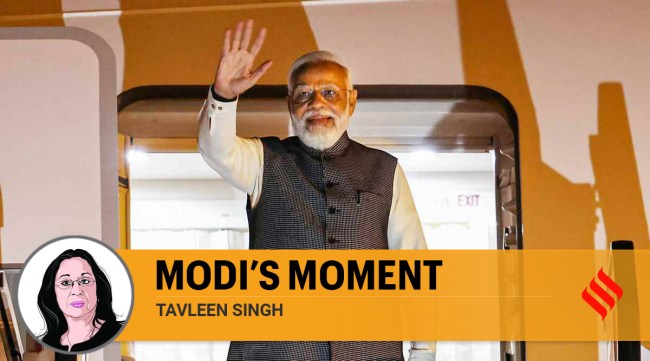 The country that once denied Narendra Modi a visa to travel there is next week going to welcome him in a way that few foreign leaders have been welcomed in the United States ever.


As political theatre, it was hard to beat Rahul Gandhi’s drive from Washington to New York last week in an enormous truck driven by an Indian immigrant. A movie of this journey has been posted on social media by his publicity team, and I recommend it. Rahul comes across as charming, humble, sincere, and genuinely interested in the driver’s account of life on the road and in the Punjabi songs he likes to listen to on his long, lonely drives.
Spokesmen for the BJP and some of Modi’s ministers have been virulent and venomous in their attacks on Rahul’s speeches and travels in the United States. They have gone out of their way to find reasons to prove that the heir to the mighty Nehru-Gandhi dynasty is obsessed with getting foreigners to intervene in Indian affairs. When, in one of his speeches, he made fun of the Prime Minister for prostrating himself before the ‘sengol’, they dug up a photograph of Rahul doing a full ‘sashtang pranam’ to portray him as a hypocrite. The truth is that ever since his Bharat Jodo Yatra, Rahul Gandhi has done a very good job of projecting himself as a political leader who is the exact opposite of Narendra Modi. He is love, compassion and humility to Modi’s autocracy, arrogance and narcissism.

If anything spoiled Rahul’s show, it was his timing. He could not have chosen a worse moment to try and convince the Indian diaspora in America that he is a worthy alternative to Narendra Modi. This is Modi’s moment in the sun. The country that once denied him a visa to travel there is next week going to welcome him in a way that few foreign leaders have been welcomed in the United States ever. There is not just a state banquet planned but a private dinner with the Bidens in the White House, and when he addresses both houses of Congress for the second time as prime minister, he will become one of a small handful of foreign leaders to be accorded this honour. Among the others are Winston Churchill, Nelson Mandela and Volodymyr Zelensky.
To add to Rahul’s timing problems came The Economist last week, with India on the cover as ‘America’s new best friend’. The Economist is among the international newspapers that Modi’s media managers usually blame for conspiring to defame India. The truth is that this caboodle of conspiracy theorists is more responsible for giving Modi a bad name than any foreign publication. And the truth is that when Modi has deserved praise, he has been given it in the very publications that are reviled for being ‘anti-India’ by BJP spokespersons. The Economist acknowledges that the biggest reason for India becoming America’s new best friend is its geo-political importance in a very difficult time. But it also acknowledges that ‘India’s ascent is an uplifting story. One of the fastest-growing economies, its GDP is expected to overtake Japan’s and Germany’s by 2028, even as it treads a novel path towards getting rich’.
There are those in the Congress Party who believe that Modi is a ‘feku’, a man who likes to spin a narrative around mythical achievements to conceal the reality that he has achieved very little. This is not true. Speaking for myself, I drove last week past the new airport that is being built in Mumbai and was stunned to see how much progress there has been in the past year. I use this as an example, because this new airport was announced years ago and all that I would see when I drove past it was a board that said it was Mumbai’s new airport.
This was how development happened in Congress times. Slowly, uncertainly and wastefully. New airports, ports and roads could take decades to come up and this generally meant that taxpayers paid three times more for major infrastructure projects because costs inevitably rose as the years went by. Modi has changed this visibly and dramatically. On my travels I see new highways where there were once rural roads and new airports where there were once grubby, crowded sheds that passed for real airports. It is these things that foreign travellers, foreign investors and foreign governments have noticed, and it is because they see these remarkable changes that they see India as a country that is finally on the move.
What pleases me personally about Modi’s visit to America next week is that it signifies stronger ties with a country that we should have always been closer to than we were to the Soviet Union. I remember going to Moscow in 1990 as part of V.P. Singh’s press party and being horrified at how decrepit it was and how similar in every possible bad way to an Indian city.
There was always more than a hint of hypocrisy in our Soviet love. The men who decided to use that country as India’s role model sent their own children to American universities and rushed to American hospitals (at taxpayers’ expense) when they got sick. We never really loved the Soviet Union and we never really hated America. Modi has said somewhere that India and America are ‘natural allies’. He is right. The only reason we did not build on this natural alliance was because Jawaharlal Nehru and his daughter had a puzzling awe of the Soviet Union that in retrospect is very hard to understand.

 Share
Share


