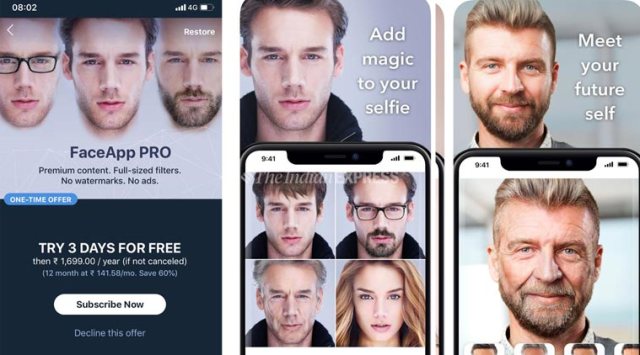


Despite well-publicised concerns that our personal information was being compromised, over a hundred million people downloaded FaceApp that uses artificial intelligence to alter an image in seconds. And voila! The users are provided with a disconcerting glimpse of what they’ll look like in their old age. Everywhere online, I could see posts of my friends and acquaintances, inexplicably and proudly, sharing an image of their 80-year-old selves. Is FaceApp accurate? Who knows, but the results seem convincing. My future self displayed my teeth more prominently and made my hair frizzier. We can be sure that in keeping with the unwritten but accepted rules of social media — people present a curated and glamorous avatar — FaceApp, too, is showcasing a best case scenario of what we’ll be a few decades hence.
How is one to make sense of the fact that the whole world was seeking out this experience of seeing our future faces, that we try, fervently and everyday — through diet, exercise and anti-aging products — not to become? It’s not news that society is obsessed with youth. Indian cinema or Hollywood, both are defined by 20-somethings. The use of botox, collagen shots and fillers is on the rise to push an idealised standard of beauty that revolves around, you guessed it, youth. On social media, youngsters spend painstaking hours figuring out the tricks of lighting and exposure with the hundreds of filters that make blemishes and dark circles disappear. Realms have been written on how the Instagram generation has contributed to the beauty industry, the desire for the perfect photograph spawning businesses in coloured contacts and 500 dollar creams made of seaweed extract sought from the depths of the Norwegian Sea. So then, what explains the lure of an app that makes us see ourselves in an unflattering light, and forces us, in a sense, to contend with our own mortality?


Perhaps the reason people have this morbid fascination to see themselves in their final years is because a photograph represents just the outside, and the indignities of old age, which is the real challenge, remain concealed. There’s nothing pretty about growing old, having to worry about discomfort and hospital bills and feel your body betraying you little by little. How you look in old age is actually the least of the problems. Having said that, there’s nothing wrong with wanting to disguise flaws to the best of your ability as long as one reconciles to the fact that eventually our faces will be marked by time.
In any case, ageing beats the alternative, hollow. We should be so lucky to live to what FaceApp so enthusiastically predicts; that selfie with salt and pepper hair, and conveniently minus the health-related ravages. Because, alas, there’s no app for that.


