
Opinion Vandita Mishra writes: Mayawati and Nitish, her nephew and his son
In the retreat of the two leaders, an undermining of their powerful legacies of an alternative politics
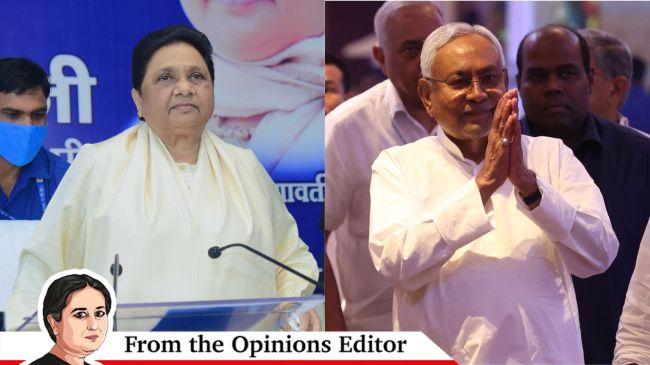 Both leaders represented, from their own specific vantage points and with their own distinctive repertoires and voices, the possibilities of an alternative politics. (Express Archive)


Dear Express Reader
Two images of two leaders this past week tell a larger story. In Uttar Pradesh, on Saturday, BSP chief Mayawati revoked the expulsion of former Rajya Sabha MP Ashok Sidharth and re-inducted him into the party after he apologised for his mistakes publicly. That image is remarkable because Ashok Sidharth is the father-in-law of Mayawati’s nephew and heir apparent, Akash Anand, who had also been expelled earlier this year because of his association with Sidharth, and then also forgiven publicly by Mayawati. At about the same time as the latest twist in the drama of Mayawati and her nephew in UP, Nitish Kumar was at the centre of renewed guessing games vis a vis his son in poll-bound Bihar.

Will Nitish’s son, Nishant, take the political plunge, come to the aid of a father-in-need, or won’t he — is reportedly the question after Upendra Kushwaha, Nitish’s ally in the NDA, again called for Nishant to save Nitish’s party.
Mayawati and Nitish Kumar are very different leaders, of course. She has a much stronger social base, and though her stint in power in UP was far briefer than that of Nitish in Bihar, it represented a potentially more radical upending of congealed caste hierarchies. But there are similarities too, between Mayawati and Nitish.
The rise of both leaders symbolised, from their own specific vantage points and with their own distinctive voices and repertoires, the possibilities of an alternative politics. In the turbulent 1990s, this politics rose to the surface in the states and at the Centre on the back of the Mandal movement, widening the political field, mobilising new constituencies, and raising hopes that political representation would better mirror India’s diversities and address inequalities.
Mayawati was shaped by, and she has shaped a long and rich legacy of Dalit cultural and political mobilisation that promised large democratic transformations. For a while, she showed skill in balancing the twin imperatives of empowerment for India’s most marginalised – to protect and energise a solidarity based on their shared experience of historical injustice, and to forge broader coalitions in order to win power in a first-past-the-post system. For the last several years, however, Mayawati has seemed to be in retreat. She has made little or no effort to reach out to her own core constituency, let alone revive the BSP’s outreach to non-Dalits, even if only strategically.
Nitish Kumar was part of the backward caste assertion that aimed to dismantle upper caste domination under the banner of Mandal in 1990s’ Bihar. He began with a much smaller constituency than that of Mayawati in UP, but he then expertly leveraged the smallness of his base to bring together a coalition of extremes.
Nitish’s unique political location helped him to deploy the idiom of caste, while softening caste polarisation. And in the spaces that were opened up in the middle, the coalition of extremes made it possible for “social justice” to move towards an agenda of “good governance”. In the best version of Nitish’s “su-raj”, “samajik nyay” and “vikas” settled down on the same side, bolstered by an array of targeted welfare schemes, after being ranged against each other in the restless tenure of his predecessor, Lalu Prasad.
For the last couple of years, however, Nitish has been an increasingly silent figurehead, as speculation swirls about his health, the cabal of bureaucrats running the government in his name, and now about the possible entry of his son into politics.
That Mayawati who fiercely built on the political capital she inherited from mentor Kanshiram, against incredible odds and bit by difficult bit, should now be seen to be engrossed in nephew-related matters, and that Nitish, who overcame the constraint of belonging to a numerically small caste to widen the grammar of caste politics, should allow himself to be painted as a father who must be bailed out by his son, may not, by itself, carry electoral costs for the two leaders. After all, ours is a polity where dynasty’s imprint is vivid across the spectrum, most parties function as black boxes and closed shops, without significant electoral penalties.
And yet, the latest freeze frames of Mayawati and Nitish, her nephew and his son, merit a moment of pause. It is no coincidence that they come alongside what seem to be the last gasps of the promised alternative politics of the 1990s. Its leaders have become inward-looking even as its gains have been coopted and domesticated, or eroded.
The weakening of a BSP or a JD(U) leaves a political vacuum – the BJP is clearly eager to rush into it. Narendra Modi’s party is the big brother in the JD(U)-BJP alliance in Bihar biding its time to swallow up the JD(U) in whole or in large part. In UP, the BJP is the formidable adversary seen to have a prominent role in the cornering of Mayawati, wielding both carrot and stick as it inches closer to her Dalit base.
In fact, in the story so far, the BJP’s rise has caught the Mandal parties at their weakest. That these parties are facing a dwindling of their policy, political and cultural capital, has helped entrench BJP dominance.
For now at least, the visible ebbing of these parties allows a BJP, losing its sheen in its third term in power at the Centre, to make mistakes with relative impunity. The BJP is being helped by the fraying politics of regional forces on one side, and possibly by the Congress’s “vote chori” pitch on the other.
By raising the pitch, Congress threatens to make the voter choice about trust and belief – whom do you trust, whom do you believe? – not about the need for a politics that is closer to the people’s lived realities, which powered the backward caste upsurge that both Nitish and Mayawati were part of in the 1990s.
As they retreat from their achievements, in this fraught moment, Nitish and Mayawati are complicit in the shrinking of their own powerful legacies.
Till next week,
Vandita

 Share
Share


