
Opinion Savarkar, a bulbul and the misplaced metaphor
Janaki Nair writes: If we accept that the hero of the Hindu Right riding the bulbul is a misunderstood metaphor, is the rest of the piece, which dwells at length on the miseries and torture that Savarkar experienced, also mere exaggeration?
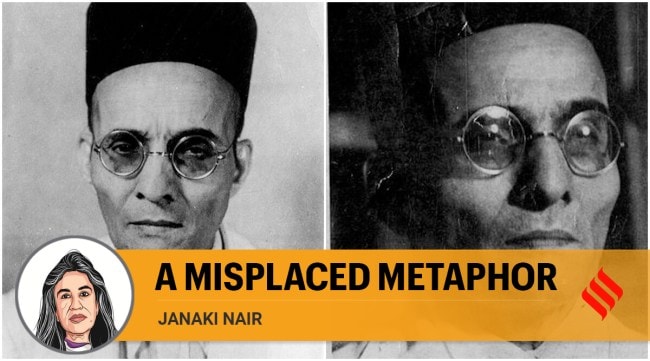 The newly, and controversially revised, Class VIII Kannada textbook, has a travelogue by a renowned writer, K T Gatti, entitled Kaalavannu Geddavaru in which he describes the daily flight to the “motherland” by the now increasingly celebrated hero of Indian independence, V D Savarkar, on the wings of an enterprising bulbul that squeezed its way into his airless, dark room in the cellular jail at the Andamans.(Express Archive)

The chickens have come home to roost. Such “meatatarian” metaphors are a minefield in contemporary Karnataka, where the nutritional value of eggs in the midday meal has already been displaced by their greater importance as projectile missiles. But stay we must with those haunting lines of Marc Anthony: “The evil that men do lives after them; the good is oft interred with their bones.” And, for once, I will not protest too much Shakespeare’s use of the masculine gender.
For some time now, in keeping with the preferred choices of their national political masters, ruling party politicians and supporters have been outdoing each other in undermining and extinguishing the place of imagination, metaphoric speech, and puns, in favour of extreme hyperbole and alliteration. Was it not Chief Minister Bommai himself, twitching with ambition since July 28, 2021, and revealing the eagerness of a new convert for his new religion, who settled queries from the media about the controversy surrounding where the legendary Hanuman was actually born? He “categorically” stated that “Lord Anjaneya was born in Anjaneya Betta (in Koppal district)”. To ensure that there is no further dispute, he added that there cannot be more important “evidence” than that of Kishkinda (mentioned in the Ramayana epic) being Anjaneya Betta. Perhaps some scriptural evidence of the specific kinds of fauna and flora at Koppal will be brought in to buttress the chief minister’s “fact”. He has also committed Rs 100 crore to the “development” of that pilgrim site. And once he had made up his mind, he “ordered” the State Archaeological Department to “study the documents” (sic) and put all controversy to rest. No mosque, fortunately, stands in his way, but neither Anjaneri in Maharashtra, nor Anjanadri in the Tirupati Tirumala hill chain can lay claim to the birthplace of the simian lord any longer.

Clearly, the likes of CM Bommai will be uneasy about acknowledging the lyrical beauty of an essay by one of Karnataka’s truly illustrious sons, AK Ramanujam. His ‘Three Hundred Ramayanas: Five Examples and Three Thoughts on Translation’, as we well know, was rudely evicted from the Delhi University syllabus some years ago by those clamouring for a “single” story. But one wishes that a bit of regional chauvinism had been exercised to allow Ramanujam entry into Karnataka’s classrooms, so that fertile imaginations, rather than fervid opinions, could luxuriate in the hills, caves, ponds, rivers, forests where the many Ramayanas took root and still flourish.
Instead, we now have a new tempest in a teapot. The newly, and controversially revised, Class VIII Kannada textbook, has a travelogue by a renowned writer, K T Gatti, entitled Kaalavannu Geddavaru [those who won over time] in which he describes the daily flight to the “motherland” by the now increasingly celebrated hero of Indian independence, V D Savarkar, on the wings of an enterprising bulbul that squeezed its way into his airless, dark room in the cellular jail at the Andamans. This flight of fancy, a bit of miraculous, if not magical, realism by the travel writer, has been joyously flourished as further evidence of the designs of the Hindu Right on the minds of the young.
Vainly, does Rohith Chakrathirtha, the former head of the textbook revision committee before he was hastily dismissed after sustained protests, himself protest that the sudden discovery of this rendering of Savarkar’s jail environment reveals the poor intellection of those who do not understand the place of metaphors as figures of speech. There is a rich irony to Chakratirtha’s whine about the (secular, to be sure) lack of training in literary devices. He assiduously replaced the true breadth of Kannada writing in the old textbook with some dubiously translated, but decidedly pious, thoughts of the likes of K B Hedgewar. He should know that it is people like himself who propelled the headlong tumble towards defiantly dull piety and worship, in history books as much in literary texts. But if we accept that this is misunderstood metaphor, what is the status of the rest of the piece which dwells at length on the miseries and torture that Savarkar experienced? Also mere exaggeration? Or is it a case of a misplaced metaphor?
Chakratirtha’s hatchet job on the textbooks has been matched at many (and multiplying) levels by the faithful in several other settings. Such as by the four or five “faithful” men who stopped a play at Sorab, Shimoga, which featured a good Muslim family. They got clean away with their argument that Jayanth Kaikini’s play, (Jotegiravannu Chandira, loosely based on Fiddler on the Roof) could not possibly foreground the sensitivity and empathy of an amiable Muslim patriarch. Not even in imaginative representations can Muslims be portrayed as anything other than the underside of humanity. Now Baraguru Ramachandrappa, the celebrated writer (and former Chair of the textbook committee) is facing the wrath of the “faithful” for his 1980s satirical comment on Congress corruption (Bharat Nagari), which used the national anthem.
The suffocating sacralisation of our everyday lives, our imaginations, our histories — we are witnessing the tortured death of the Indian imagination. Salman Rushdie cited Carlos Fuentes in his reflections on living in hiding following the publication of Satanic Verses — “impose a unitary language: you kill the novel, you also kill the society”. We now live in an absurd country where policemen feel empowered to arrest artists who might hang a plastic cow as a powerful symbolic reminder of what the unsuspecting bovines are compelled to graze on in our squalid cities. We send to jail a comic who merely cites an older film riff. Tall tales of scientific achievement are built on the heads of our splendidly “fact”-defying gods, and our goddesses are being saved from their own previous avatars. All this is bad news for figures of speech: If the vigilant protectors of the mature female Genus Bos have their way, will an “oxymoron” only translate into a “beefy dolt”?
The writer taught history at JNU
 Share
Share


